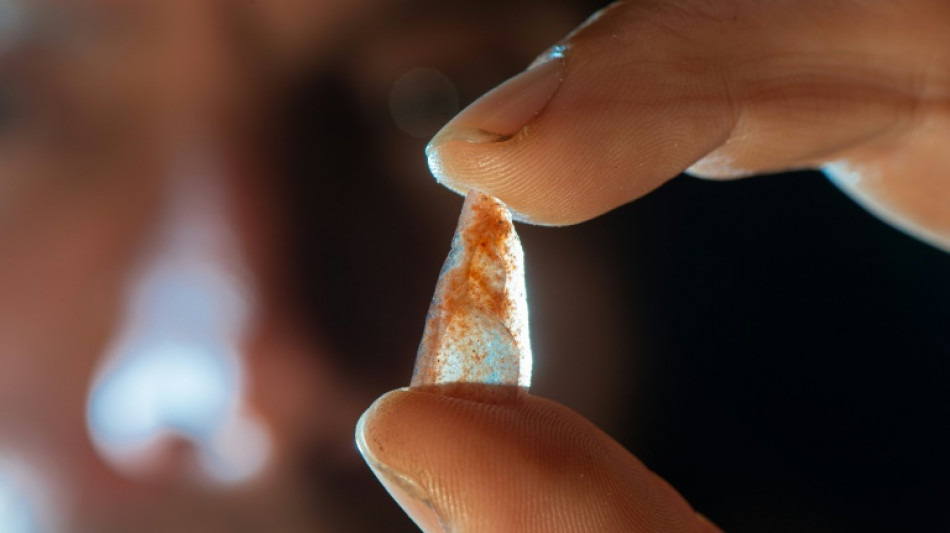
Homo sapiens in Europe used bow-and-arrow 54,000 years ago: study / Photo: Philippe Psaila - EUREKALERT!/AFP

A cave in southern France has revealed evidence of the first use of bows and arrows in Europe by modern humans some 54,000 years ago, far earlier than previously known.
The research, published on Wednesday in the journal Science Advances, pushes back the age of archery in Europe by more than 40,000 years.
The use of the bow-and-arrow in Africa has been documented to date back some 70,000 years.
But the oldest previous evidence of archery in Europe was the discovery of bows and arrows in peat bogs of Northern Europe, notably Stellmoor in Germany, dating back 10,000 to 12,000 years.
The new research comes from the Mandrin rock shelter overlooking the middle valley of the Rhone River in southern France.
The Grotte Mandrin site, which was first excavated in 1990, includes layer upon layer of archaeological remains dating back over 80,000 years.
The researchers who conducted the latest study have documented previously that Neanderthals and their modern "cousins" -- Homo sapiens -- alternated in inhabiting the Mandrin cave.
A level known as the "Layer E" has been attributed to the presence of Homo sapiens some 54,000 years ago and is interposed between layers of numerous Neanderthal occupations.
The researchers conducted a functional analysis of flint artifacts found in Layer E that were more finely executed than the points and blades in the layers above and below.
Tiny flint points were the key because other elements of archery technology such as wood, fibers, leather, resins and sinew are perishable and rarely preserved in European Paleolithic sites.
- 'Too light to be efficient' -
For the study, the researchers reproduced the tiny flint points found in the cave, some of which are smaller than a US penny, and fired them as arrowheads with a replica bow at dead animals.
"We couldn't throw them at the animals any other way than with a bow because they were too tiny and too light to be efficient," said Laure Metz of Aix Marseille University, a co-author of the study along with Ludovic Slimak of the University of Toulouse.
"We had to use this kind of propulsion," Metz told AFP. "The only way that it was working was with a bow."
Fractures on the flint points were compared with scars found on the artifacts found in the cave, proving undoubtedly that they were used as arrowheads, the researchers said.
"Fractures for a lot of them, not all, were fractures of impact," Metz said. "And they are coming at the end of the point."
Metz said the evidence suggests that the Neanderthals and the Homo sapiens who used in the cave likely met at some point although "we don't know the nature of the meeting, whether it was nicely or not."
The Neanderthals who inhabited the Mandrin site continued to use traditional weapons, however, such as thrusted or hand-thrown spears and did not develop mechanically propelled weapons, she said.
"The traditions and technologies mastered by these two populations were thus profoundly distinct, illustrating a remarkable objective technological advantage to modern populations during their expansion into the European continent," the researchers said.
Metz said the occupants of the cave would have typically hunted horses, bison and deer and animal bones have been found inside.
K.Tanaka--JT