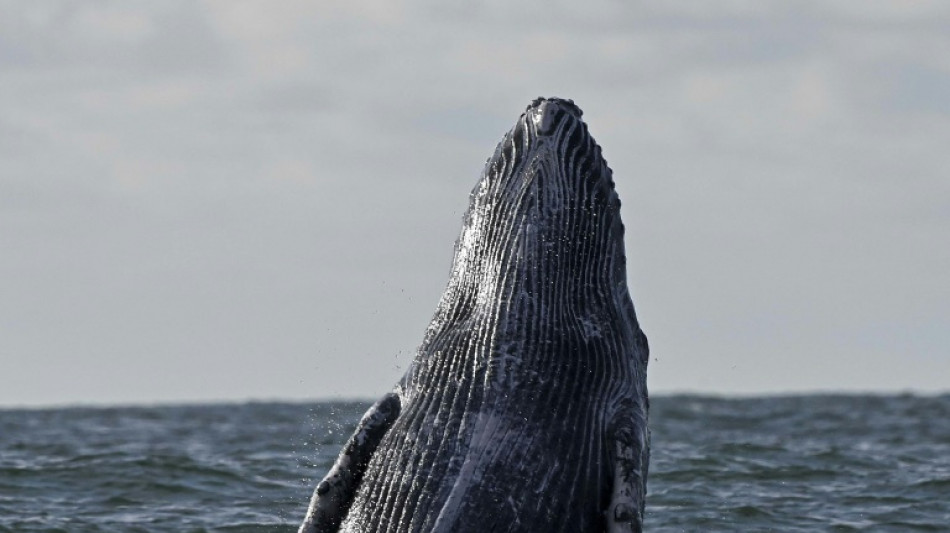
Deep-sea mining noise pollution threatens whales: study / Photo: LUIS ROBAYO - AFP/File

Scientists warned on Tuesday that controversial seabed mining could significantly threaten ocean ecosystems, especially blue whales and other cetaceans already stressed by shipping, pollution and climate change.
A study in the journal Frontiers in Marine Science found that commercial-scale extraction of valuable minerals from the ocean floor, which could begin for the first time later this year, would damage habitats and interfere with the way cetaceans communicate.
Earlier research has detailed the likely destructive impact of deep-sea mining on the ocean floor. The new analysis by the University of Exeter and Greenpeace Research Laboratories shifts the spotlight to marine megafauna and noise pollution.
"Cetaceans rely on sound for every aspect of their behaviour, such as foraging, breeding and navigation," Kirsten Thompson, the lead author of the study and a lecturer in marine mammal biology at the University of Exeter, told AFP.
"That's why noise pollution from deep seabed mining is a particular concern."
The report points to overlap between the frequencies at which cetaceans communicate and the sound that would be generated by drilling, dredging and the acoustic telemetry needed to remotely operate vehicles mining the seabed.
This phenomenon, called "auditory masking", has been previously shown to interfere with the communications of marine mammals and to alter their behaviour.
Underwater noise generated by industrial or military operations can induce foraging whales to surface more quickly than normal, increasing the risk of gas bubbles forming in the bloodstream, which can in turn lead to stranding and death.
Other research has found that man-made noise increased the risk of separation between humpback whales and their calves, which communicate via quiet vocalisations.
- 'Two-year rule' -
The new findings come with some caveats.
Because seabed mining has yet to be authorised anywhere in the oceans, Thompson and her team did not have real-world data to draw from.
They thus used proxies from other industries to estimate the expected sound from industrial seabed mining operations.
Thompson also pointed to knowledge gaps in the distribution of marine mammal species, mainly due to the high cost of biological surveys across vast expanses of ocean.
The impact of deep-sea mining on cetaceans is predicted to be particularly acute in the Pacific Ocean's Clarion-Clipperton Zone, a habitat for some two dozen cetacean species, including baleen whales, beaked whales, sperm whales and Risso's dolphins.
The region is poised to become home to the world's largest extraction of manganese nodule, a mineral crucial in electric car batteries.
The tiny island nation of Nauru, in particular, sees deep-sea mining as a potentially lucrative income stream for climate adaptation in the face of sea level rise and increasingly powerful storms.
In June 2021, the Nauru government triggered a rule requiring the International Seabed Authority (ISA) -- the UN body governing deep-sea exploration and exploitation in areas beyond national jurisdiction -- to finalise regulations for high-seas mining worldwide within two years.
According to this so-called "two-year rule", mining could go ahead in July this year with whatever regulations the ISA has formulated by that time.
"Given the imminent threat that the two-year rule presents to ocean conservation, we suggest there is no time to waste," said Thompson.
M.Sugiyama--JT