The Japan Times - Relentless sex drive may threaten survival of quolls

EUR -
AED 4.237583
AFN 72.693752
ALL 96.083665
AMD 433.726263
ANG 2.065521
AOA 1058.097238
ARS 1611.096401
AUD 1.627012
AWG 2.076964
AZN 1.957395
BAM 1.955434
BBD 2.317406
BDT 141.175387
BGN 1.972318
BHD 0.435926
BIF 3416.234019
BMD 1.153869
BND 1.470256
BOB 7.950648
BRL 5.996198
BSD 1.150604
BTN 106.252936
BWP 15.636342
BYN 3.451113
BYR 22615.829146
BZD 2.314007
CAD 1.580015
CDF 2613.512848
CHF 0.907177
CLF 0.026486
CLP 1045.785768
CNY 7.946522
CNH 7.938554
COP 4269.233915
CRC 539.31065
CUC 1.153869
CUP 30.577524
CVE 110.246257
CZK 24.445461
DJF 204.885168
DKK 7.471843
DOP 70.228365
DZD 152.511672
EGP 60.430077
ERN 17.308033
ETB 179.623441
FJD 2.54889
FKP 0.864765
GBP 0.863994
GEL 3.127214
GGP 0.864765
GHS 12.535869
GIP 0.864765
GMD 84.844491
GNF 10083.329455
GTQ 8.813502
GYD 240.719076
HKD 9.044641
HNL 30.452955
HRK 7.528765
HTG 150.924996
HUF 390.627295
IDR 19568.461556
ILS 3.569811
IMP 0.864765
INR 106.997682
IQD 1507.230698
IRR 1516183.648142
ISK 143.298995
JEP 0.864765
JMD 181.000013
JOD 0.818054
JPY 183.519391
KES 149.56326
KGS 100.905754
KHR 4617.235044
KMF 492.702289
KPW 1038.457027
KRW 1723.170402
KWD 0.353753
KYD 0.958829
KZT 554.390945
LAK 24690.588441
LBP 103033.2836
LKR 358.295982
LRD 210.554204
LSL 19.248161
LTL 3.407074
LVL 0.697964
LYD 7.365748
MAD 10.789366
MDL 20.071588
MGA 4790.102621
MKD 61.593693
MMK 2423.243908
MNT 4120.582999
MOP 9.287041
MRU 45.769417
MUR 53.666511
MVR 17.827435
MWK 1995.026251
MXN 20.352175
MYR 4.519126
MZN 73.744171
NAD 19.248161
NGN 1564.577088
NIO 42.342985
NOK 11.060872
NPR 170.005834
NZD 1.972608
OMR 0.44369
PAB 1.15052
PEN 3.932614
PGK 4.964178
PHP 68.948263
PKR 321.238287
PLN 4.262882
PYG 7458.731962
QAR 4.194987
RON 5.091795
RSD 117.421168
RUB 96.593463
RWF 1682.684766
SAR 4.332929
SBD 9.283085
SCR 15.84955
SDG 693.475127
SEK 10.746038
SGD 1.47424
SHP 0.8657
SLE 28.383287
SLL 24196.065005
SOS 656.391253
SRD 43.414286
STD 23882.755212
STN 24.495942
SVC 10.067201
SYP 127.601462
SZL 19.251727
THB 37.528395
TJS 11.028225
TMT 4.05008
TND 3.391723
TOP 2.778239
TRY 51.023508
TTD 7.806605
TWD 36.807836
TZS 3007.247299
UAH 50.55213
UGX 4343.261614
USD 1.153869
UYU 46.772048
UZS 13962.505268
VES 516.71188
VND 30358.289022
VUV 137.994476
WST 3.154336
XAF 655.834136
XAG 0.014683
XAU 0.000235
XCD 3.118389
XCG 2.073629
XDR 0.815647
XOF 655.845502
XPF 119.331742
YER 275.255428
ZAR 19.297997
ZMK 10386.182289
ZMW 22.442185
ZWL 371.545294
  • RBGPF

    0.1000

    82.5

    +0.12%

  • CMSC

    -0.0400

    22.95

    -0.17%

  • BP

    0.9500

    43.85

    +2.17%

  • RIO

    -0.0600

    89.8

    -0.07%

  • CMSD

    -0.0700

    22.88

    -0.31%

  • BTI

    -0.3900

    60.55

    -0.64%

  • AZN

    -0.7200

    191.29

    -0.38%

  • RELX

    -0.1800

    34.29

    -0.52%

  • BCE

    0.1100

    26.01

    +0.42%

  • NGG

    -0.4700

    90.42

    -0.52%

  • GSK

    -0.3600

    53.41

    -0.67%

  • RYCEF

    0.6900

    16.81

    +4.1%

  • BCC

    1.2000

    72.92

    +1.65%

  • VOD

    0.1500

    14.75

    +1.02%

  • JRI

    -0.0800

    12.46

    -0.64%

Relentless sex drive may threaten survival of quolls
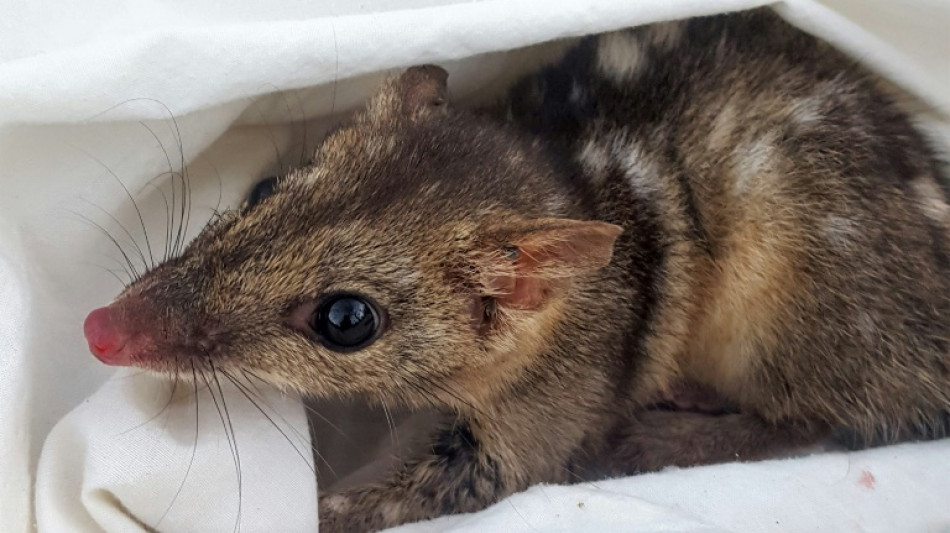
Relentless sex drive may threaten survival of quolls / Photo: KAYLAH DEL SIMONE - UNIVERSITY OF QUEENSLAND/AFP

Relentless sex drive may threaten survival of quolls

For male northern quolls, sex is a death sentence.

Text size:

The cute marsupials native to northern Australia are the world's largest semelparous mammal, which means that the males drop dead after their first breeding season.

But what exactly causes them to die has remained a mystery.

Research published on Wednesday suggests that the males are depriving themselves of rest in their relentless pursuit to mate with females, potentially threatening the survival of their already endangered species.

Hoping to shed light on this sex-driven death frenzy, a team of researchers strapped tiny backpacks carrying tracking devices to seven male and six female northern quolls on Groote Eylandt, an island off the coast of Australia's Northern Territory.

The data, collected over 42 days that included breeding season, was entered into a machine learning algorithm which analysed different quoll behaviours.

The males were found to be far more active than females, who live for up to four breeding seasons.

And while females rested or laid around nearly 24 percent of the time, the proportion for males was just seven percent, according to a study published in the journal Royal Society Open Science.

The study's lead author, Joshua Gaschk of the University of the Sunshine Coast, told AFP that the "males didn't seem to be sleeping anywhere near as much as they should".

For the first time, "we might have a smoking gun" for what is causing the males to die after breeding, he said.

Smaller relatives of the northern quoll, such as the antechinus, are also semelparous.

But research has found that their males die from internal haemorrhaging and infection due to escalating stress hormones during mating season -- which is not what is killing the northern quolls.

- 'Mating frenzy' -

Gaschk said the yearly male die-off could threaten the survival of the northern quoll, which has been badly affected by the introduction of non-native cane toads, cats and foxes to Australia.

But the carnivorous marsupials have been using this extreme breeding strategy, also known as suicidal reproduction, "for thousands of years -- there's got to be a benefit to it," Gaschk said.

Indeed on Groote Eylandt, an island with no cane toads and few cats, the northern quolls are "not just surviving, but doing really well", he said.

Adrian Bradley of the University of Queensland, who was not involved in the study, called the new research "significant".

Bradley said he was quite certain that the "mating frenzy" of smaller semelparous marsupials like the antechinus is "stimulated as an irresistible response to the release of perfume-like pheromones from the cloacal glands of females."

The amount of weight lost during these frenzies likely explains why only smaller members of the dasyuridae family are semelparous, he said.

But for the larger northern quoll, Bradley warned it was not yet "possible to conclusively say" why some "males generally do not survive the breeding season," calling for further research.

T.Maeda--JT