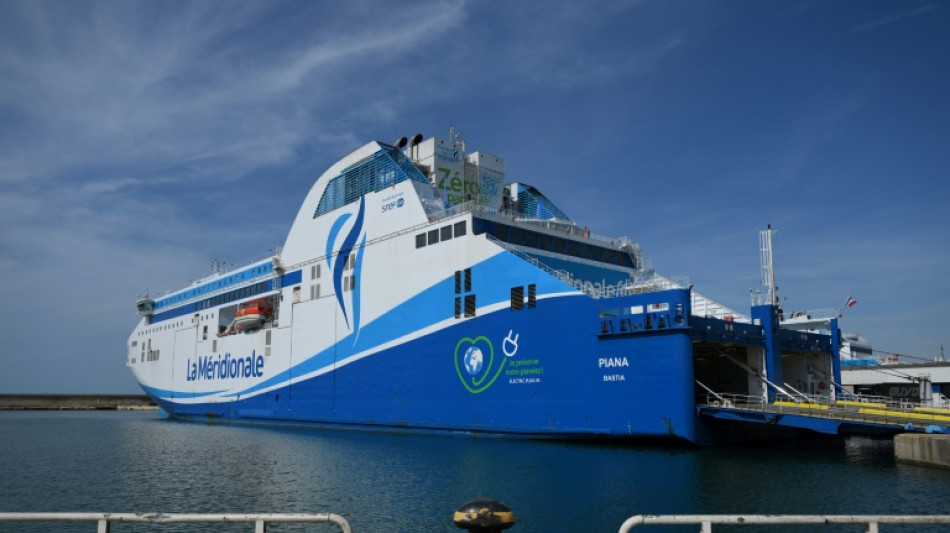
Filtered ferry engines hailed for tackling air pollution / Photo: Nicolas TUCAT - AFP

A French ferry company has launched what it claims is the first vessel that uses filters to capture almost all air pollutants from the boat's exhaust fumes, sparking praise from campaigners and local authorities.
La Meridionale, based in the southern French port of Marseille, showed off its innovative ship on Monday to the media.
"It's an unprecedented solution, a world first," company chairman Marc Reverchon told reporters on board the blue-and white Piana which sails between Marseille and the French island of Corsica.
The company said the filters captured 99 percent of sulphur oxides emitted by the ferry's four engines, as well as 99.9 percent of particulate matter created from the burning of its heavy fuel.
The filters use technology already found in power stations or incineration plants in which sodium bicarbonate is injected into the exhaust fumes, causing a chemical reaction with the tiny particles produced during the combustion process.
The pollutants can then be captured by a type of industrial air filter that has been around for more than 30 years, company technical director Christophe Seguinot told reporters.
"We didn't have to look too far. We didn't invent anything," Seguinot explained. "The challenge for us was to make it suitable for a marine setting."
The ferry group has an agreement with chemicals supplier Solvay, which will dispose of the toxic filter residue -- with a view to recycling it in the future, Seguinot said.
Heavy fuel oil, also known as bunker fuel, is one of the cheapest but most polluting transportation fuels, resulting in the thick plumes of dirty brown smoke seen above most ships.
It is also high in sulphur which can cause respiratory problems and acid rain.
- Regulation -
Regulations on the amount of sulphur authorised vary, with ultra-clean fuel mandated in areas such as the North Sea and Baltic Sea in Europe, as well as around North American ports.
Marseille, which hosts cruise and container ships as well as ferries, has struggled with increased smog in recent years and the shipping sector is thought to be responsible for a large part of the problem.
"Let's hope that the big polluters follow the example of La Meridionale," Marseille's Socialist mayor Benoit Payan tweeted on Monday after attending the company event.
He has been battling ship operators over the summer with a petition calling for the dirtiest vessels to be barred during peak pollution times.
Shipping companies are under pressure from regulators and tightening industry standards to tackle their emissions of greenhouse gases as well as atmospheric pollutants, but campaigners want faster action.
La Meridionale "is going much further than current regulations require by treating all of their particulate matter," Damien Piga from Atmosud, a regional air quality surveillance group, told AFP.
Some ship owners favour the use of so-called "scrubbing" technology which sees water sprayed into the exhaust fumes, which captures some of the pollutants.
Environmentalists point out that in many cases the water is then discharged into the sea, however.
Other groups are experimenting with engines that run on cleaner liquefied natural gas (LNG) or methanol, while electric and sail powered vessels are also being developed.
S.Fujimoto--JT