The Japan Times - NASA readies for Saturday Moon rocket launch attempt

EUR -
AED 4.309328
AFN 75.686443
ALL 95.456633
AMD 432.519171
ANG 2.10026
AOA 1077.186483
ARS 1637.502559
AUD 1.6273
AWG 2.11213
AZN 1.994862
BAM 1.953628
BBD 2.367368
BDT 144.219672
BGN 1.95736
BHD 0.443929
BIF 3498.325843
BMD 1.173406
BND 1.488052
BOB 8.121971
BRL 5.804016
BSD 1.175393
BTN 110.787838
BWP 15.738309
BYN 3.321707
BYR 22998.748453
BZD 2.363972
CAD 1.602584
CDF 2717.606917
CHF 0.915467
CLF 0.026564
CLP 1045.469272
CNY 7.981328
CNH 7.985148
COP 4388.161205
CRC 539.228116
CUC 1.173406
CUP 31.095247
CVE 110.142555
CZK 24.308914
DJF 209.307315
DKK 7.472499
DOP 69.905861
DZD 154.98577
EGP 61.855722
ERN 17.601083
ETB 183.539445
FJD 2.568822
FKP 0.863007
GBP 0.865445
GEL 3.144651
GGP 0.863007
GHS 13.2233
GIP 0.863007
GMD 85.658792
GNF 10316.059203
GTQ 8.975023
GYD 245.916616
HKD 9.191198
HNL 31.224111
HRK 7.537016
HTG 153.949511
HUF 356.847858
IDR 20354.831106
ILS 3.404466
IMP 0.863007
INR 110.605789
IQD 1537.161249
IRR 1540564.124637
ISK 143.800686
JEP 0.863007
JMD 185.143644
JOD 0.831922
JPY 184.035757
KES 151.744974
KGS 102.579694
KHR 4714.778704
KMF 491.657324
KPW 1056.077778
KRW 1712.879072
KWD 0.361338
KYD 0.979511
KZT 544.334867
LAK 25794.324631
LBP 105257.585883
LKR 378.489236
LRD 215.690219
LSL 19.208025
LTL 3.464761
LVL 0.709781
LYD 7.434735
MAD 10.72786
MDL 20.222519
MGA 4880.823595
MKD 61.681812
MMK 2463.965572
MNT 4201.314278
MOP 9.48066
MRU 47.030122
MUR 54.82158
MVR 18.134946
MWK 2044.072648
MXN 20.279263
MYR 4.596187
MZN 74.977041
NAD 19.208459
NGN 1595.955879
NIO 43.069885
NOK 10.909092
NPR 177.269995
NZD 1.975017
OMR 0.451177
PAB 1.175393
PEN 4.05705
PGK 5.115575
PHP 71.114218
PKR 327.514152
PLN 4.2314
PYG 7194.002478
QAR 4.274695
RON 5.263664
RSD 117.401569
RUB 87.597326
RWF 1723.272367
SAR 4.429954
SBD 9.425096
SCR 16.401448
SDG 704.633198
SEK 10.883231
SGD 1.48904
SHP 0.876066
SLE 28.862889
SLL 24605.722832
SOS 670.599169
SRD 43.921728
STD 24287.125444
STN 24.474044
SVC 10.284567
SYP 129.717992
SZL 19.208208
THB 37.866319
TJS 10.984189
TMT 4.118653
TND 3.367093
TOP 2.825279
TRY 53.158433
TTD 7.951161
TWD 36.853263
TZS 3049.692885
UAH 51.471511
UGX 4396.112872
USD 1.173406
UYU 46.997753
UZS 14243.165973
VES 582.254457
VND 30872.299582
VUV 138.571802
WST 3.181704
XAF 655.262055
XAG 0.01479
XAU 0.000249
XCD 3.171187
XCG 2.118345
XDR 0.814936
XOF 655.228587
XPF 119.331742
YER 279.964716
ZAR 19.299467
ZMK 10562.055152
ZMW 22.391108
ZWL 377.836103
  • RBGPF

    0.0000

    63.18

    0%

  • JRI

    -0.0200

    13.15

    -0.15%

  • CMSD

    0.0000

    23.42

    0%

  • NGG

    -1.9400

    85.91

    -2.26%

  • CMSC

    -0.0400

    22.97

    -0.17%

  • BCE

    0.3400

    24.57

    +1.38%

  • GSK

    -0.0300

    50.5

    -0.06%

  • RIO

    -2.4000

    103.11

    -2.33%

  • AZN

    -2.4000

    182.52

    -1.31%

  • BCC

    -1.4800

    72.76

    -2.03%

  • RELX

    -1.5900

    34.16

    -4.65%

  • RYCEF

    -0.0500

    17.45

    -0.29%

  • VOD

    -0.4400

    15.69

    -2.8%

  • BTI

    -1.4800

    58.08

    -2.55%

  • BP

    -0.8200

    43.81

    -1.87%

NASA readies for Saturday Moon rocket launch attempt
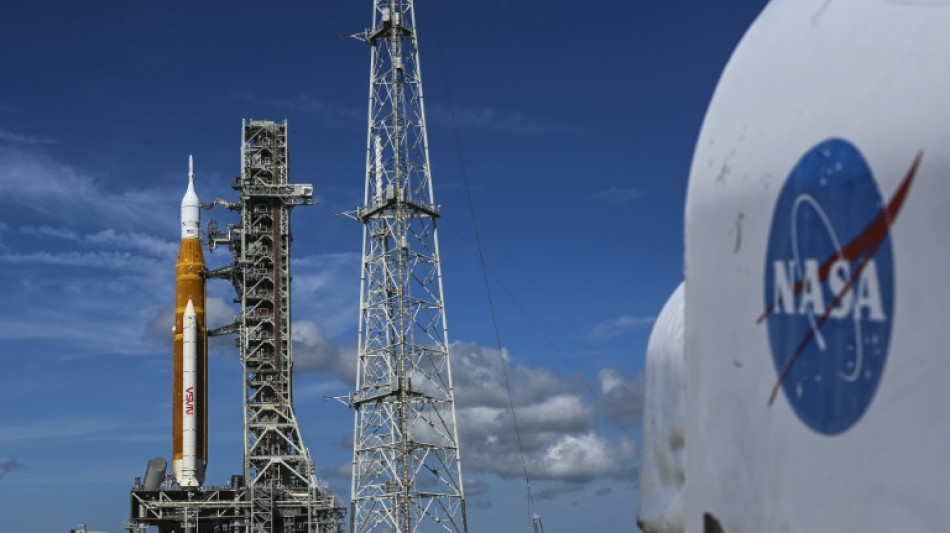
NASA readies for Saturday Moon rocket launch attempt / Photo: CHANDAN KHANNA - AFP/File

NASA readies for Saturday Moon rocket launch attempt

The stars appear to be aligned for NASA's Moon rocket to finally blast off on Saturday, with weather forecasts favorable and technical issues that postponed the launch earlier this week resolved.

Text size:

Liftoff is scheduled for 2:17 pm local time (1817 GMT) from Kennedy Space Center in Florida, with the potential for up to a two-hour delay if necessary.

The chance for favorable weather conditions within that window sat at 60 percent Thursday evening.

"The weather looks good," and isn't expected to be a "showstopper," forecast analyst Melody Lovin said at a press conference.

NASA has also been working to correct the technical difficulties that lead to the last-minute delay of the launch during its originally scheduled window Monday.

At first, it seemed that one of the rocket's four main engines was too hot, though it turned out just to be a reading from a "bad sensor," the rocket's program manager John Honeycutt said Thursday.

In the future, the incorrect information will simply be ignored.

Then a fuel tank leak had to be patched.

"We were able to find what we believe is the source of the leak and correct that," launch director Charlie Blackwell-Thompson said.

The Artemis 1 mission is an uncrewed test flight. It will be the first launch for the Space Launch System (SLS) rocket, the most powerful in the world and which has been in development for more than a decade.

"There's no guarantee that we're going to get off on Saturday, but we're going to try," Artemis mission manager Mike Sarafin said.

If the mission goes ahead Saturday, the Orion capsule fixed atop the rocket will spend 37 days in space, orbiting the Moon from about 60 miles (100 kilometers) away.

It is the Orion that will then take future astronauts back to the Moon -- including the first woman and the first person color to walk on its surface -- in 2025 at the earliest.

Artemis is named for the twin sister of the Greek god Apollo, for whom the first Moon missions were named. With the new flagship program, NASA hopes to test technology someday meant for sending humans to Mars.

T.Kobayashi--JT