Chinese AI drives price competition among US labs / Photo: Pedro PARDO - AFP

Artificial intelligence users are shopping around as US giants face fierce competition from Chinese rivals -- and in Beijing's tech district, drinkers at an AI-themed bar can even plug in to DeepSeek for free.
A new generation of cost-efficient, high-performance Chinese AI is putting pressure on Silicon Valley's leading labs to lower prices to grab market share as they try and find ways to turn a profit.
ChatGPT maker OpenAI has slashed fees by 80 percent for its latest lightweight model "Luna", and Anthropic has unveiled a model approaching its most powerful system's performance at half the price.
Meanwhile some of China's buzziest AI companies are raising fees as their open-source offerings gain traction among businesses and programmers worldwide.
DeepSeek -- whose V4 Flash tops the usage leaderboard of technical platform OpenRouter -- said last week it plans a "significant increase" in prices for programmers.
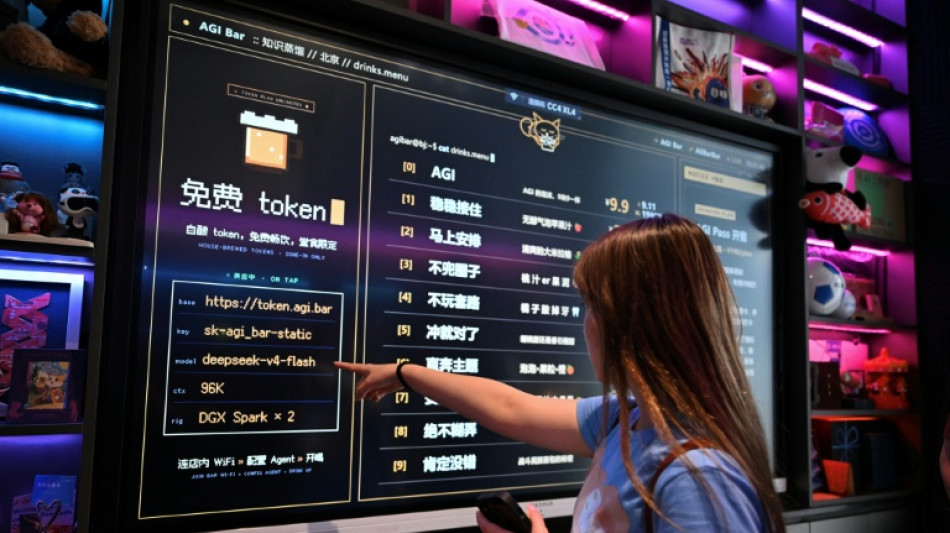
Thirsty Beijingers have another option: free AI for customers at AGI Bar, which opened last summer as a hub for developers, founders and investors.
The bar is decorated with references to China's AI boom, with logos of the country's major labs on the walls and the menu full of jokes riffing on tech jargon.
Its signature drink AGI -- "Artificial General Intelligence", meaning future AI tools as clever as humans -- is a glass almost entirely full of beer foam, a nod to the frothy hype rife in the industry.
"It's quite common for bars to provide free Wi-Fi with routers, so I'll provide free tokens," or units of AI usage, bar owner Song De told AFP.
- Challengers -
The bar in Zhongguancun, often called China's Silicon Valley, has two boxy Nvidia workstations to self-host DeepSeek V4 Flash -- meaning Song doesn't need to pay the Chinese startup to use its model.
Large language models are the technology that underpins chatbots and other AI tools by crunching vast amounts of digital data.
Song, an independent AI developer himself, is one of many swapping the most cutting-edge, bells-and-whistles -- and expensive -- models, like Anthropic's Fable 5, for leaner alternatives like V4 Flash.
These are much cheaper to run and good enough for many purposes, such as helping run AI agents that can carry out real-world tasks autonomously, experts say.
"There's a lot of stuff that can be done with older models, or lesser models, or small language models," said technology analyst Jack Gold, founder of J.Gold Associates.
"Especially as we move into the agentic world, a lot of the models will be running locally."
New Chinese AI models big and small -- from Moonshot AI's Kimi K3 to Alibaba's popular Qwen series -- are grabbing attention as challengers to Anthropic and OpenAI's lead.
Both US companies are preparing to go public, which means they "need to start showing a profit", Gold told AFP.
"I hesitate to say it's a price war because we're not quite there yet. But it's certainly a price competition to try and get more users on board," Gold said.
"Also there's a lot of pressure from enterprises to say: agents are great, AI is great, but I can't be spending twice the annual salary for (a given employee) on AI."
- 'The cheaper, the better' -
Chinese AI models are often open-source, meaning they can be modified by programmers -- unlike top US options, where the underlying code and data is locked away.
"Open-source is closing the performance gap with closed models faster than anyone expected," said Wang Tiezhen, an independent AI consultant and former head of APAC ecosystem at developer platform HuggingFace.
"Last year's frontier is quickly becoming today's commodity," he told AFP.
Smaller US players are also fuelling competition in the fast-evolving sector.
Elon Musk's xAI has slashed the price of some Grok models, while Meta just released a low-cost option called Muse Spark 1.2.
Leo Feng, founder of Chinese agent operating system Cola.APP, said price cuts are "an inevitable trend" that "may lead to a boom in downstream applications".
And Max Liu of LobeHub, another agent system, sees international AI price competition as "a good thing for the world as a whole".
"The cheaper AI is, the better," Liu said.
K.Inoue--JT