The Japan Times - Half of China hit by drought in worst heatwave on record

EUR -
AED 4.213128
AFN 72.274165
ALL 95.82505
AMD 432.610172
ANG 2.053602
AOA 1051.991743
ARS 1602.058592
AUD 1.62491
AWG 2.067847
AZN 1.946198
BAM 1.952227
BBD 2.307876
BDT 140.602685
BGN 1.960937
BHD 0.432938
BIF 3402.24774
BMD 1.147211
BND 1.465749
BOB 7.946457
BRL 6.005076
BSD 1.145908
BTN 105.693493
BWP 15.624474
BYN 3.413453
BYR 22485.325948
BZD 2.304582
CAD 1.571317
CDF 2598.431776
CHF 0.906021
CLF 0.026437
CLP 1043.86968
CNY 7.980283
CNH 7.905961
COP 4249.852797
CRC 538.231412
CUC 1.147211
CUP 30.401078
CVE 110.064053
CZK 24.439258
DJF 204.047465
DKK 7.472522
DOP 69.94413
DZD 151.736916
EGP 60.085037
ERN 17.208158
ETB 180.499165
FJD 2.542104
FKP 0.862506
GBP 0.864148
GEL 3.120203
GGP 0.862506
GHS 12.472229
GIP 0.862506
GMD 84.313418
GNF 10045.921601
GTQ 8.782965
GYD 239.861034
HKD 8.988337
HNL 30.335541
HRK 7.533958
HTG 150.188415
HUF 391.473541
IDR 19495.695365
ILS 3.587156
IMP 0.862506
INR 106.04877
IQD 1501.052946
IRR 1515522.440914
ISK 143.206441
JEP 0.862506
JMD 180.250911
JOD 0.813397
JPY 182.933027
KES 148.620839
KGS 100.32354
KHR 4594.691453
KMF 492.153602
KPW 1032.539825
KRW 1714.24211
KWD 0.352205
KYD 0.954853
KZT 553.337346
LAK 24589.998219
LBP 102611.112968
LKR 356.816995
LRD 209.685344
LSL 19.277321
LTL 3.387415
LVL 0.693936
LYD 7.344591
MAD 10.765199
MDL 19.937513
MGA 4770.290754
MKD 61.53132
MMK 2409.31785
MNT 4100.701193
MOP 9.241288
MRU 45.686386
MUR 53.482911
MVR 17.736019
MWK 1986.573061
MXN 20.329201
MYR 4.502797
MZN 73.313996
NAD 19.277321
NGN 1574.213511
NIO 42.16504
NOK 11.125535
NPR 169.114403
NZD 1.970827
OMR 0.441115
PAB 1.145903
PEN 3.955461
PGK 4.941065
PHP 68.676661
PKR 320.095393
PLN 4.276927
PYG 7437.583088
QAR 4.188453
RON 5.09304
RSD 117.41012
RUB 93.210041
RWF 1672.346752
SAR 4.305081
SBD 9.236949
SCR 16.0868
SDG 689.473717
SEK 10.765865
SGD 1.468022
SHP 0.860705
SLE 28.223759
SLL 24056.443157
SOS 653.706511
SRD 43.102415
STD 23744.941298
STN 24.45599
SVC 10.02665
SYP 127.197991
SZL 19.262831
THB 37.304415
TJS 11.000121
TMT 4.020973
TND 3.384521
TOP 2.762207
TRY 50.696726
TTD 7.770779
TWD 36.633867
TZS 2988.483316
UAH 50.516271
UGX 4326.082902
USD 1.147211
UYU 46.584543
UZS 13854.644826
VES 511.938387
VND 30150.98656
VUV 137.191631
WST 3.159658
XAF 654.761585
XAG 0.014203
XAU 0.000229
XCD 3.100394
XCG 2.065121
XDR 0.814313
XOF 654.761585
XPF 119.331742
YER 273.611097
ZAR 19.21256
ZMK 10326.274118
ZMW 22.315161
ZWL 369.401315
  • RBGPF

    0.1000

    82.5

    +0.12%

  • RYCEF

    -0.1500

    16.4

    -0.91%

  • GSK

    0.3800

    53.77

    +0.71%

  • VOD

    0.1900

    14.6

    +1.3%

  • BTI

    1.0100

    60.94

    +1.66%

  • NGG

    -0.0100

    90.89

    -0.01%

  • CMSC

    0.0000

    22.99

    0%

  • AZN

    2.1100

    192.01

    +1.1%

  • RIO

    2.0300

    89.86

    +2.26%

  • BP

    0.2300

    42.9

    +0.54%

  • RELX

    0.3300

    34.47

    +0.96%

  • CMSD

    -0.0400

    22.95

    -0.17%

  • JRI

    -0.0500

    12.54

    -0.4%

  • BCC

    1.7200

    71.72

    +2.4%

  • BCE

    0.6521

    25.9

    +2.52%

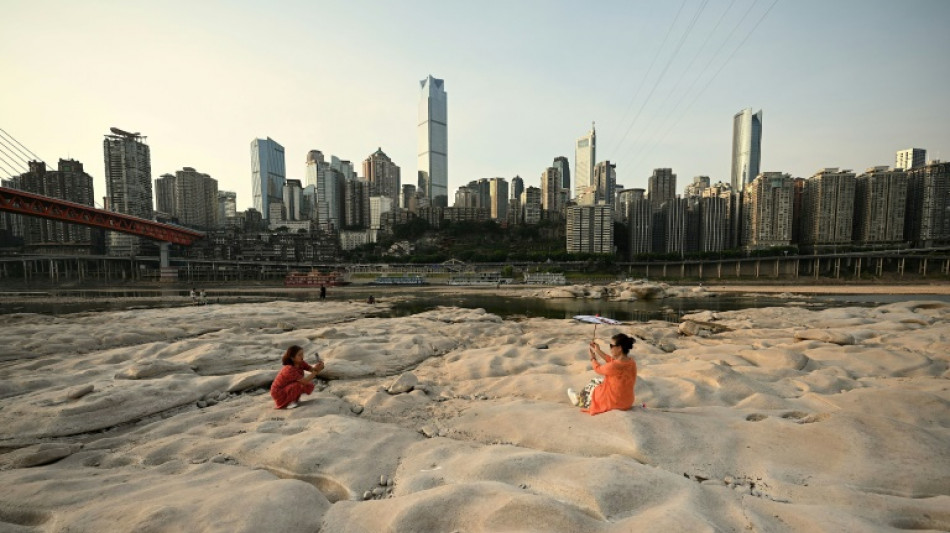
Half of China hit by drought in worst heatwave on record
Half of China hit by drought in worst heatwave on record / Photo: Noel Celis - AFP

Half of China hit by drought in worst heatwave on record

Half of China's vast territory is now experiencing drought, including parts of the frigid Tibetan Plateau, official data showed -- with more high temperatures forecast Thursday for hundreds of millions of people enduring the country's hottest summer on record.

Text size:

The world's second-largest economy has been hit by record heat, flash floods and droughts -- phenomena that scientists say are becoming more frequent and intense due to climate change.

Southern China has recorded its longest continuous period of high temperatures since records began more than 60 years ago, the agriculture ministry said this week.

Experts have said the intensity, scope and duration of the heatwave could make it one of the worst recorded in global history.

A chart from the National Climate Centre showed Wednesday that swathes of southern China -- including the Tibetan Plateau -- were experiencing "severe" to "extraordinary" drought conditions.

The worst-affected area -- the Yangtze river basin, stretching from coastal Shanghai to Sichuan province in China's southwest -- is home to over 370 million people and contains several manufacturing hubs including the megacity of Chongqing.

The China Meteorological Administration predicted continued high temperatures of up to 40 degrees Celsius (104 degrees Fahrenheit) in Chongqing and the provinces of Sichuan, Jiangxi and Zhejiang Thursday.

China's State Council on Wednesday announced a 10 billion yuan ($1.45 billion) subsidy to support rice farmers experiencing drought conditions which authorities have warned pose a "severe threat" to this year's autumn harvest.

China produces more than 95 percent of the rice, wheat and maize it consumes, but a reduced harvest could mean increased demand for imports in the world's most populous country -- putting further pressure on global supplies already strained by the conflict in Ukraine.

Officials also called for "a combination of measures to increase water sources to fight drought, first ensure drinking water for the people, ensure water for agricultural irrigation," the readout added.

Wednesday's CCTV evening news broadcast showed trucks supplying villagers who lacked drinking and agricultural water in rural Sichuan and Chongqing, with remote mountain areas particularly hard hit.

Temperatures as high as 45 degrees Celsius (113 Fahrenheit) have led multiple Chinese provinces to impose industrial power cuts, as cities struggle to cope with a surge in demand for electricity partly driven by people cranking up the air conditioning.

Record low water levels on the Yangtze River have also put pressure on the region's hydropower generators.

The heat broke records in Sichuan, where a temperature of 43.9 degrees Celsius (111 Fahrenheit) was recorded Wednesday afternoon, the province's Meteorological Service Centre said in a statement.

Y.Ishikawa--JT