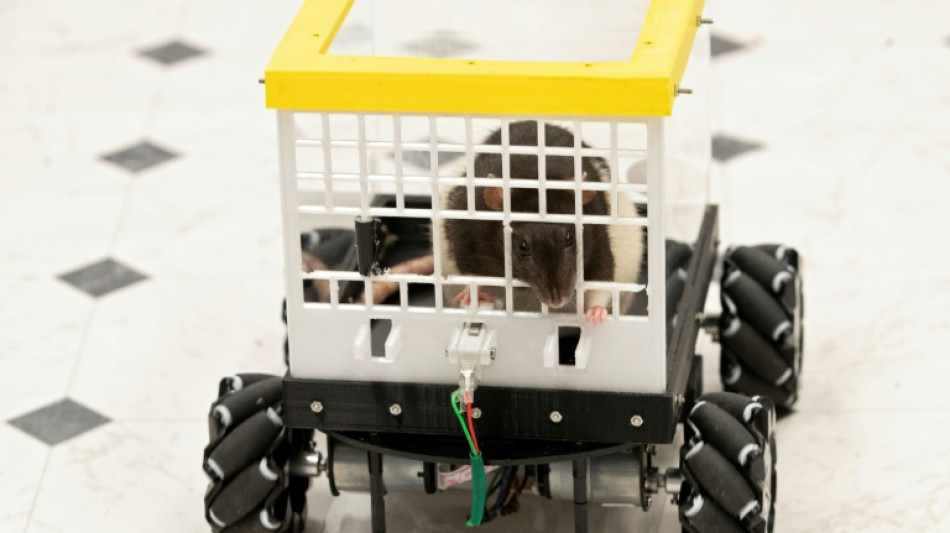
Rat race: What rodent drivers can teach us about mental health / Photo: Ryan M. Kelly - AFP

The girls can't hide their excitement as they're brought out to the racing arena.
"Black Tail" is up first, taking a few seconds to sniff her surroundings before placing her paw on a lever and zooming away.
After storming to the finish line, she devours a well-earned Froot Loop hanging on a "treat tree."
Black Tail is one of the University of Richmond's rat drivers -- a group that first dazzled the world with their ability to operate tiny cars back in 2019.
Now, the rodents serve as ambassadors for the school's Behavioral Neuroscience Laboratory, headed by Professor Kelly Lambert.
"It gets people's attention about how clever and teachable these animals are," explained Lambert, who has to balance her affection for the furry speedsters with the need for scientific detachment -- naming them only by the Sharpie colors that mark their tails.
The idea of racing rodents started out as a playful challenge from a colleague.
But far from being a novelty act, the animals are part of a boundary-pushing project exploring the ways in which environmental enrichment sculpts the brain -- and could in turn hold potential for solving human mental health challenges.
For Lambert, one of the great failings of modern medicine has been its inability to cure mental illness through drugs, even as pharmaceutical companies have reaped in huge profits.
These pharmaceutical approaches have faced increasing scrutiny since a landmark study published in July questioned the theory that chemical imbalances, especially a lack of serotonin, cause depression.
- Froots of their labor -
Instead, Lambert sees behavior therapy as the key to treating the mind, which is where studying fellow mammals comes in.
"Our brains are changing, from the womb to the tomb," she said. "If we have some type of engaging life, this is probably important and related to depression."
A previous experiment of hers had split rats into groups of "workers," who were assigned an effort-based reward task of digging through dirt mounds for a Froot Loop -- or a control group of "trust fund" rats that were simply handed over treats.
When challenged with stressful tasks, the worker rats persisted longer than those conditioned to remain in a state of what psychologists call "learned helplessness."
And when tasked with swimming, the worker rats showed greater emotional resilience, as shown by a higher ratio of the hormone dehydroepiandrosterone to cortisol in their droppings.
Rats that learned to drive also had biomarkers of greater resilience and lowered stress -- which Lambert suggests might be linked to the satisfaction of acquiring a new skill, like a human mastering a new piano piece.
"They make pathways that they take over and over again in the wild, and we wanted to see if they could continue to have this great navigational skill in a vehicle," explained research lab specialist Olivia Harding.
Training wasn't simple: the team first tried having the rats nudge the driving control with their snouts, before finding the animals preferred to stand on their hind legs and use their front paws.
Early car models required the rats to touch wiring placed in the front, left or right of the car, completing a mild electric circuit that corresponded to movement direction.
Now, though, they get around in fancier rides with levers designed by a roboticist.
Even when their cars were placed in an unfamiliar spot, pointed away from the treat, the rats learned to turn their vehicles and navigate toward the reward, indicating advanced cognitive processing at work.
Today's driving ladies, Black Tail and Multicolored Tail, show clear signs of "anticipatory" behavior when humans enter the room, pacing back and forth and trying to climb their walls.
However, just like people, not all rats have similar interests: while certain individuals seemed eager to drive just for the fun of it, others did so just for treats, while still others couldn't be coaxed into participating at all.
- Into the wild -
Female rats in particular were long ignored by science, because earlier generations of researchers thought their four-day estrous cycles muddied research results.
This potentially deprived scientists of female-specific insights, a trend Lambert has been adamant to reverse in her experiments -- and is also now a required condition for federal grants.
Lambert recognized early in her career that studying rats living "non-enriched" lives inside cages without obstacle courses and activities was of limited use, akin to studying humans in solitary confinement.
In her driving study, rats raised in enriched cages fared far better at driving tasks.
Her most recent paper focused on differences between lab rats and those caught in the wild -- finding the latter had larger brains, more brain cells, larger spleens to fight disease, and much higher stress levels than their captive cousins.
"It kind of blows my mind" that there had been so little interest in understanding these differences, given their possible impact on human medicine, she said.
It also raises an intriguing philosophical question: are we more like the caged lab rats, the enriched-setting lab rats, or the wild rats?
"I'm feeling a little bit closer to the provisioned lab rat rather than the wild rat," muses Lambert.
But the wild rats, who have to scavenge for food and avoid predators every day of their lives -- much like our own ancestors -- might have something to teach us about mental resilience.
T.Sato--JT