The Japan Times - Euclid telescope snaps best photo yet of Milky Way's heart

EUR -
AED 4.164208
AFN 72.00998
ALL 94.434546
AMD 416.141076
ANG 2.030119
AOA 1039.776155
ARS 1667.938109
AUD 1.643687
AWG 2.042418
AZN 1.933877
BAM 1.95548
BBD 2.283526
BDT 139.460253
BGN 1.917271
BHD 0.427643
BIF 3384.450624
BMD 1.133889
BND 1.472904
BOB 7.83496
BRL 5.896206
BSD 1.133814
BTN 107.293281
BWP 15.511804
BYN 3.195377
BYR 22224.23314
BZD 2.280297
CAD 1.61374
CDF 2572.795518
CHF 0.921444
CLF 0.026379
CLP 1038.200854
CNY 7.699673
CNH 7.72575
COP 3887.369882
CRC 516.13147
CUC 1.133889
CUP 30.04807
CVE 110.239668
CZK 24.240118
DJF 201.902302
DKK 7.475489
DOP 66.461176
DZD 151.406462
EGP 56.28398
ERN 17.008342
ETB 182.796329
FJD 2.549267
FKP 0.859712
GBP 0.861812
GEL 2.999178
GGP 0.859712
GHS 12.699314
GIP 0.859712
GMD 82.21178
GNF 9934.593302
GTQ 8.648585
GYD 237.167464
HKD 8.889982
HNL 30.338035
HRK 7.530042
HTG 148.250316
HUF 356.224942
IDR 20384.270736
ILS 3.384603
IMP 0.859712
INR 107.05889
IQD 1485.256947
IRR 1559154.682862
ISK 143.788626
JEP 0.859712
JMD 178.574715
JOD 0.803884
JPY 183.309674
KES 146.782103
KGS 99.158642
KHR 4555.39515
KMF 488.706469
KPW 1020.500898
KRW 1753.554359
KWD 0.350905
KYD 0.944866
KZT 551.776737
LAK 24887.695494
LBP 101546.616976
LKR 382.507405
LRD 206.520758
LSL 18.849715
LTL 3.348081
LVL 0.685878
LYD 7.291967
MAD 10.660238
MDL 20.080157
MGA 4736.37112
MKD 61.631002
MMK 2380.646135
MNT 4059.399525
MOP 9.157403
MRU 45.335381
MUR 54.664928
MVR 17.52989
MWK 1966.030288
MXN 19.977202
MYR 4.692041
MZN 72.455312
NAD 18.849715
NGN 1556.116226
NIO 41.724092
NOK 11.158895
NPR 171.664908
NZD 2.009745
OMR 0.435982
PAB 1.133849
PEN 3.845356
PGK 4.974318
PHP 69.676386
PKR 315.335197
PLN 4.287752
PYG 6915.990227
QAR 4.121935
RON 5.237447
RSD 117.371138
RUB 84.929041
RWF 1665.564163
SAR 4.257629
SBD 9.144864
SCR 15.480675
SDG 680.894475
SEK 11.085015
SGD 1.47222
SHP 0.846563
SLE 28.064139
SLL 23777.098891
SOS 647.99396
SRD 42.501591
STD 23469.222217
STN 24.495991
SVC 9.920595
SYP 125.331179
SZL 18.847497
THB 37.908763
TJS 10.527509
TMT 3.979952
TND 3.370448
TOP 2.730134
TRY 52.723308
TTD 7.687979
TWD 35.981737
TZS 2971.360693
UAH 50.894118
UGX 4183.315426
USD 1.133889
UYU 45.263391
UZS 13634.00936
VES 699.457025
VND 29860.978558
VUV 134.704289
WST 3.131396
XAF 655.869916
XAG 0.01913
XAU 0.000281
XCD 3.064393
XCG 2.043429
XDR 0.81296
XOF 655.861241
XPF 119.331742
YER 270.603134
ZAR 18.836341
ZMK 10206.36389
ZMW 20.437286
ZWL 365.111939
  • RYCEF

    -0.4700

    18.16

    -2.59%

  • RBGPF

    0.9600

    61.3

    +1.57%

  • RIO

    -3.7800

    95.58

    -3.95%

  • GSK

    1.3300

    52.07

    +2.55%

  • CMSD

    -0.1200

    21.96

    -0.55%

  • BTI

    1.8400

    60.74

    +3.03%

  • NGG

    0.6000

    81.57

    +0.74%

  • BCE

    0.3900

    23.04

    +1.69%

  • CMSC

    -0.0500

    22.11

    -0.23%

  • VOD

    -0.0700

    14.05

    -0.5%

  • BCC

    -0.7400

    71.8

    -1.03%

  • JRI

    -0.0200

    12.63

    -0.16%

  • RELX

    0.3800

    31.21

    +1.22%

  • AZN

    4.5900

    181.02

    +2.54%

  • BP

    -0.4500

    39.33

    -1.14%

Euclid telescope snaps best photo yet of Milky Way's heart
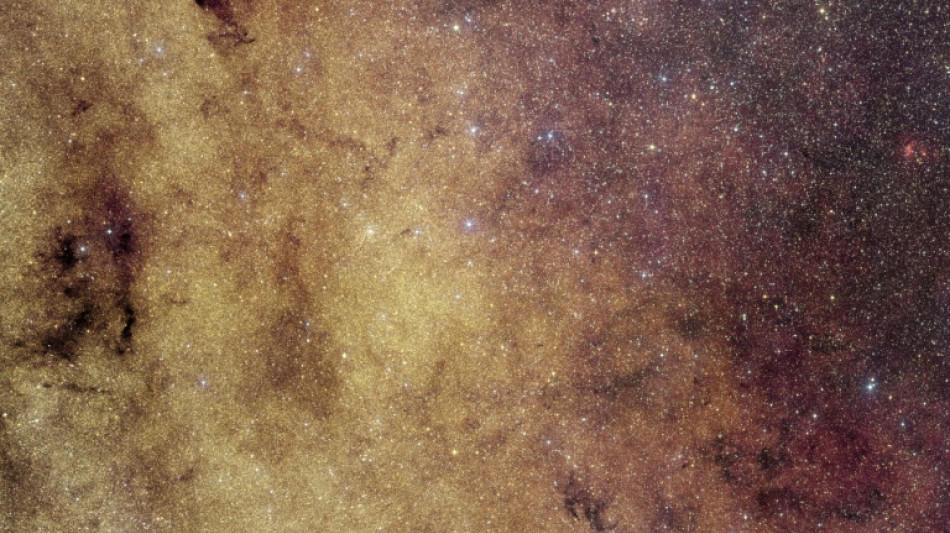
Euclid telescope snaps best photo yet of Milky Way's heart / Photo: - - EUROPEAN SPACE AGENCY/AFP

Euclid telescope snaps best photo yet of Milky Way's heart

The Euclid space telescope has captured the largest and most detailed photo ever taken of our galaxy's crowded heart, a dazzling image packed with 60 million stars, the European Space Agency said Wednesday.

Text size:

The new photo of the Milky Way's bright centre will help in the search for planets beyond our Solar System, the agency added.

At the centre of our spiral galaxy "lies the bulge -- a large bubble containing billions of stars", French astronomer Jean-Charles Cuillandre, who works on the Euclid mission, told AFP.

Euclid launched in 2023 on a mission to chart one-third of the sky in the hopes of shedding light on the enduring mysteries of dark matter and dark energy.

"Now we've decided to point Euclid at the brightest area of the sky -- and it works superbly, it's extraordinary," Cuillandre said.

Euclid, which is hovering 1.5 million kilometres (930,0000 miles) from Earth, captured the image with its visible light camera over 26 hours in March 2025.

The mosaic is composed of nine photographs, each covering an area of the sky larger than the Moon.

The original image was captured in black and white, but colour was added using observations from the Canada-France-Hawaii Telescope located in Hawaii.

However "we didn't do this just to produce a beautiful image", Cuillandre emphasised.

- 'Cosmic magnifying glass' -

In recent decades, scientists have identified thousands of planets outside our Solar System, which are known as exoplanets.

New exoplanets are unlikely to be identified within the Euclid image, but it will help the scientists measure the mass of planets already spotted -- and those that will be discovered in the future.

It can do this via a process called microlensing, which happens when one star crosses over another.

The closer star "acts like a cosmic magnifying glass, bending and brightening the background star's light", the ESA explained in a statement.

If a planet is orbiting the closer star, its gravity also slightly bends this light. This tiny change in brightness allows scientists to track the planet down.

"During the last 20 years, almost 300 exoplanets have been discovered using this technique, all with ground-based telescopes and all towards the centre of our galaxy," French astronomer Jean-Philippe Beaulieu said in the statement.

For example, Beaulieu said he led the team that discovered an icy planet "a bit like Hoth from Star Wars" 20 years ago.

The new image from Euclid "includes 51 known planetary systems -- and it will assist in studying many more that will be found", he added.

T.Shimizu--JT