The Japan Times - NASA's new rocket on launchpad for trip to Moon

EUR -
AED 4.277861
AFN 77.136147
ALL 96.657949
AMD 444.757798
ANG 2.08512
AOA 1068.154478
ARS 1678.808333
AUD 1.754654
AWG 2.098161
AZN 1.978573
BAM 1.957987
BBD 2.34611
BDT 142.338967
BGN 1.95787
BHD 0.439079
BIF 3444.346704
BMD 1.164836
BND 1.509986
BOB 8.048989
BRL 6.361141
BSD 1.164796
BTN 104.721505
BWP 15.516329
BYN 3.383779
BYR 22830.783798
BZD 2.342716
CAD 1.614131
CDF 2597.583856
CHF 0.93502
CLF 0.027447
CLP 1076.809445
CNY 8.227936
CNH 8.229012
COP 4473.855162
CRC 573.54054
CUC 1.164836
CUP 30.868152
CVE 110.388283
CZK 24.251359
DJF 207.420761
DKK 7.469021
DOP 75.023788
DZD 151.614484
EGP 55.494063
ERN 17.472539
ETB 181.440736
FJD 2.646272
FKP 0.874683
GBP 0.873732
GEL 3.133595
GGP 0.874683
GHS 13.371934
GIP 0.874683
GMD 85.623095
GNF 10132.315939
GTQ 8.916959
GYD 243.702171
HKD 9.064602
HNL 30.680264
HRK 7.535437
HTG 152.529693
HUF 383.333535
IDR 19401.623369
ILS 3.766054
IMP 0.874683
INR 104.64758
IQD 1525.904155
IRR 49039.591876
ISK 148.598106
JEP 0.874683
JMD 186.788609
JOD 0.825897
JPY 182.17102
KES 150.554416
KGS 101.864659
KHR 4667.21242
KMF 493.89021
KPW 1048.348457
KRW 1712.185734
KWD 0.357663
KYD 0.970684
KZT 603.901855
LAK 25261.212141
LBP 104310.195358
LKR 359.701721
LRD 205.589606
LSL 19.799512
LTL 3.439457
LVL 0.704598
LYD 6.33908
MAD 10.766024
MDL 19.831148
MGA 5200.808349
MKD 61.603703
MMK 2446.793693
MNT 4134.417229
MOP 9.336327
MRU 46.452879
MUR 53.873448
MVR 17.930198
MWK 2019.847129
MXN 21.189629
MYR 4.796816
MZN 74.44481
NAD 19.799512
NGN 1694.777782
NIO 42.867876
NOK 11.824879
NPR 167.555128
NZD 2.014054
OMR 0.447884
PAB 1.164801
PEN 3.916174
PGK 4.94252
PHP 68.955374
PKR 329.267131
PLN 4.223987
PYG 7936.864021
QAR 4.246142
RON 5.088581
RSD 117.437603
RUB 91.00593
RWF 1695.393444
SAR 4.371075
SBD 9.587289
SCR 15.685695
SDG 700.645729
SEK 10.860272
SGD 1.509051
SHP 0.873929
SLE 28.068787
SLL 24426.024407
SOS 664.542172
SRD 44.982457
STD 24109.751503
STN 24.527287
SVC 10.192383
SYP 12879.402776
SZL 19.792104
THB 37.088773
TJS 10.774633
TMT 4.088574
TND 3.423824
TOP 2.804645
TRY 49.625766
TTD 7.898822
TWD 36.333543
TZS 2855.727986
UAH 49.312873
UGX 4158.626572
USD 1.164836
UYU 45.650984
UZS 13981.6149
VES 300.069051
VND 30701.580029
VUV 142.017642
WST 3.24734
XAF 656.690403
XAG 0.019252
XAU 0.000277
XCD 3.148027
XCG 2.099336
XDR 0.817204
XOF 656.690403
XPF 119.331742
YER 277.842465
ZAR 19.791901
ZMK 10484.906002
ZMW 27.088253
ZWL 375.076687
  • RBGPF

    -1.5200

    77.68

    -1.96%

  • SCS

    0.0200

    16.14

    +0.12%

  • BCC

    2.1900

    74.19

    +2.95%

  • BTI

    1.2300

    58.52

    +2.1%

  • RIO

    0.5600

    74.96

    +0.75%

  • CMSC

    -0.0200

    23.22

    -0.09%

  • RELX

    0.5300

    40.07

    +1.32%

  • NGG

    -0.1500

    74.74

    -0.2%

  • GSK

    0.8400

    48.11

    +1.75%

  • BP

    0.0450

    35.595

    +0.13%

  • RYCEF

    -0.2300

    14.6

    -1.58%

  • VOD

    0.0350

    12.535

    +0.28%

  • JRI

    0.0220

    13.723

    +0.16%

  • CMSD

    -0.0610

    23.159

    -0.26%

  • BCE

    0.0890

    23.239

    +0.38%

  • AZN

    -0.0400

    89.78

    -0.04%

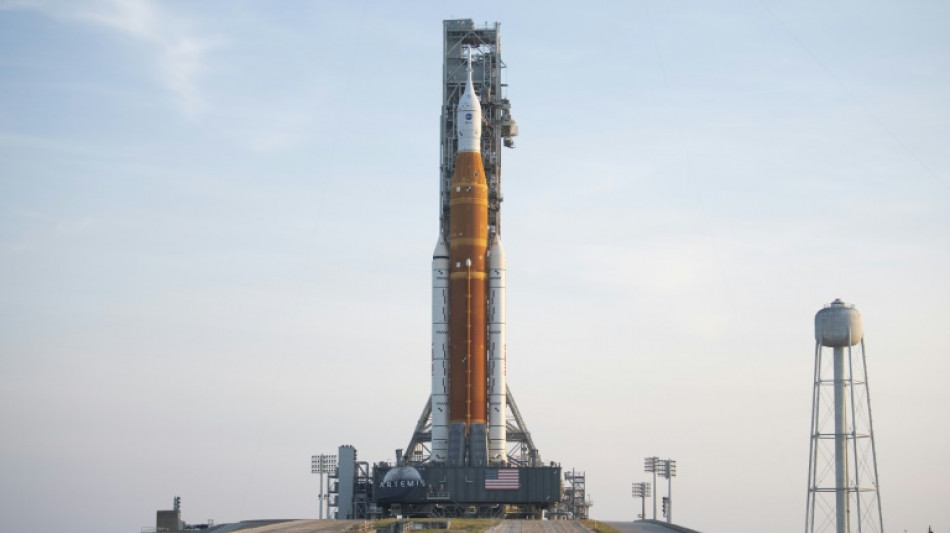
NASA's new rocket on launchpad for trip to Moon
NASA's new rocket on launchpad for trip to Moon / Photo: Joel KOWSKY - NASA/AFP

NASA's new rocket on launchpad for trip to Moon

NASA's giant new SLS rocket arrived at its launchpad Wednesday in Cape Canaveral ahead of a planned flight to the Moon in less than two weeks.

Text size:

It will be the maiden voyage of the Artemis program -- America's quest to return humans to the Moon for the first time since the last Apollo mission in 1972.

The Artemis 1 mission, an uncrewed test flight, will feature the first blastoff of the Space Launch System rocket, which will be the most powerful in the world.

It will propel the Orion crew capsule into orbit around the Moon, and the spacecraft will remain in space for 42 days before returning to Earth.

Starting in 2024, astronauts will travel aboard Orion for the same trip, and the following year, at the earliest, Americans will once again set foot on the Moon.

The SLS rocket, in development for more than a decade, is 98 meters (322 feet) tall.

On Wednesday it stood at historic launch complex 39B, after a 10-hour overnight crawl from the assembly building.

"To all of us that gaze up at the Moon, dreaming of the day humankind returns to the lunar surface, folks, we're here. We are going back," NASA administrator Bill Nelson said earlier this month.

The Orion capsule will fly to the Moon and 64,000 kilometers (40,000 miles) beyond it -- further than any previous crewed spacecraft.

On the way back through Earth's atmosphere, traveling at 40,000 km per hour (25,000 mph), Orion's thermal shield will have to withstand a temperature that is half that of the surface of the sun.

Liftoff for the Artemis 1 mission is scheduled for August 29 at 8:33 am (1233 GMT). If it has to be postponed due to bad weather, the backup dates are September 2 and 5.

After the 42-day trip, the capsule is supposed to splash down in the Pacific and be picked up by a US Navy vessel.

In 2024, an Artemis 2 mission is scheduled to take astronauts up to orbit the Moon but without landing on it. That honor is reserved for Artemis 3, a mission scheduled for 2025 at the earliest.

The last time people walked on the Moon was with the Apollo 17 mission in 1972.

While the Apollo program featured only white male astronauts, NASA says the Artemis missions will land the first woman and first person of color on the Moon.

The hope is to use the Moon as a staging ground to develop technologies for sending humans to Mars.

M.Fujitav--JT