Chinese EVs look to sideline foreign brands at Beijing auto show / Photo: Adek BERRY - AFP

The world's biggest auto show opens in Beijing on Friday, as Chinese manufacturers solidify their status as industry innovators and foreign brands face ferocious competition in the country's giant car market.
Brands such as Volkswagen, Toyota and BMW once dominated in China, but have steadily lost market share to domestic firms that beat them to the electric vehicle revolution and undercut them on price.
Electric cars are also getting a boost as oil prices sent spiking by the Mideast war nudge drivers away from fossil-fuel powered models.
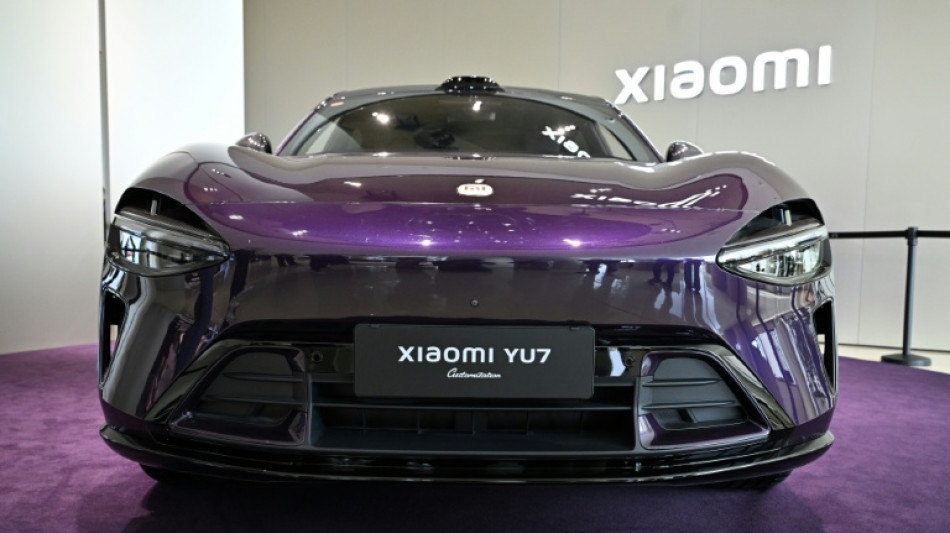
Dozens of carmakers will display their latest models at the 10-day exhibition in the Chinese capital, with domestic manufacturers like BYD, Xiaomi and Xpeng now at the forefront of integrating AI software and autonomous driving technology into their EVs.
Foreign brands have been "too slow to localise decision-making and product development", said Bill Russo, founder of Shanghai-based consultancy Automobility.
"The basis of competition in China has fundamentally shifted from hardware and brand to software, speed, and ecosystem integration," Russo told AFP.
Mercedes-Benz's China sales plunged 19 percent last year, while fellow German brand BMW saw sales hit their lowest level since 2017.
Volkswagen, long the largest seller in China, is battling to maintain a Chinese market share while also fending off competition at home.
The German car giant plans to cut 50,000 jobs domestically by 2030, after post-tax earnings fell 44 percent last year.
- 'Centre of gravity' –
"China is now the centre of gravity for automotive innovation, not just production," Russo said.
Foreign automakers are increasingly collaborating with local companies to keep pace with technological advances.
BMW has partnered with battery maker CATL, while Audi is using Huawei's driving assistance systems and Volkswagen is developing EVs together with Chinese brand Xpeng.
"The golden time for foreign brands has passed," said Ernan Cui, an analyst at Gavekal Dragonomics in Beijing.
"Chinese brands... are upgrading much faster."
Foreign manufacturers also face being outcompeted in other markets, as Chinese carmakers look abroad to boost profitability.
Chinese brands already control around a fifth of the auto market in Latin America, and plan to boost overseas production to 3.4 million vehicles by 2030 from 1.2 million in 2025, according to consulting firm AlixPartners.
Major players like BYD have high hopes for the Middle East and European markets, with sky-high tariffs keeping Chinese models out of the United States.
The European Union had imposed tariffs of up to 35.3 percent on EVs imported from China, but in January agreed that Chinese carmakers could accept minimum prices to sell into the bloc.
Still, BYD is building a factory in Hungary to manufacture cars for Europe, Leapmotor is due to start making EVs in Spain this year and Chery said Tuesday it wants to produce a small electric vehicle in Europe.
- Too many players -
But Chinese brands are also facing headwinds as a ferocious price war at home eats into profit margins.
"There are still too many players in the market with too much investment behind them," according to Cui.
"The losers are not quitting the market as fast as they are supposed to because they have investors' backing, local governments' backing, who do not want their existing investments to be written off," she said.
BYD logged a record 2.26 million EV sales in 2025, but net profit declined 19 percent.
Overall, Chinese passenger car sales fell 17.4 percent in the first quarter of this year, according to the China Passenger Car Association (CPCA), as the government scaled back incentives for EVs.
In that context, Chinese brands "are increasingly treating overseas markets as a strategic growth pillar rather than simply an outlet for excess capacity", Russo said.
China exported more than 2.6 million new energy vehicles -- which includes electric and hybrid autos -- last year, more than double in 2024, according to the China Association of Automobile Manufacturers.
Meanwhile, higher oil prices caused by the US-Israeli war on Iran are reinforcing the economic incentives for EVs, which is likely to further benefit Chinese brands, according to Russo.
Exports of Chinese electric vehicles more than doubled in March, compared to the same month last year across all manufacturers, according to the CPCA.
K.Nakajima--JT