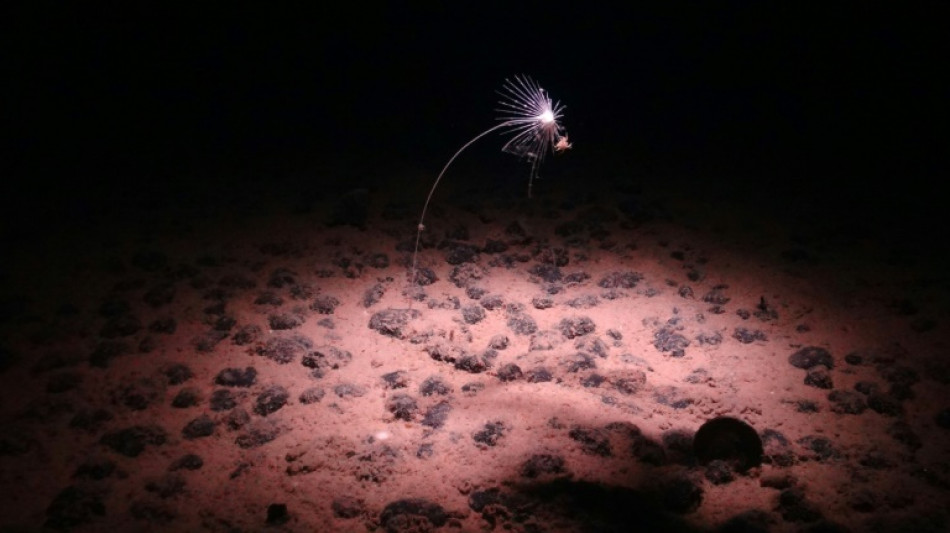
Scientists plan deep-sea expedition to probe 'dark oxygen' / Photo: Handout - National Oceanography Centre / Smartex project (NERC)/AFP/File

A team of scientists announced Tuesday they have developed new deep-sea landers specifically to test their contentious discovery that metallic rocks at the bottom of the ocean are producing "dark oxygen".
If a previously unknown source of oxygen has always been lurking in Earth's depths, it would represent a remarkable revelation that would call into question long-held assumptions about the origins of life on our planet.
But the deep-sea mining industry -- which is keen to extract precious metals from these potato-sized polymetallic nodules -- and some researchers have expressed doubts about the claim.
So British marine ecologist Andrew Sweetman, who led the 2024 research that revealed the possible existence of dark oxygen, is planning a new underwater expedition in the coming months.
At a press conference on Tuesday, Sweetman and his team unveiled two new landers capable of diving to a depth of 11 kilometres (seven miles) with the aim of finding out how the nodules could be creating oxygen.
Unlike previous missions, these landers will have sensors specifically designed to "measure seafloor respiration", Sweetman explained.
They can withstand 1,200 times the pressure on Earth's surface and more resemble space exploration equipment, a statement said.
The landers will be launched from a research ship in the Clarion-Clipperton Zone, a vast region between Hawaii and Mexico.
Mining companies have plans to start harvesting the nodules, which contain valuable metals used in electric car batteries and other tech.
The scientists believe that the nodules give off enough electric charge to split seawater into hydrogen and oxygen, a process known as electrolysis.
- Underwater gold rush? -
Sweetman also used the press conference to push back against criticism of his 2024 study.
Some researchers have suggested that the oxygen was not coming from the nodules, but instead were just air bubbles trapped in the measuring instruments.
"We've used these instruments over the last 20 years and every time we've deployed them, we've never had bubbles," Sweetman said, adding that the team conducted tests to rule out such a possibility.
The debate comes as companies and nations battle over proposed rules regulating the new and potentially environmentally destructive deep-sea mining industry.
Sweetman's 2024 study was partly funded by a Canadian deep-sea mining firm, The Metals Company, which has since sharply criticised his research.
"If commercial mining goes ahead then there will be quite widespread impacts," Sweetman said, adding that "these nodules are home to a variety of diverse fauna".
But the scientist emphasised it is "not our intention" to find something to stop deep-sea mining.
He instead wants to gather as much information as possible to "minimise the impacts as much as possible" if mining does go ahead.
Matthias Haeckel, a biogeochemist at Germany's GEOMAR Helmholtz Centre for Ocean Research, told AFP that his own research did "not show any hint towards oxygen production" from the nodules.
But he said Sweetman will "join our cruise at the end of this year, where we plan to compare our methods".
For the new research funded by the Japanese Nippon Foundation, Sweetman and his team plan to spend May on a research ship in the Clarion-Clipperton Zone.
"We'll be able to confirm dark oxygen production within 24 to 48 hours after the landers come up," he said.
The world will probably not know the results until the ship returns in June -- and further experiments back on dry land could take months, Sweetman added.
Y.Watanabe--JT