The Japan Times - Astronomers detect cosmic flash from early universe star blast

EUR -
AED 4.392152
AFN 77.725587
ALL 96.672854
AMD 453.321241
ANG 2.140553
AOA 1096.536528
ARS 1726.354217
AUD 1.702659
AWG 2.15391
AZN 2.033848
BAM 1.957275
BBD 2.408115
BDT 146.100104
BGN 2.008168
BHD 0.450751
BIF 3541.969294
BMD 1.195786
BND 1.51254
BOB 8.261226
BRL 6.227054
BSD 1.195601
BTN 110.003901
BWP 15.59175
BYN 3.377445
BYR 23437.408869
BZD 2.404612
CAD 1.615896
CDF 2678.561483
CHF 0.916074
CLF 0.026
CLP 1026.642284
CNY 8.316274
CNH 8.309949
COP 4352.661647
CRC 591.5458
CUC 1.195786
CUP 31.688333
CVE 110.34816
CZK 24.311169
DJF 212.515477
DKK 7.466943
DOP 75.116609
DZD 154.547848
EGP 55.98635
ERN 17.936793
ETB 185.990966
FJD 2.624154
FKP 0.867664
GBP 0.866562
GEL 3.222681
GGP 0.867664
GHS 13.061844
GIP 0.867664
GMD 87.292383
GNF 10491.906897
GTQ 9.173914
GYD 250.138509
HKD 9.333768
HNL 31.552779
HRK 7.535726
HTG 156.718106
HUF 380.793919
IDR 20077.249741
ILS 3.699996
IMP 0.867664
INR 109.878519
IQD 1566.280378
IRR 50372.492465
ISK 145.00113
JEP 0.867664
JMD 187.60138
JOD 0.847828
JPY 182.882941
KES 154.2563
KGS 104.572042
KHR 4808.623869
KMF 492.664252
KPW 1076.287842
KRW 1714.135323
KWD 0.366425
KYD 0.996351
KZT 600.612633
LAK 25718.381853
LBP 107067.187834
LKR 369.918778
LRD 221.18669
LSL 18.864417
LTL 3.530846
LVL 0.723319
LYD 7.51066
MAD 10.82726
MDL 20.110155
MGA 5344.027359
MKD 61.830948
MMK 2511.644633
MNT 4265.240494
MOP 9.612344
MRU 47.692942
MUR 53.990114
MVR 18.486994
MWK 2073.162374
MXN 20.62846
MYR 4.696452
MZN 76.243574
NAD 18.864417
NGN 1660.038615
NIO 44.003162
NOK 11.427375
NPR 176.006642
NZD 1.971959
OMR 0.45974
PAB 1.195601
PEN 3.998413
PGK 5.195916
PHP 70.549589
PKR 334.443043
PLN 4.207314
PYG 8023.046318
QAR 4.358485
RON 5.098113
RSD 117.393954
RUB 89.984025
RWF 1744.414623
SAR 4.485017
SBD 9.659173
SCR 16.575561
SDG 719.266256
SEK 10.540765
SGD 1.512418
SHP 0.897149
SLE 29.055949
SLL 25075.037148
SOS 682.114054
SRD 45.444057
STD 24750.35937
STN 24.518478
SVC 10.461884
SYP 13224.88667
SZL 18.858212
THB 37.434099
TJS 11.167016
TMT 4.185252
TND 3.42398
TOP 2.879166
TRY 51.908359
TTD 8.115116
TWD 37.536328
TZS 3067.191445
UAH 51.169262
UGX 4253.205295
USD 1.195786
UYU 45.244097
UZS 14548.964371
VES 428.660821
VND 31090.440337
VUV 142.978985
WST 3.248725
XAF 656.451714
XAG 0.010348
XAU 0.000223
XCD 3.231672
XCG 2.154824
XDR 0.815555
XOF 656.451714
XPF 119.331742
YER 285.072955
ZAR 18.876633
ZMK 10763.513161
ZMW 23.642818
ZWL 385.042658
  • SCS

    0.0200

    16.14

    +0.12%

  • RBGPF

    0.0000

    82.4

    0%

  • CMSC

    -0.0300

    23.67

    -0.13%

  • RYCEF

    -0.1700

    16.43

    -1.03%

  • BCC

    -1.3700

    79.48

    -1.72%

  • NGG

    -0.1300

    84.55

    -0.15%

  • AZN

    -0.2300

    92.99

    -0.25%

  • BTI

    0.0200

    60.18

    +0.03%

  • GSK

    0.7750

    50.875

    +1.52%

  • RIO

    1.4900

    94.86

    +1.57%

  • VOD

    0.0600

    14.63

    +0.41%

  • RELX

    -1.4650

    35.915

    -4.08%

  • BCE

    0.3050

    25.575

    +1.19%

  • JRI

    0.0150

    13.005

    +0.12%

  • CMSD

    0.0692

    24.12

    +0.29%

  • BP

    0.4050

    38.105

    +1.06%

Astronomers detect cosmic flash from early universe star blast
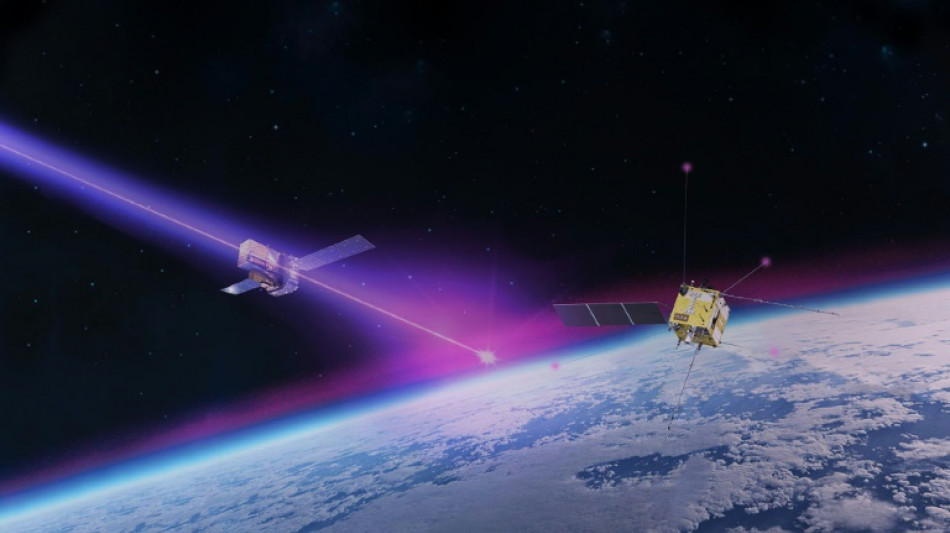
Astronomers detect cosmic flash from early universe star blast / Photo: Handout - ESA/ATG Europe/AFP/File

Astronomers detect cosmic flash from early universe star blast

An immensely powerful flash detected earlier this year was created by a massive star exploding when the universe was just five percent of its current age, astronomers said Tuesday.

Text size:

The flash was spotted on March 14 by a French-Chinese space telescope called SVOM, which launched last year on a mission to track gamma-ray bursts, the brightest and most powerful explosions in the cosmos.

When the young scientists working on the mission for France's Atomic Energy Commission (CEA) received a mobile phone alert that a major burst had arrived at Earth, they urged other telescopes to turn towards the source.

It came from a star around a hundred times bigger than our Sun that exploded 700 million years after the Big Bang, according to two studies published in the Astronomy & Astrophysics journal.

"This is extremely rare -- it's the fifth most distant gamma-ray burst ever detected," said Bertrand Cordier, the CEA's scientific lead for SVOM and a co-author of both studies.

"The photons that reached our instruments travelled for 13 billion years" to reach Earth, he told AFP.

The detection of the burst, which lasted tens of seconds, is also "the most precise in terms of the light we collected and the measurements we made," he added.

- Glimpse of ancient cosmos -

Gamma-ray bursts are the most energetic events in the universe, Cordier explained. They are thought to be caused by cataclysmic cosmic events such as massive stars going supernova or when binary neutron stars merge.

These flashes can release as much energy in a few seconds as our Sun will emit during its 10-billion-year life.

They shoot out matter at "speeds close to the speed of light", creating conditions impossible to reproduce on Earth, Cordier said.

These bright flashes also act as "probes" of the cosmos, illuminating all the matter they pass through before finally reaching us, he added.

This allows scientists a rare glimpse into the distant past of the universe, which is 13.8 billion years old.

The gamma-ray burst in March, called GRB250314A, was created by an explosion during the first generation of stars formed after the Big Bang.

These stars produced the first heavy elements -- such as iron, carbon and oxygen -- which played a fundamental role in the evolution of the universe.

Cordier hopes SVOM will be able to detect one or two similar events every year.

"The challenge is to get everything together in the chain" of observations which involves other telescopes, he said.

For example, after the burst was first detected in March, it took 17 hours before the Very Large Telescope in Chile turned its powerful lens towards the flash.

"During that time, the intensity had decreased," Cordier said.

"If we get there earlier, then we'll have better data."

Y.Kimura--JT