The Japan Times - NASA releases next wave of images from James Webb Space Telescope

EUR -
AED 4.221747
AFN 72.422506
ALL 96.096124
AMD 433.854203
ANG 2.057804
AOA 1054.144007
ARS 1605.343242
AUD 1.62721
AWG 2.072078
AZN 1.960051
BAM 1.958112
BBD 2.314834
BDT 141.027774
BGN 1.964949
BHD 0.433991
BIF 3414.18599
BMD 1.149558
BND 1.470207
BOB 7.970482
BRL 6.017126
BSD 1.149357
BTN 106.012117
BWP 15.671644
BYN 3.423907
BYR 22531.328422
BZD 2.311641
CAD 1.573341
CDF 2603.747768
CHF 0.906288
CLF 0.026491
CLP 1046.005378
CNY 7.996609
CNH 7.923573
COP 4257.949753
CRC 539.842224
CUC 1.149558
CUP 30.463276
CVE 111.075975
CZK 24.455341
DJF 204.299564
DKK 7.472308
DOP 70.525208
DZD 152.070977
EGP 60.259119
ERN 17.243364
ETB 180.911604
FJD 2.544489
FKP 0.867846
GBP 0.86372
GEL 3.126595
GGP 0.867846
GHS 12.51293
GIP 0.867846
GMD 84.494185
GNF 10087.367912
GTQ 8.80948
GYD 240.586214
HKD 9.001093
HNL 30.54346
HRK 7.53374
HTG 150.639208
HUF 390.941602
IDR 19501.09466
ILS 3.589419
IMP 0.867846
INR 106.076517
IQD 1505.92042
IRR 1518623.031549
ISK 143.200349
JEP 0.867846
JMD 180.793508
JOD 0.815051
JPY 183.004388
KES 148.749321
KGS 100.528243
KHR 4619.499883
KMF 493.160304
KPW 1034.601807
KRW 1714.737502
KWD 0.352971
KYD 0.957739
KZT 555.010269
LAK 24686.749085
LBP 102984.32807
LKR 357.895771
LRD 210.656014
LSL 19.266793
LTL 3.394345
LVL 0.695356
LYD 7.368303
MAD 10.80013
MDL 19.99779
MGA 4776.411683
MKD 61.626292
MMK 2413.659739
MNT 4105.397681
MOP 9.269227
MRU 46.114513
MUR 53.730146
MVR 17.772616
MWK 1996.781613
MXN 20.349122
MYR 4.516039
MZN 73.469562
NAD 19.267225
NGN 1571.74444
NIO 42.212001
NOK 11.131183
NPR 169.626436
NZD 1.964706
OMR 0.441999
PAB 1.149367
PEN 3.941261
PGK 4.945974
PHP 68.697741
PKR 321.042684
PLN 4.265129
PYG 7459.809679
QAR 4.188126
RON 5.093117
RSD 117.412322
RUB 93.404853
RWF 1677.204498
SAR 4.313632
SBD 9.255847
SCR 16.038223
SDG 690.88424
SEK 10.746495
SGD 1.469888
SHP 0.862466
SLE 28.275548
SLL 24105.659962
SOS 656.973773
SRD 43.190599
STD 23793.520804
STN 24.830444
SVC 10.056964
SYP 127.054834
SZL 19.266787
THB 37.222575
TJS 11.033426
TMT 4.029199
TND 3.357813
TOP 2.767858
TRY 50.790212
TTD 7.794272
TWD 36.73957
TZS 2994.597374
UAH 50.668778
UGX 4339.162089
USD 1.149558
UYU 46.725587
UZS 13915.39409
VES 512.985756
VND 30221.868582
VUV 137.447144
WST 3.144287
XAF 656.738289
XAG 0.014209
XAU 0.000229
XCD 3.106737
XCG 2.071364
XDR 0.819094
XOF 661.569692
XPF 119.331742
YER 274.167096
ZAR 19.188978
ZMK 10347.394961
ZMW 22.382628
ZWL 370.157069
  • RBGPF

    0.1000

    82.5

    +0.12%

  • CMSD

    -0.0400

    22.95

    -0.17%

  • JRI

    -0.0500

    12.54

    -0.4%

  • CMSC

    0.0000

    22.99

    0%

  • BCE

    0.6521

    25.9

    +2.52%

  • BCC

    1.7200

    71.72

    +2.4%

  • GSK

    0.3800

    53.77

    +0.71%

  • RIO

    2.0300

    89.86

    +2.26%

  • NGG

    -0.0100

    90.89

    -0.01%

  • AZN

    2.1100

    192.01

    +1.1%

  • RELX

    0.3300

    34.47

    +0.96%

  • VOD

    0.1900

    14.6

    +1.3%

  • RYCEF

    -0.1500

    16.4

    -0.91%

  • BTI

    1.0100

    60.94

    +1.66%

  • BP

    0.2300

    42.9

    +0.54%

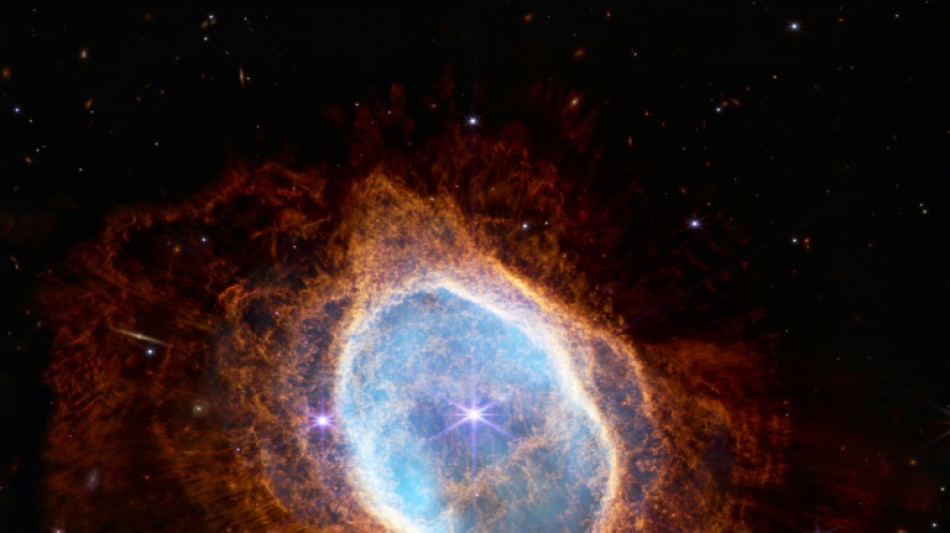
NASA releases next wave of images from James Webb Space Telescope
NASA releases next wave of images from James Webb Space Telescope / Photo: Handout - NASA/AFP

NASA releases next wave of images from James Webb Space Telescope

The James Webb Space Telescope began releasing a new wave of cosmic images on Tuesday, heralding a new era of astronomy.

Text size:

"Every image is a new discovery," said NASA administrator Bill Nelson. "Each will give humanity a view of the universe that we've never seen before."

On Monday, Webb revealed the clearest image to date of the early universe, going back 13 billion years.

One new image on Tuesday shown water vapor in the atmosphere of a faraway gas planet. The spectroscopy -- an analysis of light that reveals detailed information -- was of planet WASP-96 b, which was discovered in 2014.

Nearly 1,150 light-years from Earth, WASP-96 b is about half the mass of Jupiter and zips around its star in just 3.4 days.

"We've seen the effect of what happens when a planet and its atmosphere passes in front of the star, and the star light filters through the atmosphere, and you can break that down into wavelengths of light," said NASA's Knicole Colon.

"So you're actually seeing bumps and wiggles that indicate the presence of water vapor in the atmosphere of the planet."

Other targets that will be released include Carina Nebula, a stellar nursery, famous for its towering pillars that include "Mystic Mountain," a three-light-year-tall cosmic pinnacle captured in an iconic image by Hubble.

One stunning shot released by the White House on Monday was overflowing with thousands of galaxies and features some of the faintest objects observed.

Known as Webb's First Deep Field, it shows the galaxy cluster SMACS 0723, which acts as a gravitational lens, bending light from more distant galaxies behind it towards the observatory, in a cosmic magnification effect.

Launched in December 2021 from French Guiana on an Ariane 5 rocket, Webb is orbiting the Sun at a distance of a million miles (1.6 million kilometers) from Earth, in a region of space called the second Lagrange point.

Here, it remains in a fixed position relative to the Earth and Sun, with minimal fuel required for course corrections.

A wonder of engineering, the total project cost is estimated at $10 billion, making it one of the most expensive scientific platforms ever built, comparable to the Large Hadron Collider at CERN.

Webb's primary mirror is over 21 feet (6.5 meters) wide and is made up of 18 gold-coated mirror segments. Like a camera held in one's hand, the structure must remain as stable as possible to achieve the best shots.

After the first images, astronomers around the globe will get shares of time on the telescope, with projects selected competitively through a process in which applicants and selectors don't know each other's identities, to minimize bias.

Thanks to an efficient launch, NASA estimates Webb has enough propellant for a 20-year life, as it works in concert with the Hubble and Spitzer space telescopes to answer fundamental questions about the cosmos.

K.Okada--JT