The Japan Times - AI tool helps researchers treat child epilepsy

EUR -
AED 4.392152
AFN 77.725587
ALL 96.672854
AMD 453.321241
ANG 2.140553
AOA 1096.536528
ARS 1726.354217
AUD 1.702659
AWG 2.15391
AZN 2.033848
BAM 1.957275
BBD 2.408115
BDT 146.100104
BGN 2.008168
BHD 0.450751
BIF 3541.969294
BMD 1.195786
BND 1.51254
BOB 8.261226
BRL 6.227054
BSD 1.195601
BTN 110.003901
BWP 15.59175
BYN 3.377445
BYR 23437.408869
BZD 2.404612
CAD 1.615896
CDF 2678.561483
CHF 0.916074
CLF 0.026
CLP 1026.642284
CNY 8.316274
CNH 8.309949
COP 4352.661647
CRC 591.5458
CUC 1.195786
CUP 31.688333
CVE 110.34816
CZK 24.311169
DJF 212.515477
DKK 7.466943
DOP 75.116609
DZD 154.547848
EGP 55.98635
ERN 17.936793
ETB 185.990966
FJD 2.624154
FKP 0.867664
GBP 0.866562
GEL 3.222681
GGP 0.867664
GHS 13.061844
GIP 0.867664
GMD 87.292383
GNF 10491.906897
GTQ 9.173914
GYD 250.138509
HKD 9.333768
HNL 31.552779
HRK 7.535726
HTG 156.718106
HUF 380.793919
IDR 20077.249741
ILS 3.699996
IMP 0.867664
INR 109.878519
IQD 1566.280378
IRR 50372.492465
ISK 145.00113
JEP 0.867664
JMD 187.60138
JOD 0.847828
JPY 182.882941
KES 154.2563
KGS 104.572042
KHR 4808.623869
KMF 492.664252
KPW 1076.287842
KRW 1714.135323
KWD 0.366425
KYD 0.996351
KZT 600.612633
LAK 25718.381853
LBP 107067.187834
LKR 369.918778
LRD 221.18669
LSL 18.864417
LTL 3.530846
LVL 0.723319
LYD 7.51066
MAD 10.82726
MDL 20.110155
MGA 5344.027359
MKD 61.830948
MMK 2511.644633
MNT 4265.240494
MOP 9.612344
MRU 47.692942
MUR 53.990114
MVR 18.486994
MWK 2073.162374
MXN 20.62846
MYR 4.696452
MZN 76.243574
NAD 18.864417
NGN 1660.038615
NIO 44.003162
NOK 11.427375
NPR 176.006642
NZD 1.971959
OMR 0.45974
PAB 1.195601
PEN 3.998413
PGK 5.195916
PHP 70.549589
PKR 334.443043
PLN 4.207314
PYG 8023.046318
QAR 4.358485
RON 5.098113
RSD 117.393954
RUB 89.984025
RWF 1744.414623
SAR 4.485017
SBD 9.659173
SCR 16.575561
SDG 719.266256
SEK 10.540765
SGD 1.512418
SHP 0.897149
SLE 29.055949
SLL 25075.037148
SOS 682.114054
SRD 45.444057
STD 24750.35937
STN 24.518478
SVC 10.461884
SYP 13224.88667
SZL 18.858212
THB 37.434099
TJS 11.167016
TMT 4.185252
TND 3.42398
TOP 2.879166
TRY 51.908359
TTD 8.115116
TWD 37.536328
TZS 3067.191445
UAH 51.169262
UGX 4253.205295
USD 1.195786
UYU 45.244097
UZS 14548.964371
VES 428.660821
VND 31090.440337
VUV 142.978985
WST 3.248725
XAF 656.451714
XAG 0.010348
XAU 0.000223
XCD 3.231672
XCG 2.154824
XDR 0.815555
XOF 656.451714
XPF 119.331742
YER 285.072955
ZAR 18.876633
ZMK 10763.513161
ZMW 23.642818
ZWL 385.042658
  • SCS

    0.0200

    16.14

    +0.12%

  • RBGPF

    0.0000

    82.4

    0%

  • BCC

    -1.3300

    79.52

    -1.67%

  • CMSD

    0.0292

    24.08

    +0.12%

  • CMSC

    -0.0050

    23.695

    -0.02%

  • GSK

    0.7800

    50.88

    +1.53%

  • BTI

    0.0400

    60.2

    +0.07%

  • BCE

    0.2650

    25.535

    +1.04%

  • RIO

    1.1600

    94.53

    +1.23%

  • RYCEF

    -0.1700

    16.43

    -1.03%

  • RELX

    -1.2950

    36.085

    -3.59%

  • JRI

    -0.0200

    12.97

    -0.15%

  • VOD

    0.1050

    14.675

    +0.72%

  • AZN

    -0.1100

    93.11

    -0.12%

  • NGG

    0.1250

    84.805

    +0.15%

  • BP

    0.3150

    38.015

    +0.83%

AI tool helps researchers treat child epilepsy
AI tool helps researchers treat child epilepsy / Photo: John SAEKI, Laurence CHU, Nicholas SHEARMAN - AFP

AI tool helps researchers treat child epilepsy

An artificial intelligence tool that can detect tiny, hard-to-spot brain malformations in children with epilepsy could help patients access life-changing surgery quicker, Australian researchers said on Wednesday.

Text size:

It is the latest example of how AI, which can crunch vast amounts of data, is changing healthcare by assisting doctors with diagnoses.

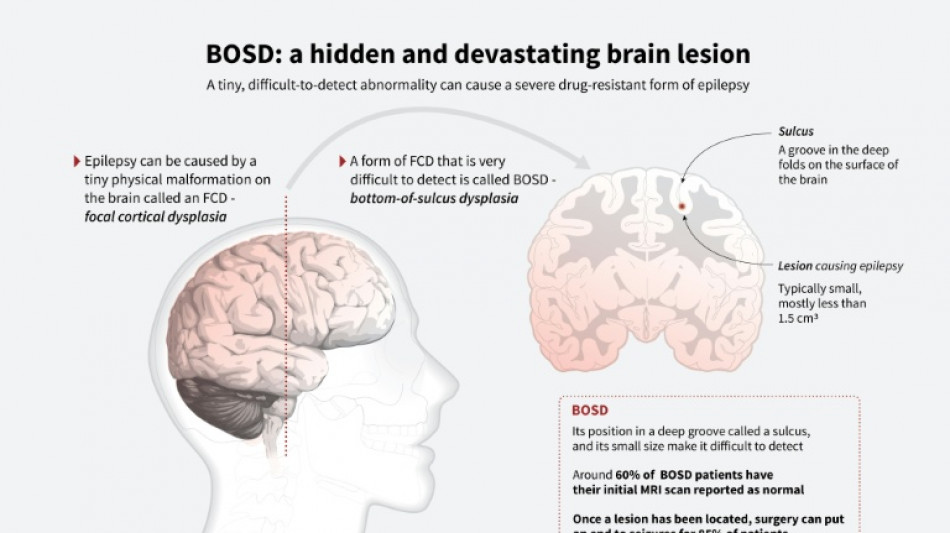
Epilepsy has several different causes, and overall around three in 10 cases are down to structural abnormalities in the brain, experts say.

These are often missed on MRI scans -- especially the smallest lesions, sometimes hidden at the bottom of a brain fold.

A team led by Emma Macdonald-Laurs, a paediatric neurologist at the Royal Children's Hospital in Melbourne, trained an AI tool on child brain images to find lesions the size of a blueberry or smaller.

"They're frequently missed and many children are not considered as surgical candidates," Macdonald-Laurs told a briefing ahead of the publication of her team's study in the journal Epilepsia.

"The tool doesn't replace radiologists or epilepsy doctors, but it's like a detective that helps us put the puzzle pieces together quicker so we can offer potentially life-changing surgery," she said.

Of the patients who took part, with conditions known as cortical dysplasia and focal epilepsy, 80 percent had previously had an MRI scan come back as normal.

When the researchers used the AI tool to analyse both MRI and another type of medical scan called a PET, its success rate was 94 percent for one test group and 91 percent for another.

Out of 17 children in the first group, 12 had surgery to remove their brain lesions, and 11 are now seizure-free, said Macdonald-Laurs's team at the Murdoch Children's Research Institute.

"Our next plans are to test this detector in more real-life hospital settings on new undiagnosed patients," she said.

Epilepsy, which causes recurrent seizures, affects about one in 200 children, and about a third of cases are drug-resistent.

"This work is really exciting" as a proof of concept and the results are "really impressive", Konrad Wagstyl, a biomedical computing expert at King's College London (KCL), told AFP.

Similar research published in February by a KCL team using AI on MRI data spotted 64 percent of epilepsy-linked brain lesions that were missed by radiologists.

The Australian researchers used MRI with PET, "but some caveats are that PET is expensive, it's not as widely available as MRI, and there is a dose of radiation like a CT scan or an X-ray associated with it," Wagstyl noted.

T.Sato--JT