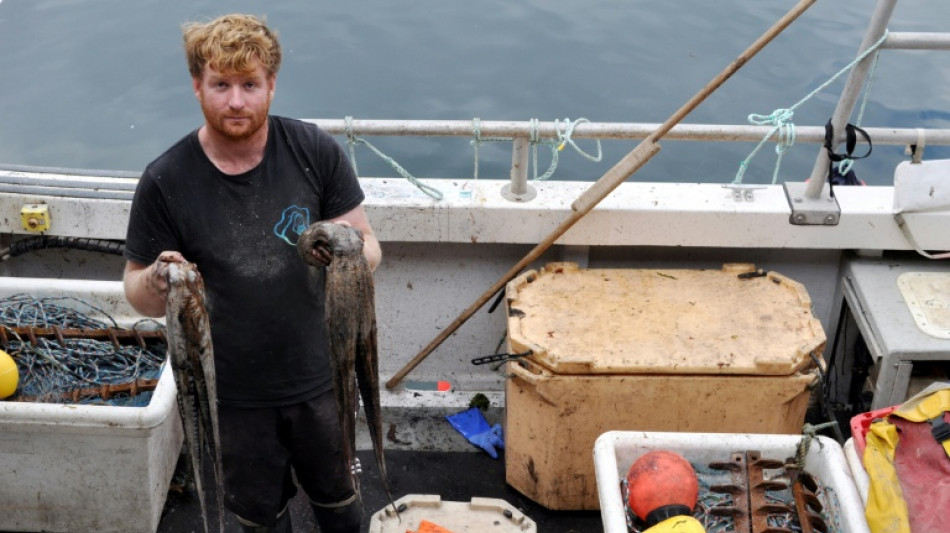
'Perfect storm': UK fishermen reel from octopus invasion / Photo: Joe JACKSON - AFP

When veteran fisherman Brian Tapper checked his 1,200 crab pots in waters off southwest England during this year's crabbing season, he got a series of unwelcome surprises.
At first, in March and April, they were almost entirely empty. Then, starting in May, they were unexpectedly packed with octopuses, before sitting largely empty again over the last month or so.
It has been a similar story along the UK's Devon and southern Cornwall coastline where the seas are warming, and an octopus bloom -- the biggest in British waters in 75 years -- has left the shellfish industry reeling.
The tentacled molluscs are notoriously voracious eaters, hoovering up crustaceans such as crab and shellfish.
Tapper's wife has already shuttered her dockside crab processing factory due to the diminished catch, while he doubts he can keep his side of the business afloat.
"It's like a perfect storm for us," Tapper told AFP from Plymouth Harbour, where his three purpose-built crab fishing vessels are idled.
The 53-year-old estimates his catch is down by half, and risks dropping by four-fifths in 2025.
An 18-month marine heatwave in the region and beyond is blamed for causing the bloom in warm water-loving octopus.
Climate scientists say human activity, such as burning fossil fuels, is behind global warming which is driving up ocean temperatures.
"I've been fishing here 39 years and I've never seen octopus like this," Tapper said.
"I've never seen an instant change like this. It's so quick. They're a plague."
- 'Scary' -
Statistics from the Marine Management Organisation, a government agency, show UK fishermen landed more than 1,200 tonnes of octopus in the first six months this year.
That compares to less than 150 tonnes in the same period in 2023, and less than 80 tonnes in those months last year.
Meanwhile, landings of shellfish such as brown crab are down significantly in 2025.
Sue MacKenzie, whose Passionate About Fish firm sources produce from southwest England, said the octopus are "eating our indigenous species at a rate that nobody can anticipate -- it's quite scary".
Decent market prices for octopus helped offset losses, but only until their numbers began dropping considerably in July.
"We're incredibly worried about the impact on shellfish stocks. It's really significant," said Beshlie Pool, executive officer at the South Devon and Channel Shellfishermen cooperative association, which represents more than 50 different vessels.
"Some people have done incredibly well on octopus this year. But across our membership we've got some vessels who haven't caught one octopus this whole season."
Chris Kelly, who fishes "a bit of everything" from his seven-metre vessel "Shadow" using pots, nets and lines, has been among those getting good prices for the unexpected catch.
"But then we're catching no lobsters, and then long-term, you're thinking 'what's it going to do to the stocks?'" he said.
- Octopus on the menu -
The impact has rippled out to restaurants and food retailers, which have adapted by offering octopus instead of shellfish.
"This is the first year we've bought it," said Caroline Bennett, whose Sole of Discretion company supplies direct-to-consumer food firms from Plymouth's dockside.
"We didn't have any crab at all to sell, and are now going a bit further down the coast for it."
Meanwhile, local and national officials have helped commission an urgent study into the situation. An initial report is due in October.
Bryce Stewart, a University of Plymouth marine scientist leading the probe, noted past blooms in Britain -- in 1950, the 1930s and 1899 -- were all preceded by similarly "ideal" warmer-than-usual waters.
However, Stewart suspects octopuses are now breeding in local waters -- an unprecedented situation that could also explain their sudden disappearance.
Both male and female Atlantic longarm octopus -- which typically only live about 18 months -- tend to die not long after breeding.
"They eat everything, they're ferocious, and they start to breed. It's like the ultimate live fast, die young life cycle," he explained.
He said he is constantly asked if the octopuses are here to stay. His answer? "Probably."
Tapper fears as much. "The crab won't come back in my working lifetime," he predicted.
"The reproduction of a crab would probably take five to 10 years to get to its marketable size, and I haven't got five to 10 years (to) pay the bills."
Y.Kato--JT