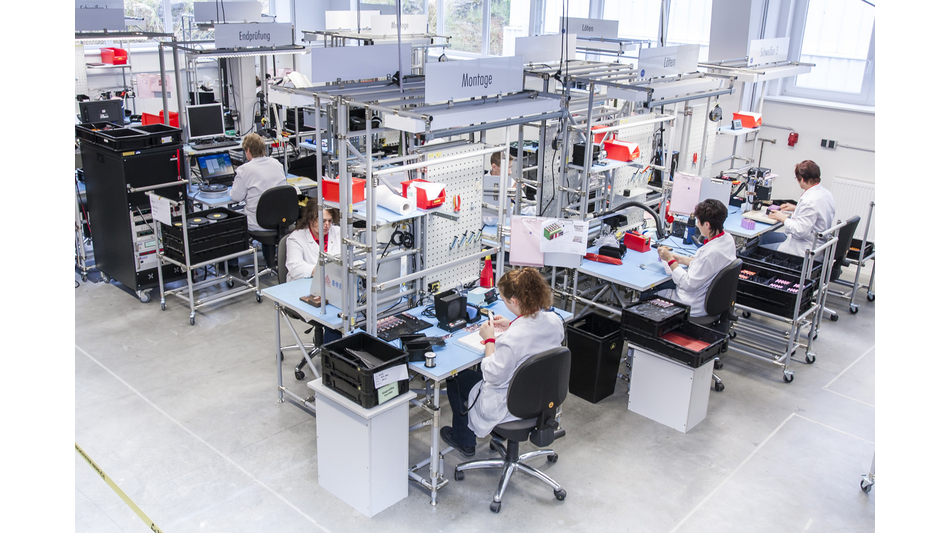
How to develop perfect battery systems for complex mobile solutions / Photo: © The modern ANSMANN AG battery pack manufacturing and testing site in Germany (Image source: @Ansmann AG)

Using a 3-step-strategy ANSMANN defines the perfect battery pack and charger for each mobile device
(Assamstadt/Bromma/Oslo/Lieusaint, 19-08-2025) Sometimes they combine supercaps with lithium hybrid storage systems; other times they search for the best battery cell for a specific task profile by using their BatteryLab and AI-systems. As mentioned in several publications before: Whatever it takes, Ansmann Group's battery system experts take a broad 3-step-approach, when it comes to finding the optimized battery and charging system for an application - like for example Driverless Transportation Systems (DTS) and Automated Guided Vehicle Systems (AGVs) or Autonomous Mobile Robots (AMRs).
++ Hybrid energy storage of supercaps and LiIon-Technology
How does it work to create a perfect customized battery pack? Step one: dare to think out of the box. A new hybrid storage system for AGVs and AMR , designed by ANSMANN and the IFL Karlsruhe (Institut für Fördertechnik und Logistiksysteme of KIT-Karlsruhe), p.ex. combines the best of two energy storage worlds: supercap capacitors and lithium-ion (LiIon) battery cells. This creates a highly efficient energy storage system, specifically for the needs of a logistic system with AGVs and AMRs. When the so-called double-layer capacitors and battery cells are skillfully combined, the new solution is 50 percent lighter, permanently available and has three times the service life of previous battery applications in AGVs.
The reason for this is, that supercaps can be quickly charged to 95 percent within 30 seconds at precisely located decentralised charging points. The vehicle is then ready for its next tour and can successively charge the conventional battery module. This supplies the vehicle with energy for longer distances, which cannot be covered by the supercap alone. The result: a perfect, extremely energy efficient hybrid energy storage system for mobile logistic solutions - which is almost half the size with up to 80 percent less battery cells and requires less capacity for identical applications than normal LiIon systems would need.
++ Cell preselection in the new Ansmann battery laboratory
Second, it is crucial for each mobile solution, to identify the best cells to be used in its battery pack. Therefor hundreds of different cells - over 300 round cell types, 60 prismatic and 40 others yet - are recorded in the ANSMANN cell database. For more than two years now, a team of ANSMANN experts is systematically searching for new cell types worldwide and tests them for unusual parameters.
The reason for the company's decision to invest in and systematically expand cell measurement and benchmarking in the form of a "battery laboratory" is clear: The number of cell sizes is constantly increasing. Same time, the number of cell chemistries and cell manufacturers is increasing. However, the cell manufacturers' data sheets often only reveal a limited part of the truth and their data was collected only under ideal conditions. So it doesn't tell anything for example about very important selection criteria like the behavior of a cell in its aging process.
Dark side: The use of unsuitable cells can have a significant negative impact on the performance and service life of a battery pack and the mobile solution it is used in. Whatever the critical selection criteria had been, be it current output capability, ability to push the systems acceleration or other: the performance of the battery pack is impaired. Through careful, preventive cell selection, complaining reasons are minimized and the warranty period for the unaffected runtime of the battery pack can be extended to reduce costs.
++ Third step is the use of a self-developed Artificial Intelligence (AI) Tool
And even more - step three: For deciding about the best cell forms for the specific solution and speeding up time-to-market of its customers, ANSMANN Industrial Solutions has developed it's own AI-tool, that helps to optimize the pack designs and formats more quickly.
For more than three decades, ANSMANN has been at the forefront as the world's leading expert in battery, accumulator, charging, drive and lighting technology. The more than 400 employees support their industrial customers in the complete development process of their mobile electronic devices and vehicles: from consulting through development, testing and distribution to cell and battery system recycling. More information: ANSMANN Industrial Solutions
Company description
The Ansmann Group is known in many European countries for more than 30 years for its particularly safe, technically pioneering and yet cost effective solutions for private and industrial applications. Those include medical equipment - as ANSMANN production is certified to the EN ISO 13485 medical standard, battery components for e-wheelchairs, e-bikes, battery-powered forestry as well as gardening powertools and various kinds of small e-vehicles and types of equipment.
The company operates a production facility and central logistics centre at its headquarters in Assamstadt and offices in France, Sweden, Norway and the UK. The ANSMANN UN test centre and a BatteryLab and test facility for cells and battery systems can run all necessary tests and checks to ensure the transportability, safety and recyclability of battery packs and solutions.
Company-Contact
Ansmann AG
Christopher Vogt
Industriestr. 10
97959 Assamstadt
+49 6294 4204-0
https://www.ansmann.de
Press
Comm:Motions - Text & PR
Miriam Leunissen
Hechtseestr 16
83022 Rosenheim
+49 174 3005749
https://www.comm-motions.com
K.Hashimoto--JT