India, Poland, Hungary make spaceflight comeback with ISS mission / Photo: - - SPACEX/AFP

India, Poland and Hungary are set to send people to space for the first time in decades on an American commercial mission to the International Space Station that blasts off Wednesday.
Axiom Mission 4, or Ax-4, will launch from NASA's Kennedy Space Center in Florida at 2:31 am (0631 GMT), with a brand-new SpaceX Crew Dragon capsule riding atop a Falcon 9 rocket.
The vehicle is scheduled to dock with the orbital lab on Thursday at approximately 1100 GMT and remain there for up to 14 days.
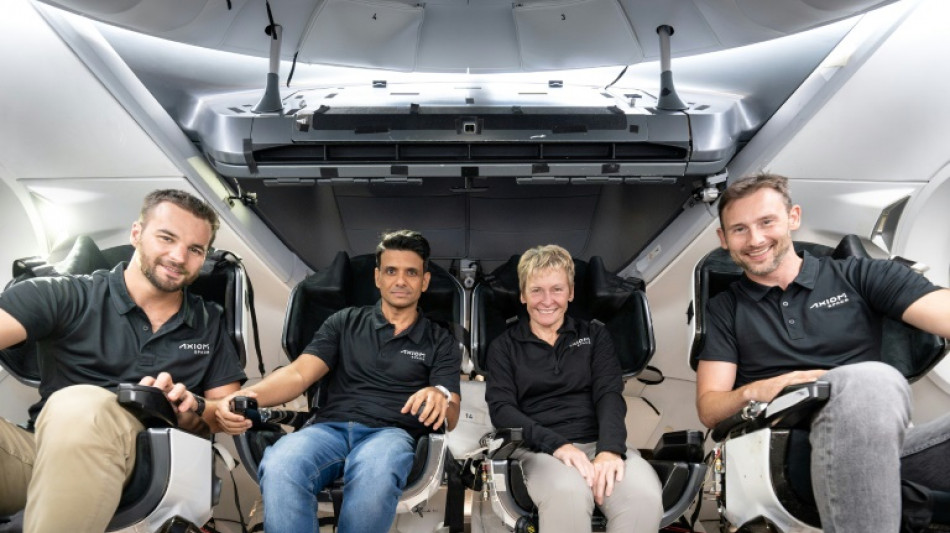
Aboard the spacecraft will be pilot Shubhanshu Shukla of India; mission specialists Slawosz Uznanski-Wisniewski of Poland and Tibor Kapu of Hungary; and commander Peggy Whitson of the United States, a former NASA astronaut who now works for the company Axiom Space, which organizes private spaceflights, among other things.
The last time India, Poland or Hungary sent people to space, their current crop of astronauts had not yet been born -- and back then they were called cosmonauts, as they all flew on Soviet missions before the Iron Curtain fell.
"I carry with me not just instruments and equipment, but the hopes and dreams of a billion hearts," said Shukla, 39, at a recent press conference.
He is set to become the first Indian in space since Rakesh Sharma, an Air Force pilot who traveled to the Salyut 7 space station in 1984 as part of a Soviet-led initiative to help allied countries access space.
India's space agency, ISRO, sees this flight as a key stepping stone toward its own maiden crewed mission, planned for 2027 under the Gaganyaan program, meaning "sky craft" in Hindi.
While aboard the ISS, Shukla is set to speak with a high-profile Indian VIP -- widely speculated in Indian media to be Prime Minister Narendra Modi -- in a soft-power moment aimed at stoking national pride.
All three countries are footing the bill for their astronauts. Hungary announced in 2022 it was paying $100 million for its seat, according to spacenews.com. India and Poland have not disclosed how much they're spending.
- Space spat -
The mission comes after of an explosive online spat between US President Donald Trump and Elon Musk, the world's richest person and, until recently, Trump's ally and advisor.
Trump threatened to yank SpaceX's federal contracts -- worth tens of billions of dollars -- prompting Musk to threaten an early retirement of Dragon, the only American spacecraft currently certified to carry astronauts to the ISS.
Musk walked back the threat a few hours later and in the days that followed, sought to distance himself further, writing on X that he had gone "too far."
Any rupture between SpaceX and the US government would be massively disruptive, given NASA and the Pentagon's reliance on Falcon 9 and Falcon Heavy to send up crew, cargo, satellites and probes.
But for now, analysts believe both sides are too entangled to risk a serious break.
The upcoming flight marks the debut of the fifth and final Crew Dragon vehicle, which will be named once it reaches orbit, joining Endeavour, Resilience, Endurance and Freedom in the active fleet.
SpaceX ultimately plans to phase out its current vehicles in the 2030s in favor of Starship, its giant next-generation rocket currently in development.
Ax-4 will carry out around 60 experiments, including studies on microalgae, sprouting salad seeds, and how well microscopic creatures called tardigrades survive in space.
T.Shimizu--JT