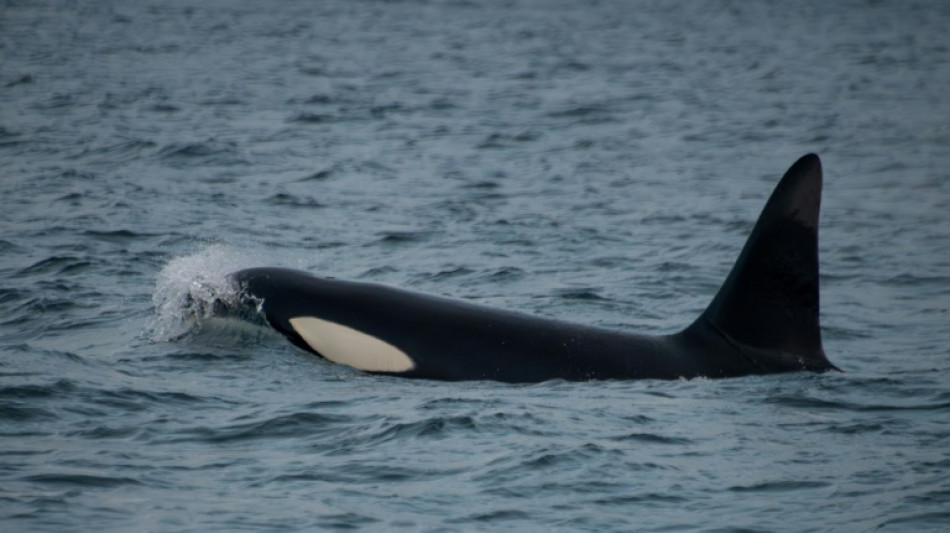
Killer whales spotted grooming each other with seaweed / Photo: Olivier MORIN - AFP/File

Killer whales have been caught on video breaking off pieces of seaweed to rub and groom each other, scientists announced Monday, in what they said is the first evidence of marine mammals making their own tools.
Humans are far from being the only member of the animal kingdom that has mastered using tools. Chimpanzees fashion sticks to fish for termites, crows create hooked twigs to catch grubs and elephants swat flies with branches.
Tool-use in the world's difficult-to-study oceans is rarer, however sea otters are known to smash open shellfish with rocks, while octopuses can make mobile homes out of coconut shells.
A study published in the journal Current Biology describes a new example of tool use by a critically endangered population of orcas.
Scientists have been monitoring the southern resident killer whales in the Salish Sea, between Canada's British Columbia and the US state of Washington, for more than 50 years.
Rachel John, a Masters student at Exeter University in the UK, told a press conference that she first noticed "something kind of weird" going on while watching drone camera footage last year.
The researchers went back over old footage and were surprised to find this behaviour is quite common, documenting 30 examples over eight days.
One whale would use its teeth to break off a piece of bull kelp, which is strong but flexible like a garden hose.
It would then put the kelp between its body and the body of another whale, and they would rub it between them for several minutes.
The pair forms an "S" shape to keep the seaweed positioned between their bodies as they roll around.
- For fun and clean skin -
Whales are already known to frolic through seaweed in a practice called "kelping".
They are thought to do this partly for fun, partly to use the seaweed to scrub their bodies to remove dead skin.
The international team of researchers called the new behaviour "allokelping," which means kelping with another whale.
They found that killer whales with more dead skin were more likely to engage in the activity, cautioning that it was a small sample size.
Whales also tended to pair up with family members or others of a similar age, suggesting the activity has a social element.
The scientists said it was the first known example of a marine mammal manufacturing a tool.
Janet Mann, a biologist at Georgetown University not involved in the study, praised the research but said it "went a bit too far" in some of its claims.
Bottlenose dolphins that use marine sponges to trawl for prey could also be considered to be manufacturing tools, she told AFP.
And it could be argued that other whales known to use nets of bubbles or plumes of mud to hunt represent tool-use benefitting multiple individuals, another first claimed in the paper, Mann said.
- Culture could soon be lost -
Michael Weiss, research director at the Center for Whale Research and the study's lead author, said it appeared to be just the latest example of socially learned behaviour among animals that could be considered "culture".
But the number of southern resident killer whales has dwindled to just 73, meaning we could soon lose this unique cultural tradition, he warned.
"If they disappear, we're never getting any of that back," he said.
The whales mainly eat Chinook salmon, whose numbers have plummeted due to overfishing, climate change, habitat destruction and other forms of human interference.
The orcas and salmon are not alone -- undersea kelp forests have also been devastated as ocean temperatures rise.
Unless something changes, the outlook for southern resident killer whales is "very bleak," Weiss warned.
H.Hayashi--JT