Moth uses stars to navigate long distances, scientists discover / Photo: Ajay Narendra - Macquarie University/AFP

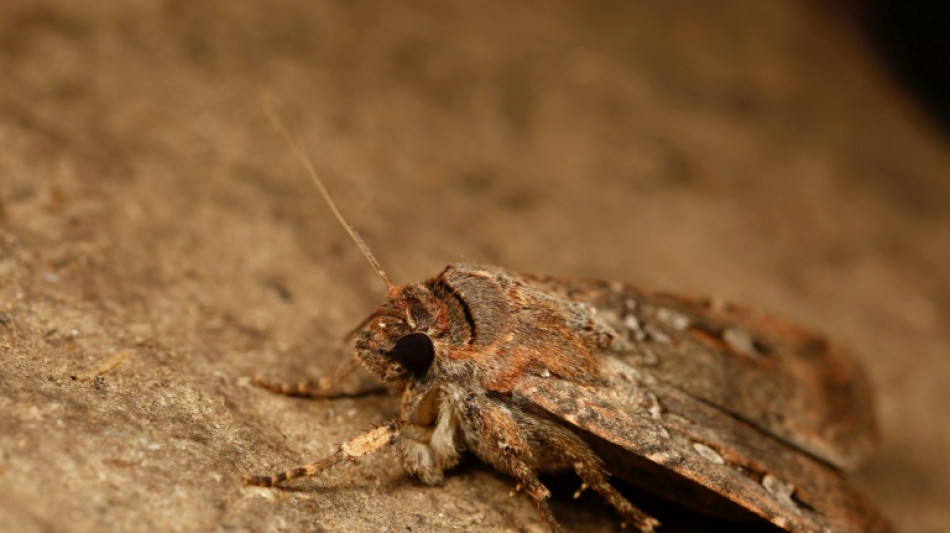
A species of Australian moth travels up to a thousand kilometres every summer using the stars to navigate, scientists said Wednesday, the first time this talent has been discovered in an invertebrate covering vast distances.
When temperatures start rising every year, Bogong moths embark on the long night-time flight from their home on the country's eastern coast to the cool inland shelter of caves in the Australian Alps.
It has recently been discovered that they can use Earth's magnetic field like a compass to stay on track during their trip of up to 1,000 kilometres (620 miles).
Now, a study published in the journal Nature has found that the moths can also use the light from the stars and the Milky Way to find their way through the dark.
"This is the first invertebrate that's known to be able to use the stars for that purpose," study co-author Eric Warrant of Sweden's Lund University told AFP.
The only other invertebrate known to use stars for orientation are dung beetles -- but that is over very short distances, Warrant said.
Out of all the animal kingdom, only some birds, possibly seals and of course humans can use starlight to navigate long distance.
Bogong moths, which are around three centimetres long and are named after the Indigenous Australian word for brown, now join that list.
- 'Flight simulator' -
To study this phenomenon, the international team of researchers put some Bogong moths in a small enclosure and projected different maps of the night sky onto its ceiling.
The moth was tethered to a rod connected to the top of the enclosure, which precisely recorded which directions it tried to fly in.
This "flight simulator" first confirmed that Bogong moths can in fact navigate using their internal magnetic compass, lead study author David Dreyer, also of Lund University, told AFP.
Then the researchers removed the effect of Earth's magnetic field in the enclosure.
"To our surprise," the moths were still able to find the right direction, Dreyer said.
When they rotated the sky 180 degrees, the moths changed their flight to follow along.
And when the researchers projected weird, incorrect maps of the night sky, the moths became erratic and lost.
This reinforced that the insects can not only navigate by the sky, but can follow along during the night when the relative positions of the stars shift along with Earth's rotation.
- Mysteries abound -
No one knows exactly how the Bogong moth manages this feat.
One theory is that they sometimes "cross-check" their direction with their magnetic compass, Dreyer said.
Another question is exactly which stars the moths are using to navigate.
In the lab, the researchers monitored 30 neurons involved in the moth's vision, coordination and navigation.
Developing the system of non-magnetic electrodes "cost me a fortune but it was worth the investment," Warrant said.
The neurons became particularly active at the sight of the long, bright stripe of the Milky Way, as well as the Carina Nebula.
The Milky Way is brighter in the Southern Hemisphere than in the north, Warrant pointed out.
"The intensity of that stripe grows as you go from the northern part of the sky to the southern part," which could offer a clue as to how the moths use it to navigate south, Warrant said.
Another mystery is how the moths know when to head south when summer arrives.
Warrant, who is supervising further research on this subject, said one option is that this knowledge was simply "something that the parents hand to their children".
The researchers believe that near the end of the moth's long migration, they start noticing clues they are getting close to their mountain refuge.
Warrant said he has identified a specific "odour compound" which emanates from the caves.
This smell "seems to act as a navigational beacon right at the very end of the journey," he added.
After the moths have seen out the sweltering summer, they return to their coastal birthplace to reproduce before dying.
T.Sato--JT