The Japan Times - Study sheds light on origin of Australia's odd echidna

EUR -
AED 4.301666
AFN 74.964245
ALL 96.098612
AMD 434.445807
ANG 2.096522
AOA 1075.268556
ARS 1634.551952
AUD 1.630204
AWG 2.108371
AZN 1.990446
BAM 1.957809
BBD 2.359448
BDT 143.766913
BGN 1.953876
BHD 0.442754
BIF 3500.747465
BMD 1.171317
BND 1.494434
BOB 8.125338
BRL 5.824022
BSD 1.171467
BTN 111.357269
BWP 15.902318
BYN 3.3136
BYR 22957.812186
BZD 2.356518
CAD 1.594092
CDF 2717.455481
CHF 0.916309
CLF 0.026959
CLP 1060.920313
CNY 7.998045
CNH 7.997576
COP 4351.079355
CRC 532.6443
CUC 1.171317
CUP 31.039899
CVE 110.378265
CZK 24.38108
DJF 208.654111
DKK 7.472136
DOP 69.67752
DZD 155.167832
EGP 62.698301
ERN 17.569754
ETB 182.962347
FJD 2.570982
FKP 0.862349
GBP 0.863993
GEL 3.139342
GGP 0.862349
GHS 13.11746
GIP 0.862349
GMD 85.506397
GNF 10281.506491
GTQ 8.953391
GYD 245.101511
HKD 9.175306
HNL 31.141708
HRK 7.537661
HTG 153.316566
HUF 362.780162
IDR 20375.292578
ILS 3.448351
IMP 0.862349
INR 111.423809
IQD 1534.666902
IRR 1539110.469778
ISK 143.39264
JEP 0.862349
JMD 184.559386
JOD 0.830504
JPY 183.936547
KES 151.232472
KGS 102.397114
KHR 4699.822729
KMF 491.953408
KPW 1054.185251
KRW 1723.463729
KWD 0.360707
KYD 0.976402
KZT 543.46768
LAK 25743.416637
LBP 104927.071037
LKR 374.360955
LRD 215.010633
LSL 19.593575
LTL 3.458594
LVL 0.708518
LYD 7.418581
MAD 10.828211
MDL 20.170698
MGA 4881.008653
MKD 61.632209
MMK 2459.472469
MNT 4189.420664
MOP 9.453401
MRU 46.821846
MUR 54.770607
MVR 18.1027
MWK 2031.784918
MXN 20.446745
MYR 4.630193
MZN 74.84353
NAD 19.59751
NGN 1609.026742
NIO 43.105585
NOK 10.838662
NPR 178.169547
NZD 1.989417
OMR 0.450374
PAB 1.171702
PEN 4.108992
PGK 5.095228
PHP 72.067028
PKR 326.462102
PLN 4.252156
PYG 7283.473945
QAR 4.270864
RON 5.194835
RSD 117.416326
RUB 88.404773
RWF 1713.157959
SAR 4.39501
SBD 9.41986
SCR 16.34319
SDG 703.374036
SEK 10.835911
SGD 1.493898
SHP 0.874506
SLE 28.812685
SLL 24561.926256
SOS 669.578514
SRD 43.872863
STD 24243.895949
STN 24.520242
SVC 10.252477
SYP 129.459787
SZL 19.593105
THB 38.18786
TJS 10.967254
TMT 4.105466
TND 3.409198
TOP 2.82025
TRY 52.946804
TTD 7.958166
TWD 37.051114
TZS 3039.567486
UAH 51.626376
UGX 4396.629516
USD 1.171317
UYU 47.188422
UZS 14057.425043
VES 572.706936
VND 30851.902759
VUV 139.127601
WST 3.180346
XAF 656.630802
XAG 0.015866
XAU 0.000257
XCD 3.165542
XCG 2.111767
XDR 0.814803
XOF 656.630802
XPF 119.331742
YER 279.472035
ZAR 19.587344
ZMK 10543.254978
ZMW 21.940514
ZWL 377.163579
  • CMSC

    0.0310

    22.901

    +0.14%

  • NGG

    -1.0100

    87.47

    -1.15%

  • GSK

    -0.6650

    50.945

    -1.31%

  • RIO

    -1.6500

    98.93

    -1.67%

  • RBGPF

    0.5000

    63.1

    +0.79%

  • AZN

    -1.2500

    183.49

    -0.68%

  • BCE

    -0.0300

    23.93

    -0.13%

  • RYCEF

    -0.3000

    16

    -1.88%

  • BTI

    -0.3000

    58.41

    -0.51%

  • JRI

    -0.0880

    12.892

    -0.68%

  • RELX

    0.0500

    36.4

    +0.14%

  • BCC

    -3.7200

    74.41

    -5%

  • BP

    0.3900

    46.8

    +0.83%

  • VOD

    -0.1150

    16.035

    -0.72%

  • CMSD

    0.0000

    23.28

    0%

Study sheds light on origin of Australia's odd echidna
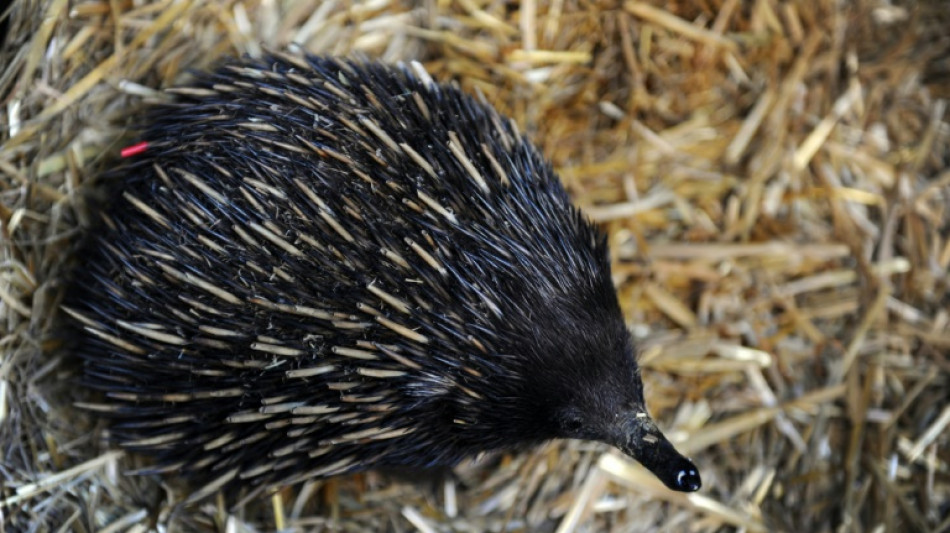
Study sheds light on origin of Australia's odd echidna / Photo: ROMEO GACAD - AFP

Study sheds light on origin of Australia's odd echidna

Australia's burrowing echidna evolved from a water-dwelling ancestor in an "extremely rare" biological event, scientists said Tuesday in a new study of the peculiar egg-laying mammals.

Text size:

With powerful digging claws, protective spikes and highly sensitive beaks, echidnas are well suited to a life shuffling through the forest undergrowth.

But a team of Australian and international scientists believe many of the echidna's unusual traits were first developed millions of years ago when its ancestors splashed through the water.

"We're talking about a semiaquatic mammal that gave up the water for a terrestrial existence," said paleontologist Suzanne Hand, from the University of New South Wales.

"While that would be an extremely rare event, we think that's what happened with echidnas."

Echidnas and another Australian oddity, the semi-aquatic platypus, are believed to have evolved from a common ancestor called Kryoryctes cadburyi that lived in Australia more than 100 million years ago.

Researchers studied the single known bone fragment left by this ancestor, which was discovered among a trove of fossils at Dinosaur Cove in southern Australia some 30 years ago.

Platypus bones were similar to this ancient ancestor, Hand said, with a thick and heavy structure that provided ballast for diving.

Echidnas, in comparison, had very thin bone walls that made it easier to walk on land, Hand said.

This indicated echidnas were descended from a water-dwelling ancestor but had evolved to live on land, the research found.

It was far more common for prehistoric mammals to go from land to water, Hand said, pointing towards seals, whales, dolphins and dugongs.

The researchers said these findings appeared to be supported by other echidna traits.

Echidnas have backward-facing hind feet that help them shift mounds of soil when burrowing.

These feet may have first developed as rudders helping the echidna's ancestor navigate fast-moving waterways, Hand said.

Echidnas also have a "diving reflex" when submerged in water, which tells their body to conserve oxygen helping them hold their breath for longer.

Echidnas and platypus are monotremes, a rare group of mammals that lay eggs instead of live young.

"We're hoping we'll discover other ancestral monotremes that will help unravel the early history of this most fascinating group of mammals," said study co-author Michael Archer.

The research was published in peer-reviewed journal PNAS.

M.Yamazaki--JT