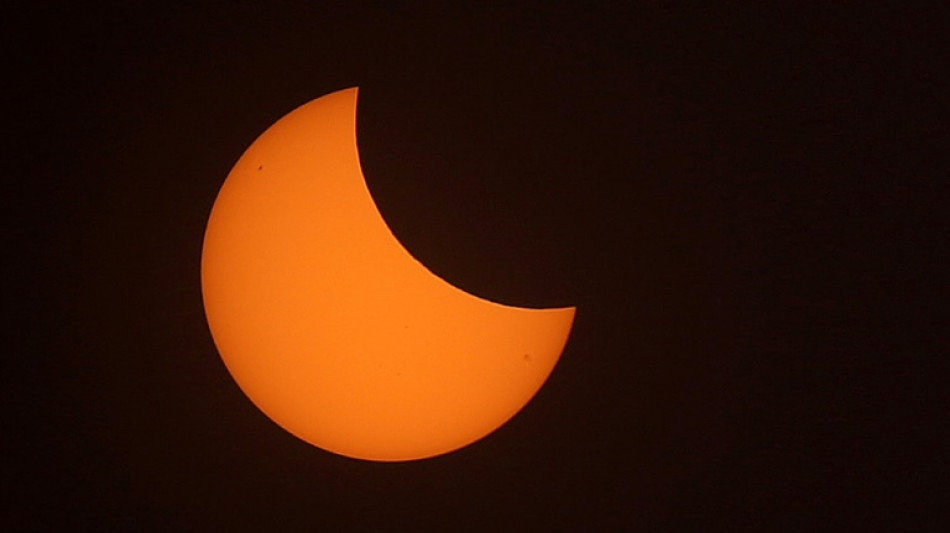
Partial solar eclipse to cross swathe of Northern Hemisphere / Photo: YASSER AL-ZAYYAT - AFP/File

Skygazers across a broad swathe of the Northern Hemisphere will have a chance to see the Moon take a bite out of the Sun on Saturday when a partial solar eclipse sweeps from eastern Canada to Siberia.
The partial eclipse, which is the first of the year and the 17th this century, will last around four hours from 0850 GMT to 1243 GMT.
Curious observers making sure to protect their eyes might be able to see the celestial show in most of Europe, as well as in some areas of northeastern North America and northwest Africa.
Eclipses occur when the Sun, Moon and Earth all line up. When they perfectly align for a total solar eclipse, the Moon fully blots out the Sun's disc, creating an eerie twilight here on Earth.
But that will not happen during Saturday's partial eclipse, which will instead turn the Sun into a crescent.
"The alignment is not perfect enough for the cone of shadow to touch the Earth's surface," Paris Observatory astronomer Florent Deleflie told AFP.
Because that shadow will "remain in space, there will not be a total eclipse anywhere" on Earth, he said.
At most, the Moon will cover around 90 percent of the Sun's disc. The best view will be from northeastern Canada and Greenland at the peak time of 1047 GMT.
- Beware eye damage -
It will be less spectacular in other areas. In France, for example, between 10 to 30 percent of the Sun's disc will be obscured, depending on the region.
Ireland will see around 40 percent, according to Sophie Murray of the Dublin Institute of Advanced Studies. However rain is forecast.
These smaller percentages of eclipse will not be visible to the naked eye.
However, if the sky is clear, skygazers will be able to watch the eclipse through special viewers -- as long as they take precautions.
Looking straight at the Sun -- during an eclipse or otherwise -- can lead to irreversible vision loss.
Skygazers are advised to buy eclipse-viewing glasses and ensure they are in good condition.
Even a slight defect or "microscopic hole" can cause eye damage, Deleflie warned.
Or, people could watch the eclipse at a local astronomy observation centre where "you can safely verify the precision of celestial mechanics and marvel at interesting details on the Sun's surface, such as sunspots", Deleflie said.
Murray offered another option.
"You can make a simple pinhole projector by poking a small hole in a piece of paper or cardboard and letting sunlight pass through it onto the ground or another surface, where you'll see a small, inverted image of the eclipsed Sun," she said.
The partial eclipse will not turn up on a smartphone camera without a suitable filter, Deleflie added.
The latest celestial show comes two weeks after skygazers across much of the world marvelled at a rare total lunar eclipse, dubbed a "Blood Moon".
These events often happen after each other because the Moon has "completed a half-circle around the Earth in the meantime, reversing the configuration", Deleflie explained.
A greater spectacle is expected on August 12, 2026, when a total solar eclipse will be visible in Iceland, northern Spain and parts of Portugal.
More than 90 percent of the Sun will also be obscured in areas of Europe including Britain, France and Italy.
It will be the first total solar eclipse since one swept across North America in April 2024.
T.Ueda--JT