The Japan Times - Oxygen detected in most distant galaxy: 'astonished' astronomers

EUR -
AED 4.381992
AFN 78.750894
ALL 96.772834
AMD 453.127673
ANG 2.135904
AOA 1094.155023
ARS 1723.006224
AUD 1.703048
AWG 2.147741
AZN 2.027312
BAM 1.958039
BBD 2.409237
BDT 146.15714
BGN 2.003807
BHD 0.449939
BIF 3543.827792
BMD 1.193189
BND 1.513334
BOB 8.264659
BRL 6.197065
BSD 1.196143
BTN 110.049154
BWP 15.598819
BYN 3.379033
BYR 23386.513916
BZD 2.405733
CAD 1.613288
CDF 2693.62495
CHF 0.916376
CLF 0.025958
CLP 1024.95004
CNY 8.290757
CNH 8.289248
COP 4358.721191
CRC 591.863639
CUC 1.193189
CUP 31.619521
CVE 110.393555
CZK 24.34441
DJF 213.004295
DKK 7.467153
DOP 75.15697
DZD 154.308073
EGP 56.001272
ERN 17.897842
ETB 185.122907
FJD 2.620781
FKP 0.864978
GBP 0.867162
GEL 3.215635
GGP 0.864978
GHS 13.067272
GIP 0.864978
GMD 87.697079
GNF 10497.500171
GTQ 9.177688
GYD 250.242459
HKD 9.315768
HNL 31.595737
HRK 7.533438
HTG 156.800337
HUF 381.275947
IDR 20028.222449
ILS 3.690338
IMP 0.864978
INR 109.703873
IQD 1563.674821
IRR 50263.107265
ISK 144.99605
JEP 0.864978
JMD 187.688003
JOD 0.845975
JPY 183.732053
KES 154.243589
KGS 104.344067
KHR 4800.801608
KMF 491.594467
KPW 1073.96939
KRW 1718.932363
KWD 0.365955
KYD 0.996727
KZT 600.839544
LAK 25677.437566
LBP 107117.524012
LKR 370.074058
LRD 221.3444
LSL 18.780413
LTL 3.523179
LVL 0.721749
LYD 7.487269
MAD 10.834074
MDL 20.11961
MGA 5321.625216
MKD 61.62671
MMK 2505.752956
MNT 4256.95142
MOP 9.615976
MRU 47.572579
MUR 54.20683
MVR 18.434798
MWK 2072.570214
MXN 20.625111
MYR 4.698727
MZN 76.065949
NAD 18.864464
NGN 1658.366152
NIO 43.187477
NOK 11.432366
NPR 176.101211
NZD 1.969586
OMR 0.458787
PAB 1.196098
PEN 3.989425
PGK 5.083586
PHP 70.333154
PKR 333.88428
PLN 4.210294
PYG 8026.784566
QAR 4.344522
RON 5.097187
RSD 117.389486
RUB 90.086234
RWF 1733.107728
SAR 4.475517
SBD 9.614842
SCR 16.593195
SDG 717.661496
SEK 10.535953
SGD 1.512051
SHP 0.895201
SLE 29.08404
SLL 25020.586042
SOS 681.867426
SRD 45.34538
STD 24696.61331
STN 24.609533
SVC 10.465837
SYP 13196.168479
SZL 18.855865
THB 37.48407
TJS 11.171609
TMT 4.188095
TND 3.373445
TOP 2.872914
TRY 51.903862
TTD 8.118318
TWD 37.534758
TZS 3072.463155
UAH 51.192889
UGX 4254.972804
USD 1.193189
UYU 45.262709
UZS 14550.945781
VES 437.717685
VND 30924.48849
VUV 142.715687
WST 3.23879
XAF 656.694211
XAG 0.011511
XAU 0.000235
XCD 3.224654
XCG 2.155638
XDR 0.816792
XOF 653.27021
XPF 119.331742
YER 284.461217
ZAR 19.03704
ZMK 10740.145808
ZMW 23.653834
ZWL 384.206528
  • SCS

    0.0200

    16.14

    +0.12%

  • RBGPF

    1.3800

    83.78

    +1.65%

  • CMSC

    0.0100

    23.71

    +0.04%

  • NGG

    0.3900

    85.07

    +0.46%

  • RYCEF

    -0.0700

    16.88

    -0.41%

  • RELX

    -1.2100

    36.17

    -3.35%

  • GSK

    0.5600

    50.66

    +1.11%

  • RIO

    1.7600

    95.13

    +1.85%

  • BCE

    0.2200

    25.49

    +0.86%

  • CMSD

    0.0392

    24.09

    +0.16%

  • BCC

    -0.5500

    80.3

    -0.68%

  • AZN

    -0.6300

    92.59

    -0.68%

  • JRI

    -0.0500

    12.94

    -0.39%

  • VOD

    0.1400

    14.71

    +0.95%

  • BTI

    0.0600

    60.22

    +0.1%

  • BP

    0.3400

    38.04

    +0.89%

Oxygen detected in most distant galaxy: 'astonished' astronomers
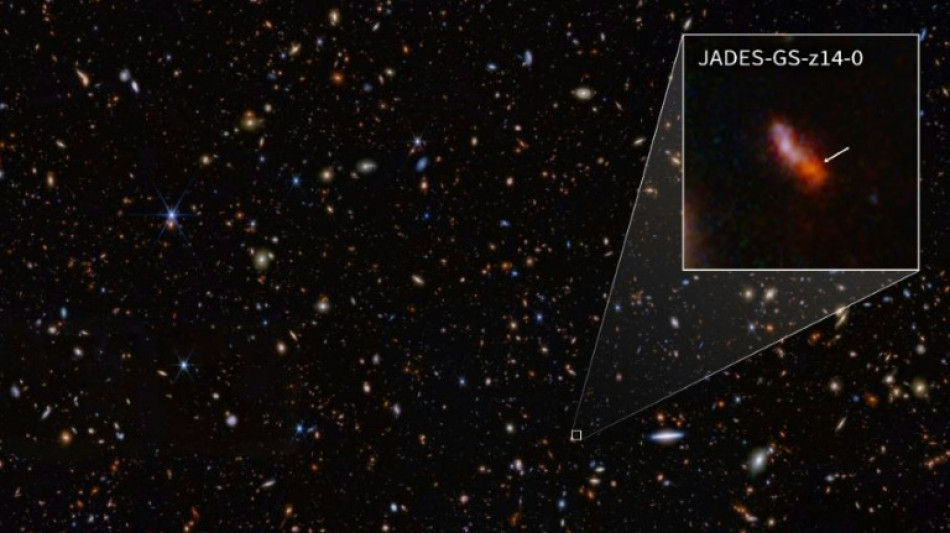
Oxygen detected in most distant galaxy: 'astonished' astronomers / Photo: HANDOUT - ESA, NASA, CSA, STScI/AFP/File

Oxygen detected in most distant galaxy: 'astonished' astronomers

Oxygen has been detected in the most distant galaxy ever discovered, surprised astronomers said Thursday, offering further evidence that stars in the early universe matured far quicker than had been thought possible.

Text size:

The galaxy JADES-GS-z14-0, which was discovered by the James Webb Space Telescope last year, is so far away that its light took 13.4 billion years to reach Earth.

This means the galaxy can also reveal what the universe was like in its infancy, when it was just 300 million years old -- two percent of its current age.

Since coming online in 2022, the powerful Webb telescope has discovered that galaxies in the young universe were much brighter, more advanced and more numerous than scientists had expected.

These discoveries have been so startling they have raised doubts about whether something important is missing in our understanding of the universe.

For the latest research, two international teams led by Dutch and Italian astronomers probed the JADES-GS-z14-0 galaxy using the ALMA radio telescope in Chile's Atacama desert.

They detected traces of oxygen, according to the European Southern Observatory, confirming hints previously spotted by the Webb telescope.

During this period known as the cosmic dawn, newly born galaxies were thought to only have young stars, which mostly contain light elements like hydrogen and helium.

Only later were they supposed to get heavier stuff such as oxygen.

But the two new studies found that JADES-GS-z14-0 has around 10 times more heavy elements than had been anticipated.

"It is like finding an adolescent where you would only expect babies," said Sander Schouws of Leiden Observatory, the first author of a Dutch-led study to be published in The Astrophysical Journal.

"The results show the galaxy has formed very rapidly and is also maturing rapidly, adding to a growing body of evidence that the formation of galaxies happens much faster than was expected," he said in a statement.

Astrophysicist Stefano Carniani, lead author of the Italian-led paper to be published in Astronomy & Astrophysics, said he was "astonished by the unexpected results".

"The evidence that a galaxy is already mature in the infant universe raises questions about when and how galaxies formed."

M.Yamazaki--JT