The Japan Times - Webb telescope directly observes exoplanet CO2 for first time

EUR -
AED 4.234484
AFN 75.525959
ALL 93.496795
AMD 423.119596
AOA 1058.346472
ARS 1725.074788
AUD 1.637107
AWG 2.07519
AZN 1.962632
BAM 1.957691
BBD 2.321202
BDT 142.667793
BHD 0.434694
BIF 3451.156725
BMD 1.152883
BND 1.478828
BOB 13.997155
BRL 5.933088
BSD 1.152493
BTN 109.987798
BWP 15.672137
BYN 3.396781
BYR 22596.516387
BZD 2.317939
CAD 1.62145
CDF 2605.516696
CHF 0.933282
CLF 0.026714
CLP 1054.808019
CNY 7.786056
CNH 7.779885
COP 3695.729428
CRC 522.595673
CUC 1.152883
CUP 30.551412
CVE 110.849957
CZK 24.182763
DJF 204.890551
DKK 7.475254
DOP 67.338982
DZD 153.235527
EGP 57.852662
ERN 17.293252
ETB 184.288964
FJD 2.550121
FKP 0.858174
GBP 0.857162
GEL 3.01479
GGP 0.858174
GHS 13.506006
GIP 0.858174
GMD 85.313246
GNF 10128.081128
GTQ 8.79049
GYD 241.279896
HKD 9.04172
HNL 30.966965
HRK 7.532253
HTG 150.684228
HUF 361.377671
IDR 20717.3163
ILS 3.472278
IMP 0.858174
INR 109.631553
IQD 1510.277371
IRR 1585358.908276
ISK 141.816466
JEP 0.858174
JMD 182.225999
JOD 0.817348
JPY 181.890788
KES 149.159955
KGS 100.819916
KHR 4669.178288
KMF 493.43364
KRW 1648.703679
KWD 0.356749
KYD 0.960407
KZT 542.922598
LAK 26055.16697
LBP 103240.716136
LKR 386.953731
LRD 208.989005
LSL 19.057421
LTL 3.404166
LVL 0.697367
LYD 7.338106
MAD 10.747153
MDL 20.174047
MGA 4951.634462
MKD 61.589485
MMK 2420.670883
MNT 4132.279507
MOP 9.310891
MRU 46.241692
MUR 53.615768
MVR 17.823439
MWK 2002.558271
MXN 19.905456
MYR 4.72314
MZN 73.666005
NAD 19.056776
NGN 1571.829631
NIO 42.410962
NOK 11.003869
NPR 175.98297
NZD 1.95845
OMR 0.44329
PAB 1.152513
PEN 3.913466
PGK 5.095683
PHP 70.32012
PKR 320.299843
PLN 4.29691
PYG 6871.666662
QAR 4.203125
RON 5.251268
RSD 117.365836
RUB 92.949
RWF 1692.432962
SAR 4.31666
SBD 9.305103
SCR 16.068725
SDG 692.305155
SEK 10.995131
SGD 1.478225
SLE 28.187833
SOS 658.63613
SRD 43.683906
STD 23862.360563
STN 24.902283
SVC 10.08474
SZL 19.057047
THB 38.344766
TJS 10.637436
TMT 4.035092
TND 3.390648
TRY 54.820534
TTD 7.824557
TWD 37.364032
TZS 3060.903378
UAH 51.534073
UGX 4316.093737
USD 1.152883
UYU 46.43505
UZS 13850.742055
VES 848.697257
VND 30278.755517
VUV 137.358929
WST 3.149926
XAF 656.591155
XAG 0.01936
XAU 0.000283
XCD 3.115725
XCG 2.077106
XDR 0.817519
XOF 654.286731
XPF 119.331742
YER 274.844616
ZAR 18.901156
ZMK 10377.338487
ZMW 21.807658
ZWL 371.228013
  • CMSC

    0.0300

    21.79

    +0.14%

  • RBGPF

    3.9500

    69.95

    +5.65%

  • BCC

    3.4600

    86.49

    +4%

  • BCE

    0.2100

    22

    +0.95%

  • RIO

    3.1100

    99.01

    +3.14%

  • JRI

    -0.1000

    12.72

    -0.79%

  • NGG

    0.5600

    80.42

    +0.7%

  • CMSD

    0.0000

    22.02

    0%

  • GSK

    0.0200

    51.53

    +0.04%

  • RELX

    0.6400

    36.8

    +1.74%

  • RYCEF

    0.1500

    20.35

    +0.74%

  • BTI

    -0.4400

    59.12

    -0.74%

  • VOD

    0.0800

    15.69

    +0.51%

  • AZN

    -2.3500

    155.62

    -1.51%

  • BP

    -1.8200

    42.44

    -4.29%

Webb telescope directly observes exoplanet CO2 for first time
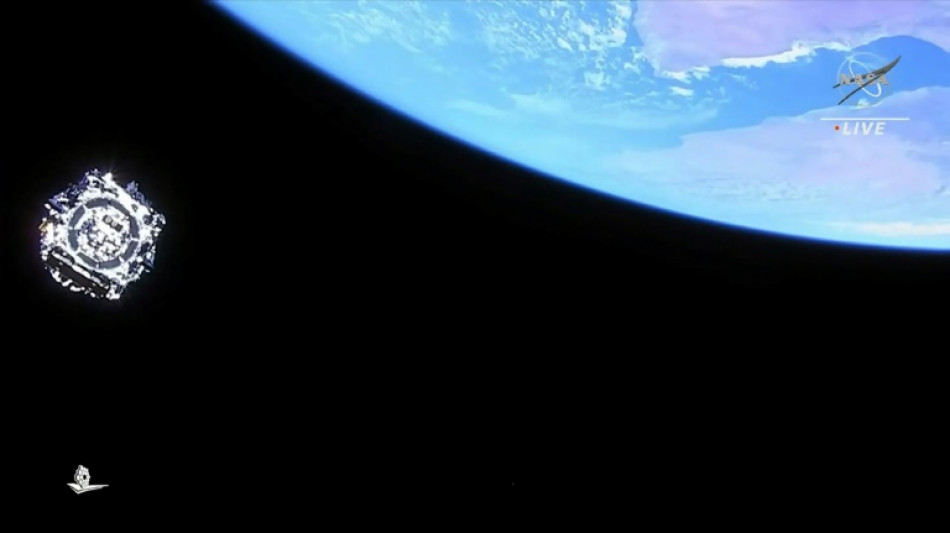
Webb telescope directly observes exoplanet CO2 for first time / Photo: - - NASA TV/AFP/File

Webb telescope directly observes exoplanet CO2 for first time

The James Webb Space Telescope has directly observed the key chemical of carbon dioxide in planets outside of our solar system for the first time, scientists announced Monday.

Text size:

The gas giants are not capable of hosting extraterrestrial life, but do offer clues in a lingering mystery about how distant planets form, according to a study in The Astrophysical Journal.

The HR 8799 system, 130 light years from Earth, is only 30 million years old -- just a baby compared to our solar system's 4.6 billion years.

A US-led team of researchers used Webb to directly detect carbon dioxide in the atmosphere of all four of the system's known planets, according to the study.

They used Webb's coronagraph instruments, which block the light from bright stars to get a better view of the planets revolving around them.

"It's like putting your thumb up in front of the Sun when you're looking up at the sky," lead study author William Balmer, an astrophysicist at Johns Hopkins University, told AFP.

Normally, the Webb telescope only detects exoplanets by glimpsing them when they cross in front of their host star.

This "transiting method" was how Webb indirectly detected CO2 in the atmosphere of the gas giant WASP-39 in 2022.

But for latest discovery, "we're actually seeing the light that is emitted from the planet itself, as opposed to the fingerprint of that light from the host star," Balmer said.

This is not easy -- Balmer compared the process to using a torch to spot fireflies next to a lighthouse.

While these gas giants may not be able to host life, it is possible that they had moons that could, he added.

There are missions currently under way to find out if there could be life in the vast oceans underneath the icy shells of several of Jupiter's moons.

- 'Key piece of proof' -

Carbon dioxide (CO2) is essential for life on Earth, making it a key target in the search for life elsewhere.

Because CO2 condenses into little ice particles in the deep cold of space, its presence can shed light on planetary formation.

Jupiter and Saturn are believed to have first formed from a "bottom up" process in which a bunch of tiny, icy particles came together into a solid core which then sucked in gas to grow into giants, Balmer said.

So the new discovery is a "key piece of proof" that far-off planets can form in a similar way to those in our celestial backyard, Balmer said.

But how common this is throughout the universe remains unclear.

Astronomers have now discovered nearly 6,000 exoplanets, many of them massive -- and none of them known to be habitable.

The "huge leap forward we need to make" is to focus on smaller Earth-sized worlds, Balmer said.

NASA's Nancy Grace Roman space telescope will use a coronagraph to do that just after its planned launch in 2027.

Balmer hopes to use Webb to observe more four-planet systems, but added that future funding was now in question.

Last week the Trump administration announced that NASA's chief scientist has been dismissed, indicating that more cuts were to come for the US space agency.

T.Sasaki--JT