Private US spaceship lands near Moon's south pole in uncertain condition / Photo: HANDOUT - Intuitive Machines, LLC/AFP

A US company's spaceship touched down on the Moon on Thursday, but its condition -- including whether it landed upright -- remains uncertain.
Houston-based Intuitive Machines made history last year as the first private firm to achieve a lunar landing, though the moment was overshadowed when its lander ended up on its side.
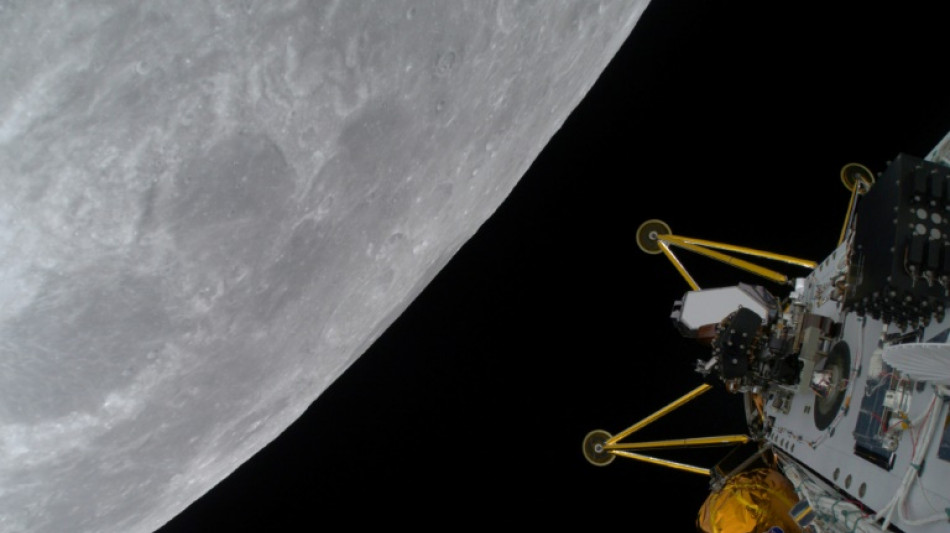
For the company's second attempt, it sent the 15.6-foot (4.8-meter) tall hexagonal Athena lander to the vast Mons Mouton plateau -- closer to the lunar south pole than any mission before it.
They were aiming for a 12:32 pm ET (1732 GMT) touchdown, and mission control teams looked downcast as they worked to confirm the outcome.
Twenty minutes past the scheduled landing time, company spokesman Josh Marshall announced on a webcast: "Athena is on the surface of the Moon." However, teams were still analyzing incoming data to assess the lander's status, and attempting to retrieve an image.
"We are working to figure out the orientation of the vehicle," Marshall added, before the live feed abruptly ended.
The mission is designed to test an array of advanced technologies that could support future crewed lunar missions -- including an ice-drilling system, a 4G network experiment, three rovers, and a first-of-its-kind hopping drone.
The pressure was high after Texas rival Firefly Aerospace successfully landed its Blue Ghost lander on the Moon just days earlier, on Sunday.
Both missions are part of US space agency NASA's $2.6-billion Commercial Lunar Payload Services (CLPS) program, which aims to leverage private industry to reduce costs and support Artemis -- NASA's effort to return astronauts to the Moon and, eventually, reach Mars.
- A hopper named Grace -
Athena aims to deploy three rovers and a unique hopping drone named Grace, named after late computer science pioneer Grace Hopper.
One of Grace's boldest objectives is a hop into a permanently shadowed crater, a place where sunlight has never shone -- a first for humanity.
While NASA's Ingenuity helicopter proved flight is possible on Mars, the Moon's lack of atmosphere makes traditional flying impossible, positioning hoppers like Grace as a key technology for future exploration.
MAPP, the largest of Athena's rovers and roughly the size of a beagle, will assist in testing a Nokia Bell Labs 4G cellular network linking it with the lander and Grace -- technology designed to one day integrate into astronaut spacesuits.
There's also a more compact, tablet-sized rover from Japanese company Dymon, and a tiny AstroAnt rover, equipped with magnetic wheels to cling to MAPP and use its sensors to measure temperature variations.
Also aboard Athena is PRIME-1, a NASA instrument carrying a drill to search for ice and other chemicals beneath the lunar surface, paired with a spectrometer to analyze its findings.
- Sticking the landing -
Lunar landings are notoriously difficult. The Moon's lack of atmosphere rules out parachutes and forces spacecraft to rely on precise thrusts and navigation over hazardous terrain.
Until Intuitive Machines' first mission, only national space agencies had achieved the feat, with NASA's last landing dating back to Apollo 17 in 1972.
The company's first lander, Odysseus, came in too fast, caught a foot on the surface and toppled over, cutting the mission short when its solar panels could not generate enough power.
This time, the company said it had made critical upgrades, including better cabling for the laser altimeter, which provides altitude and velocity readings to ensure a safe touchdown.
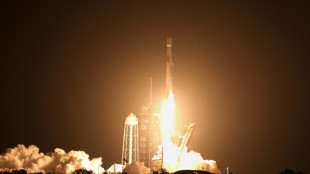
Athena launched last Wednesday aboard a SpaceX Falcon 9 rocket, which also carried NASA's Lunar Trailblazer probe, which has also faced problems.
Ground controllers are struggling to re-establish contact with the small satellite, designed to map the Moon's water distribution.
These missions come at a delicate time for NASA, amid speculation that the agency may scale back or even cancel the crewed Moon missions in favor of prioritizing Mars -- a goal championed by President Donald Trump and his billionaire advisor Elon Musk.
T.Shimizu--JT