The Japan Times - Study reveals how Earth's orbit controls ice ages

EUR -
AED 4.235825
AFN 75.545802
ALL 93.537535
AMD 423.305618
AOA 1058.811708
ARS 1726.050045
AUD 1.636636
AWG 2.076101
AZN 1.961033
BAM 1.95855
BBD 2.32222
BDT 142.730393
BHD 0.434886
BIF 3452.671024
BMD 1.153389
BND 1.479477
BOB 14.003296
BRL 5.934074
BSD 1.152999
BTN 110.036059
BWP 15.679013
BYN 3.398271
BYR 22606.431288
BZD 2.318956
CAD 1.622248
CDF 2606.660577
CHF 0.933046
CLF 0.026726
CLP 1055.304781
CNY 7.789473
CNH 7.782898
COP 3701.468641
CRC 522.824977
CUC 1.153389
CUP 30.564818
CVE 110.898381
CZK 24.174001
DJF 204.980328
DKK 7.474932
DOP 67.343891
DZD 153.308454
EGP 57.874195
ERN 17.30084
ETB 184.37006
FJD 2.552393
FKP 0.858551
GBP 0.857378
GEL 3.016125
GGP 0.858551
GHS 13.511962
GIP 0.858551
GMD 85.350816
GNF 10132.525167
GTQ 8.794347
GYD 241.385765
HKD 9.045745
HNL 30.980157
HRK 7.535899
HTG 150.750346
HUF 360.8921
IDR 20725.88762
ILS 3.473801
IMP 0.858551
INR 109.684501
IQD 1510.94005
IRR 1586054.532116
ISK 141.797162
JEP 0.858551
JMD 182.305956
JOD 0.817769
JPY 181.856081
KES 149.249433
KGS 100.863577
KHR 4671.226492
KMF 493.651222
KRW 1647.050939
KWD 0.356917
KYD 0.960828
KZT 543.160821
LAK 26066.599277
LBP 103286.016357
LKR 387.123519
LRD 209.080658
LSL 19.065344
LTL 3.405659
LVL 0.697674
LYD 7.341378
MAD 10.751869
MDL 20.182899
MGA 4953.807106
MKD 61.54284
MMK 2421.733025
MNT 4134.092669
MOP 9.314976
MRU 46.262325
MUR 53.621184
MVR 17.831455
MWK 2003.437477
MXN 19.901041
MYR 4.723245
MZN 73.697531
NAD 19.065769
NGN 1572.5428
NIO 42.429571
NOK 11.006044
NPR 176.060187
NZD 1.961494
OMR 0.443477
PAB 1.153019
PEN 3.915185
PGK 5.098267
PHP 70.350996
PKR 320.440363
PLN 4.295418
PYG 6874.681812
QAR 4.204969
RON 5.24954
RSD 117.355054
RUB 92.995645
RWF 1693.175568
SAR 4.318554
SBD 9.309186
SCR 15.476883
SDG 692.597559
SEK 10.979563
SGD 1.478288
SLE 28.200099
SOS 658.925127
SRD 43.703089
STD 23872.830891
STN 24.91321
SVC 10.089165
SZL 19.065835
THB 38.33829
TJS 10.642103
TMT 4.036863
TND 3.39216
TRY 54.866503
TTD 7.82799
TWD 37.381464
TZS 3062.246425
UAH 51.556685
UGX 4317.987553
USD 1.153389
UYU 46.455425
UZS 13856.819878
VES 849.069652
VND 30292.041232
VUV 137.419199
WST 3.151308
XAF 656.879254
XAG 0.019387
XAU 0.000283
XCD 3.117093
XCG 2.078018
XDR 0.817877
XOF 654.547231
XPF 119.331742
YER 274.974351
ZAR 18.891917
ZMK 10381.891222
ZMW 21.817226
ZWL 371.390901
  • CMSC

    0.0300

    21.79

    +0.14%

  • RYCEF

    0.1500

    20.35

    +0.74%

  • GSK

    0.0200

    51.53

    +0.04%

  • RBGPF

    3.9500

    69.95

    +5.65%

  • BTI

    -0.4400

    59.12

    -0.74%

  • RIO

    3.1100

    99.01

    +3.14%

  • AZN

    -2.3500

    155.62

    -1.51%

  • BCE

    0.2100

    22

    +0.95%

  • NGG

    0.5600

    80.42

    +0.7%

  • BP

    -1.8200

    42.44

    -4.29%

  • BCC

    3.4600

    86.49

    +4%

  • CMSD

    0.0000

    22.02

    0%

  • JRI

    -0.1000

    12.72

    -0.79%

  • RELX

    0.6400

    36.8

    +1.74%

  • VOD

    0.0800

    15.69

    +0.51%

Study reveals how Earth's orbit controls ice ages
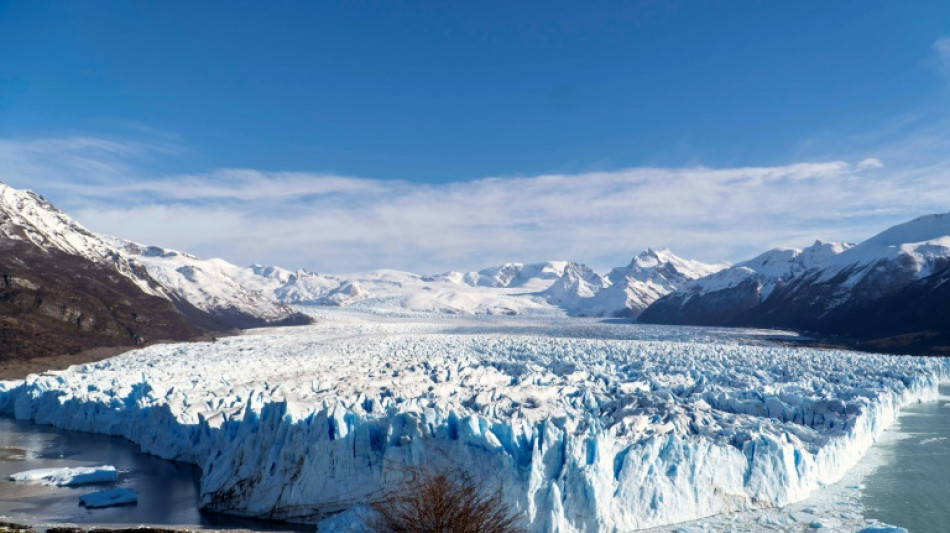
Study reveals how Earth's orbit controls ice ages / Photo: Walter Diaz - AFP

Study reveals how Earth's orbit controls ice ages

The Earth's next ice age is expected to begin in about 11,000 years -- unless human-caused global warming disrupts natural cycles.

Text size:

That's according to a new study published Thursday in Science, which analyzed how subtle shifts in Earth's orbit around the Sun have historically triggered massive climate changes.

A research team examined a million-year record of climate change, focusing on land-based ice sheets across the Northern Hemisphere and deep ocean temperatures.

They then paired this data with small but cyclical variations in Earth's orbital patterns.

"For many years, the difficulty in answering how small changes in Earth's orbit around the Sun translate to large shifts between glacial and interglacial states has been a central theme in paleoclimate research," lead author Stephen Barker, a professor at Cardiff University, told AFP.

Earth has long alternated between ice ages and warmer interglacial periods, with the last glaciation ending approximately 11,700 years ago. This transition marked the beginning of the Holocene epoch, an era of relative climate stability that enabled early human societies to shift from nomadic hunting and gathering to settled agriculture.

Scientists have long recognized a connection between Earth's orbit and ice ages. However, due to challenges in accurately dating climate changes that occurred so far in the past, they struggled to pinpoint which orbital parameters were responsible for starting and ending these glacial cycles.

According to Barker, the key breakthrough came from analyzing the "shape" of the ancient climate record -- the curves showing how temperatures rose and fell over time -- rather than just the timing of ice age transitions.

This approach allowed the team to determine how the three orbital factors -- tilt, wobble, and the shape of Earth's orbit around the Sun -- interact to drive ice age cycles over the past 900,000 years.

Barker said that without the Industrial Revolution, assuming fossil fuels had never been burned, "we would expect a glaciation to occur within the next 11,000 years, and it would end in 66,000 years' time."

Co-author Lorraine Lisiecki, a professor at the University of California, Santa Barbara, emphasized the significance of the study, stating that it "confirms the natural climate change cycles we observe on Earth over tens of thousands of years are largely predictable and not random or chaotic."

However, Barker strongly cautioned against interpreting the findings to suggest that human-caused climate change is beneficial.

Carbon dioxide levels have nearly doubled since the Industrial Revolution, and if emissions remain unchecked, "then in around 8,000 years' time, Antarctica would have melted, leading to around 70 meters of sea-level rise," said Barker.

"Instead of there being glaciers, you'll be underwater," he warned.

Looking ahead, the research team aims to expand on their findings by investigating the long-term impact of human-driven climate change and how it may reshape the planet's natural climate cycles.

M.Ito--JT