The Japan Times - Life's 'basic building blocks' found in asteroid samples

EUR -
AED 4.29132
AFN 74.203609
ALL 95.805414
AMD 433.4011
ANG 2.091481
AOA 1072.683853
ARS 1638.188454
AUD 1.635513
AWG 2.106222
AZN 1.985616
BAM 1.953101
BBD 2.353774
BDT 143.421198
BGN 1.949178
BHD 0.440993
BIF 3476.288379
BMD 1.1685
BND 1.49084
BOB 8.105799
BRL 5.801133
BSD 1.16865
BTN 111.08949
BWP 15.864078
BYN 3.305632
BYR 22902.60579
BZD 2.350851
CAD 1.591894
CDF 2706.246758
CHF 0.916396
CLF 0.027083
CLP 1065.929196
CNY 7.981149
CNH 7.986584
COP 4356.694927
CRC 531.363456
CUC 1.1685
CUP 30.965258
CVE 110.598731
CZK 24.400589
DJF 207.665735
DKK 7.472548
DOP 69.678194
DZD 154.723383
EGP 62.546481
ERN 17.527504
ETB 183.542149
FJD 2.573271
FKP 0.860275
GBP 0.863931
GEL 3.137447
GGP 0.860275
GHS 13.081357
GIP 0.860275
GMD 85.886397
GNF 10256.527946
GTQ 8.931861
GYD 244.512118
HKD 9.155872
HNL 31.117461
HRK 7.535193
HTG 152.947888
HUF 364.799928
IDR 20373.386901
ILS 3.452103
IMP 0.860275
INR 111.408203
IQD 1530.735387
IRR 1536577.888516
ISK 143.398483
JEP 0.860275
JMD 184.115578
JOD 0.828489
JPY 183.758944
KES 150.972215
KGS 102.150883
KHR 4688.022868
KMF 491.349122
KPW 1051.650263
KRW 1724.431853
KWD 0.360026
KYD 0.974054
KZT 542.160809
LAK 25663.184483
LBP 104465.362619
LKR 373.460733
LRD 214.565871
LSL 19.666146
LTL 3.450278
LVL 0.706815
LYD 7.402479
MAD 10.80515
MDL 20.122194
MGA 4855.118969
MKD 61.663486
MMK 2453.558203
MNT 4179.346411
MOP 9.430668
MRU 46.681467
MUR 54.860921
MVR 18.059139
MWK 2034.93947
MXN 20.461022
MYR 4.633061
MZN 74.679165
NAD 19.665886
NGN 1601.931692
NIO 42.907309
NOK 10.841901
NPR 177.741105
NZD 1.989903
OMR 0.449285
PAB 1.168885
PEN 4.096709
PGK 5.062529
PHP 72.106988
PKR 325.719728
PLN 4.256204
PYG 7265.959457
QAR 4.256826
RON 5.190447
RSD 117.422683
RUB 87.636497
RWF 1706.594681
SAR 4.384441
SBD 9.378229
SCR 15.60968
SDG 701.689458
SEK 10.869375
SGD 1.492529
SHP 0.872403
SLE 28.803202
SLL 24502.862465
SOS 667.79835
SRD 43.767328
STD 24185.596923
STN 24.713781
SVC 10.227823
SYP 129.148477
SZL 19.665661
THB 38.292338
TJS 10.940881
TMT 4.095594
TND 3.371707
TOP 2.813468
TRY 52.838293
TTD 7.939029
TWD 36.968998
TZS 3049.786129
UAH 51.502231
UGX 4386.05699
USD 1.1685
UYU 47.074949
UZS 14019.666522
VES 571.329748
VND 30758.433277
VUV 138.793042
WST 3.172698
XAF 655.05181
XAG 0.015991
XAU 0.000257
XCD 3.157931
XCG 2.106689
XDR 0.812844
XOF 652.608671
XPF 119.331742
YER 278.833394
ZAR 19.63285
ZMK 10517.907557
ZMW 21.887754
ZWL 376.256618
  • RBGPF

    1.6000

    64.7

    +2.47%

  • CMSD

    -0.0300

    23.25

    -0.13%

  • RELX

    0.0100

    36.36

    +0.03%

  • CMSC

    -0.0100

    22.87

    -0.04%

  • RIO

    -1.9500

    98.63

    -1.98%

  • NGG

    -0.9800

    87.5

    -1.12%

  • GSK

    -0.7100

    50.9

    -1.39%

  • RYCEF

    -0.0200

    16.33

    -0.12%

  • BCC

    -3.8000

    74.33

    -5.11%

  • BCE

    -0.0300

    23.93

    -0.13%

  • JRI

    -0.0500

    12.93

    -0.39%

  • BTI

    -0.3600

    58.35

    -0.62%

  • VOD

    -0.1000

    16.05

    -0.62%

  • BP

    0.5300

    46.94

    +1.13%

  • AZN

    -1.2800

    183.46

    -0.7%

Life's 'basic building blocks' found in asteroid samples
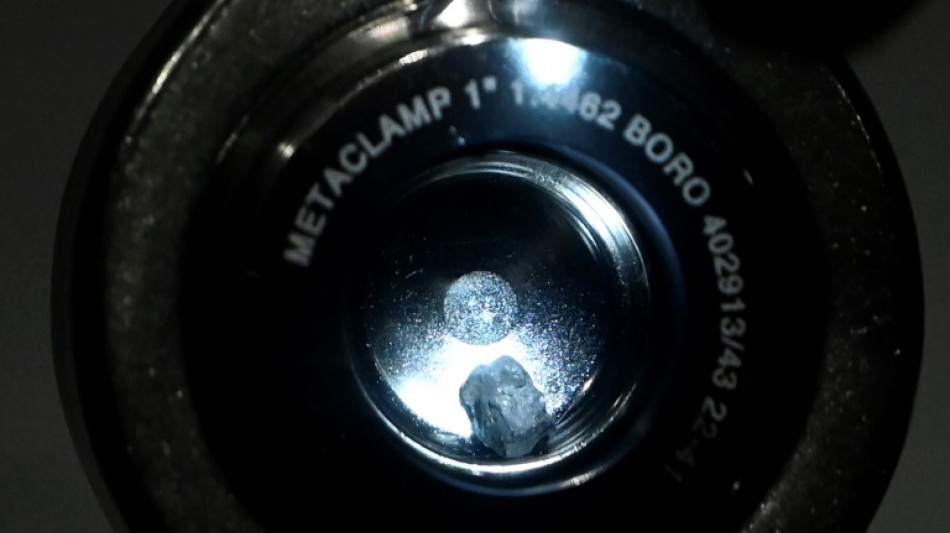
Life's 'basic building blocks' found in asteroid samples / Photo: OLIVIER DOULIERY - AFP

Life's 'basic building blocks' found in asteroid samples

Pristine samples of the asteroid Bennu transported to Earth contain the "basic building blocks" for life, shedding new light on the perennial question of how life began on our planet.

Text size:

The revelation, in two studies published Wednesday, is the result of work on just 120 grams of material -- about the weight of a banana -- collected from Bennu by NASA's OSIRIS-REx spacecraft in 2020.

The samples from Bennu, then around 300 million kilometres (186 million miles) from Earth, were returned in a capsule that OSIRIS-REx dropped off during a pass-by in 2023.

Initial analysis had already revealed evidence of high-carbon content and water.

But the new research found that evaporated water on Bennu's parent asteroid left behind "the raw ingredients of life", said Tim McCoy, curator of meteorites at the Smithsonian's National Museum of Natural History and co-lead author of one of the studies.

"We have discovered that next step on a pathway to life," he said in a press release issued by the museum.

Bennu appears to have formed around 65 million years ago from the debris of a parent asteroid dating back some 4.5 billion years.

The findings suggest Bennu's parent was once home to pockets of liquid water. When these evaporated, they left behind a "briny broth" of salts and minerals.

Some of the minerals include compounds that have never been seen in samples from outer space, the museum said.

And analysis of the samples strongly suggests a "non-terrestrial origin", adds one of the studies.

That could lend support to the theory that life on Earth was seeded from outer space.

- 'Unprecedented insight' -

The samples "give unprecedented insight into the processes that drove the formation of the Solar System," according to Yasuhito Sekine, a professor at the Institute of Science Tokyo.

"This discovery was only possible by analysing samples that were collected directly from the asteroid then carefully preserved back on Earth," he added.

"The salts would otherwise have rapidly absorbed moisture in the Earth's humid atmosphere."

The researchers believe similar salty brines may exist on other extraterrestrial bodies, including the dwarf planet Ceres and Saturn's moon Enceladus, as well as other asteroids.

They plan to reexamine specimens already on Earth for traces of compounds that previous research might have missed.

"Even though asteroid Bennu has no life, the question is could other icy bodies harbour life?" said Nick Timms, an associate professor at Curtin University's School of Earth and Planetary Sciences also involved in the research.

Much about life's origin remains unclear despite the secrets revealed from Bennu, McCoy cautioned.

"We now know we have the basic building blocks to move along this pathway towards life, but we don't know how far along that pathway this environment could allow things to progress," he said.

Still, Sara Russell, co-lead author with McCoy and a cosmic mineralogist at the museum, said the research had made "huge progress in understanding how asteroids like Bennu evolved, and how they may have helped make the Earth habitable".

S.Yamamoto--JT