The Japan Times - NASA eyes SpaceX, Blue Origin to cut Mars rock retrieval costs

EUR -
AED 4.291853
AFN 74.20555
ALL 95.817815
AMD 433.455649
ANG 2.091744
AOA 1072.818501
ARS 1638.506826
AUD 1.632748
AWG 2.106487
AZN 1.990357
BAM 1.953347
BBD 2.35407
BDT 143.439249
BGN 1.949423
BHD 0.441046
BIF 3476.725911
BMD 1.168647
BND 1.491028
BOB 8.106819
BRL 5.803267
BSD 1.168797
BTN 111.103472
BWP 15.866075
BYN 3.306048
BYR 22905.488356
BZD 2.351147
CAD 1.591388
CDF 2706.587474
CHF 0.915754
CLF 0.027087
CLP 1066.063434
CNY 7.982153
CNH 7.984544
COP 4357.243268
CRC 531.430334
CUC 1.168647
CUP 30.969155
CVE 110.612191
CZK 24.389204
DJF 207.691682
DKK 7.472507
DOP 69.652174
DZD 154.919394
EGP 62.777052
ERN 17.52971
ETB 183.565314
FJD 2.569626
FKP 0.860383
GBP 0.863052
GEL 3.137761
GGP 0.860383
GHS 13.083022
GIP 0.860383
GMD 85.895285
GNF 10257.799024
GTQ 8.932985
GYD 244.542893
HKD 9.157094
HNL 31.121083
HRK 7.532867
HTG 152.967138
HUF 363.833773
IDR 20359.181045
ILS 3.445114
IMP 0.860383
INR 111.424699
IQD 1530.928048
IRR 1536771.285057
ISK 143.404361
JEP 0.860383
JMD 184.138751
JOD 0.828586
JPY 184.014633
KES 150.9308
KGS 102.163736
KHR 4688.613046
KMF 491.418383
KPW 1051.782626
KRW 1722.925073
KWD 0.360066
KYD 0.974177
KZT 542.229047
LAK 25666.412509
LBP 104478.510829
LKR 373.507738
LRD 214.592902
LSL 19.668377
LTL 3.450711
LVL 0.706903
LYD 7.403358
MAD 10.806479
MDL 20.124727
MGA 4855.72974
MKD 61.629324
MMK 2453.867013
MNT 4179.872431
MOP 9.431855
MRU 46.687326
MUR 54.867673
MVR 18.061438
MWK 2035.196284
MXN 20.443791
MYR 4.630763
MZN 74.688328
NAD 19.668818
NGN 1601.502687
NIO 42.912313
NOK 10.821663
NPR 177.763476
NZD 1.988226
OMR 0.449351
PAB 1.169032
PEN 4.097227
PGK 5.063165
PHP 71.926154
PKR 325.76083
PLN 4.254285
PYG 7266.873964
QAR 4.257374
RON 5.198375
RSD 117.379233
RUB 88.062485
RWF 1706.809477
SAR 4.384993
SBD 9.37941
SCR 15.611293
SDG 701.776103
SEK 10.848785
SGD 1.492579
SHP 0.872513
SLE 28.807263
SLL 24505.946442
SOS 667.878202
SRD 43.77288
STD 24188.640968
STN 24.716892
SVC 10.22911
SYP 129.164732
SZL 19.668031
THB 38.261526
TJS 10.942258
TMT 4.096109
TND 3.372136
TOP 2.813823
TRY 52.845082
TTD 7.940029
TWD 36.926332
TZS 3035.574024
UAH 51.508713
UGX 4386.609027
USD 1.168647
UYU 47.080874
UZS 14021.431015
VES 571.401656
VND 30757.045679
VUV 138.810511
WST 3.173098
XAF 655.134256
XAG 0.015865
XAU 0.000256
XCD 3.158328
XCG 2.106954
XDR 0.812946
XOF 652.69255
XPF 119.331742
YER 278.868447
ZAR 19.623401
ZMK 10519.232616
ZMW 21.890509
ZWL 376.303975
  • JRI

    -0.0500

    12.93

    -0.39%

  • BCC

    -3.8000

    74.33

    -5.11%

  • RIO

    -1.9500

    98.63

    -1.98%

  • NGG

    -0.9800

    87.5

    -1.12%

  • AZN

    -1.2800

    183.46

    -0.7%

  • BTI

    -0.3600

    58.35

    -0.62%

  • CMSD

    -0.0300

    23.25

    -0.13%

  • CMSC

    -0.0100

    22.87

    -0.04%

  • BCE

    -0.0300

    23.93

    -0.13%

  • GSK

    -0.7100

    50.9

    -1.39%

  • RBGPF

    1.6000

    64.7

    +2.47%

  • RYCEF

    -0.0200

    16.33

    -0.12%

  • VOD

    -0.1000

    16.05

    -0.62%

  • RELX

    0.0100

    36.36

    +0.03%

  • BP

    0.5300

    46.94

    +1.13%

NASA eyes SpaceX, Blue Origin to cut Mars rock retrieval costs
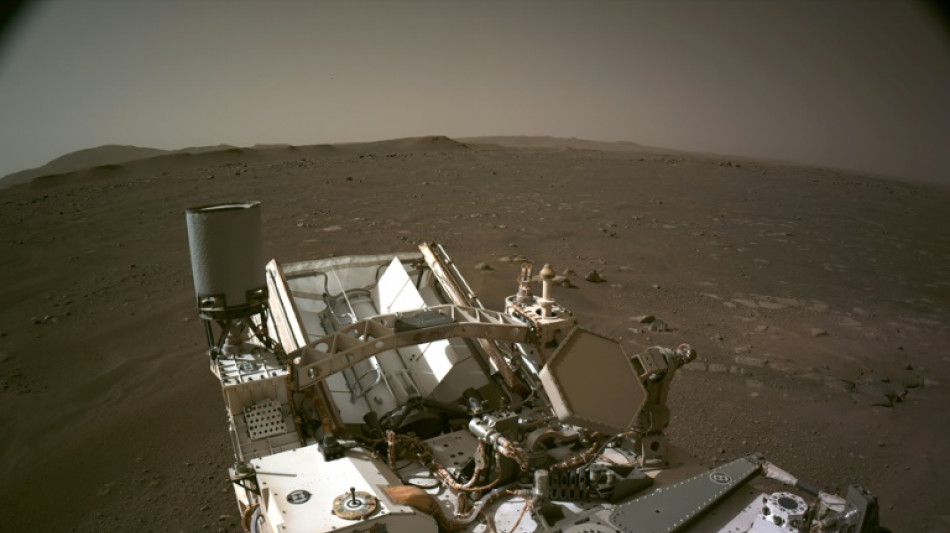
NASA eyes SpaceX, Blue Origin to cut Mars rock retrieval costs / Photo: Handout - NASA/JPL-CALTECH/AFP/File

NASA eyes SpaceX, Blue Origin to cut Mars rock retrieval costs

NASA announced Tuesday it may turn to Elon Musk's SpaceX or Jeff Bezos's Blue Origin to help reduce the soaring costs of returning Martian rocks collected by the Perseverance rover to Earth.

Text size:

Originally planned to deliver 30 sample tubes to Earth by the 2030s, the Mars Sample Return mission has faced rising expenses and delays, prompting the US space agency to explore more streamlined solutions.

The pivot comes as China progresses towards a simpler "grab-and-go" sample return mission to the Red Planet "around 2028," according to state media, potentially making it the first nation to achieve the feat.

Outgoing NASA Administrator Bill Nelson revealed Tuesday that the agency is evaluating two potential architectures for landing a robotic platform on Mars, with a final decision expected in mid-2026.

The first option uses NASA's tried-and-true Sky Crane system, a robotic jetpack that famously lowered the Curiosity and Perseverance rovers onto the Martian surface in 2012 and 2021, respectively.

The second involves a "heavy lift lander" developed by a commercial partner to place the necessary hardware on the surface.

"You all know that SpaceX and Blue Origin have already been ones that have expressed an interest, but it could be others as well," said Nelson.

Under both scenarios, the lander would carry a scaled-down Mars Ascent Vehicle -- a lightweight rocket designed to launch samples into Mars orbit.

There, the Earth Return Orbiter, being developed by the European Space Agency (ESA), would intercept the payload for the journey back to Earth.

NASA is also revising its power strategy for the lander. Instead of solar panels, which are vulnerable to Mars's dust storms, the agency plans to use a nuclear battery for heat and energy.

With the Sky Crane option, NASA estimates expenses could range from $6.6 billion to $7.7 billion -- far less than the $11 billion projected under the original plan, as reported in an independent audit.

Partnering with commercial providers could reduce costs further, to between $5.8 billion and $7.1 billion, with the return expected between 2035-2039, compared to 2040 under the original plan.

The mission's timeline depends on variables like annual congressional funding and whether NASA and ESA opt for a direct Mars-to-Earth flight or a detour to a "cislunar orbit" around the Moon, where samples would need retrieval.

Meanwhile, China's simpler mission could deliver samples years ahead of NASA, marking a significant symbolic victory.

Nelson downplayed comparisons between the programs, emphasizing the complexity and scope of NASA's effort. "You cannot compare the two -- ours... is an extremely well thought-out mission created by the scientific community of the world," he said.

Perseverance landed on Mars in 2021 to search for evidence of ancient microbial life from billions of years ago, when the planet was warmer and wetter.

H.Nakamura--JT