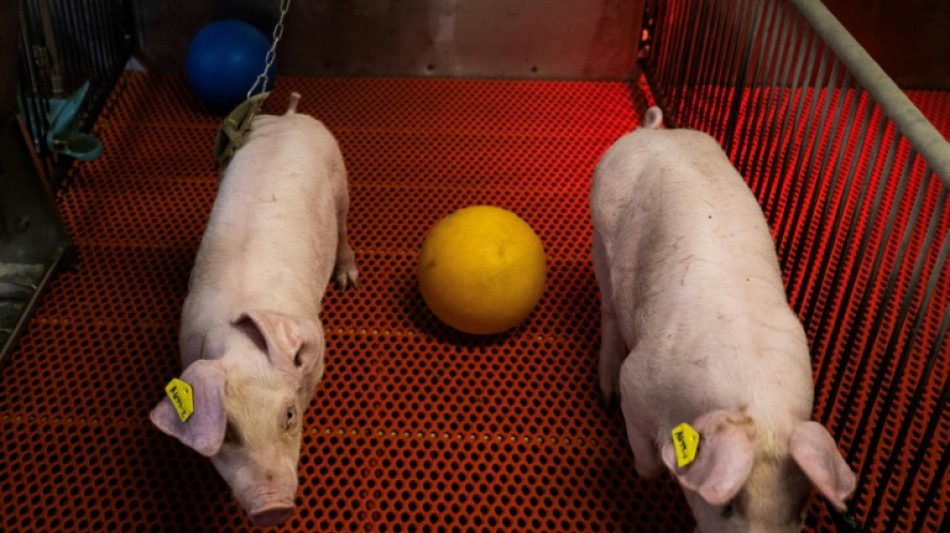
A US farm breeds pigs for human kidney transplants / Photo: Andrew Caballero-Reynolds - AFP

On a farm in the southern US state of Virginia, David Ayares and his research teams are breeding genetically modified pigs to transplant their organs into human patients.
Revivicor, the biotech company Ayares leads, is at the forefront of xenotransplantation research -- the implantation of animal organs into humans -- which aims to solve a chronic organ shortage that has thousands of Americans dying each year.
It was on this farm that Revivicor bred a pig whose kidney was recently transplanted into patient Towana Looney, according to an announcement made Tuesday by a New York hospital.
"It's just an exciting time," Ayares told AFP during a recent tour of the research farm.
The pigs are genetically modified to make their organs less likely to be rejected by patients' immune systems.
"These pigs are not typical farm pigs," said Ayares, as he cradled several pink piglets in his arms. "Millions of dollars have gone into the production of these genetics, and so they're very high-value animals."
The kidneys may one day sell for $1 million.
For more than 20 years, Revivicor in Blacksburg, Virginia has been conducting research to turn pig-to-human transplantation from science fiction to life-saving medical care.
In the United States alone, more than 100,000 people are on the transplant list and thousands die every year waiting, most often for a kidney, according to health authorities.
- 'Little room for recognition' -
Since 2021, several US surgeons have successfully transplanted genetically modified pig kidneys and hearts into humans, most of them supplied by Revivicor. Another key provider is the biotech firm eGenesis.
The first trials were carried out on brain-dead people, before the procedure was attempted on a handful of seriously ill patients.
While those patients died within weeks of the operation, the animal organs they received were not immediately rejected by their immune systems, which scientists hailed as a promising sign.
In a dark laboratory several kilometers away from the research farm, Todd Vaught, head of cell biology at Revivicor, has his eyes glued to a microscope.
With a pipette, he pierces a pig egg to remove its DNA and replace it with cells that have "all the instructions needed to make a genetically modified pig."
A few hours later, the edited eggs are implanted into sows. Four months later new litters are born.
While xenotransplantation research is happening in various parts of the world, the United States is a clear leader in the field.
French sociologist Catherine Rene criticized what she characterizes as mistreatment of the pigs as merely vessels for organs destined for humans.
"Ultimately, there is very little room for recognition of the donor animal, of the gift that is made," Rene told AFP.
Ayares disagreed.
"Hundreds of millions of pigs are used every year as food," Ayares said. "I would argue that this is a much higher calling for that pig organ to be used for transplantation."
- Million dollar price tag -
The first line of pigs developed by Revivicor carried only one genome edit meant to deactivate the animal's production of a substance that causes people to reject the transplanted organ.
The second has 10 modified genes, six of which come from human DNA in order to improve biological compatibility.
It is with this second line of pigs that United Therapeutics (UT), Revivicor's parent company, is thinking big.
In March, the publicly traded company opened another medical facility near Blacksburg where, in a brand-new operating room, pigs' kidneys will be removed and prepared for transfer to the receiving patient.
The rest of the pig will be discarded.
Spokesman Dewey Steadman said the facility has "rigorous controls" in place to prevent any infection of the 200 animals being kept there.
The company's goal is to begin several years of clinical studies on patients in 2025 and, if the Food and Drug Administration gives the green light, to begin full-scale production of genetically modified pigs in 2029.
UT is already planning to invest billions of dollars into building more and bigger facilities.
The company is considering selling kidneys for around $1 million each, which is close to the cost of 10 years of dialysis for patients in the United States, according to Steadman.
Making pig kidneys available to a large number of patients will not be an easy task in the United States, which lacks universal health care.
But Ayares hopes that with health insurance, "the patient is not bearing a million dollars... price tag."
K.Tanaka--JT