The Japan Times - The first 'zoomed-in' image of a star outside our galaxy

EUR -
AED 4.306856
AFN 77.711435
ALL 96.6361
AMD 447.361782
ANG 2.099662
AOA 1075.394579
ARS 1704.294082
AUD 1.770295
AWG 2.110917
AZN 2.005017
BAM 1.958609
BBD 2.362187
BDT 143.432006
BGN 1.956234
BHD 0.442095
BIF 3467.77264
BMD 1.172732
BND 1.516174
BOB 8.104414
BRL 6.458585
BSD 1.172782
BTN 105.082996
BWP 16.496656
BYN 3.446943
BYR 22985.5403
BZD 2.358692
CAD 1.614034
CDF 2655.064863
CHF 0.93241
CLF 0.02719
CLP 1066.669732
CNY 8.257496
CNH 8.250701
COP 4502.269252
CRC 585.724921
CUC 1.172732
CUP 31.077389
CVE 110.421457
CZK 24.312427
DJF 208.841456
DKK 7.471421
DOP 73.463464
DZD 152.117402
EGP 55.815926
ERN 17.590975
ETB 182.194198
FJD 2.678165
FKP 0.876
GBP 0.877004
GEL 3.154673
GGP 0.876
GHS 13.469971
GIP 0.876
GMD 86.196305
GNF 10251.437886
GTQ 8.986657
GYD 245.365567
HKD 9.1252
HNL 30.897305
HRK 7.533159
HTG 153.7705
HUF 386.871253
IDR 19612.76408
ILS 3.758194
IMP 0.876
INR 105.006053
IQD 1536.403138
IRR 49401.320328
ISK 147.213301
JEP 0.876
JMD 187.654288
JOD 0.831454
JPY 184.553364
KES 151.177306
KGS 102.55556
KHR 4706.568421
KMF 493.720346
KPW 1055.441417
KRW 1732.464732
KWD 0.360228
KYD 0.977402
KZT 606.914765
LAK 25400.773858
LBP 105023.312388
LKR 363.111398
LRD 207.582354
LSL 19.674209
LTL 3.462772
LVL 0.709373
LYD 6.357007
MAD 10.749902
MDL 19.854963
MGA 5333.511594
MKD 61.568211
MMK 2462.539291
MNT 4164.850513
MOP 9.399839
MRU 46.935102
MUR 54.121387
MVR 18.130742
MWK 2033.664165
MXN 21.099196
MYR 4.781237
MZN 74.949594
NAD 19.674713
NGN 1712.879934
NIO 43.160787
NOK 11.89246
NPR 168.132794
NZD 2.036114
OMR 0.450907
PAB 1.172737
PEN 3.949462
PGK 4.989154
PHP 68.793606
PKR 328.586273
PLN 4.20796
PYG 7867.980444
QAR 4.275622
RON 5.088925
RSD 117.377558
RUB 94.286458
RWF 1707.648697
SAR 4.398893
SBD 9.546173
SCR 16.056028
SDG 705.396175
SEK 10.876582
SGD 1.514917
SHP 0.879852
SLE 28.260452
SLL 24591.600589
SOS 669.042264
SRD 45.081562
STD 24273.177377
STN 24.535182
SVC 10.261452
SYP 12967.019711
SZL 19.672209
THB 36.851333
TJS 10.807221
TMT 4.116288
TND 3.432835
TOP 2.823657
TRY 50.203768
TTD 7.960211
TWD 36.962743
TZS 2925.964839
UAH 49.589409
UGX 4195.015476
USD 1.172732
UYU 46.045242
UZS 14098.856501
VES 327.442389
VND 30857.501487
VUV 142.369685
WST 3.271174
XAF 656.873724
XAG 0.017642
XAU 0.00027
XCD 3.169365
XCG 2.113677
XDR 0.815972
XOF 656.887747
XPF 119.331742
YER 279.638002
ZAR 19.623612
ZMK 10555.991785
ZMW 26.53437
ZWL 377.619112
  • NGG

    0.1700

    76.56

    +0.22%

  • RBGPF

    0.0000

    80.22

    0%

  • CMSC

    0.0100

    23.3

    +0.04%

  • GSK

    0.3050

    48.595

    +0.63%

  • RIO

    0.6000

    78.23

    +0.77%

  • JRI

    -0.0200

    13.41

    -0.15%

  • RYCEF

    -0.1500

    15.25

    -0.98%

  • BCC

    -2.4550

    75.245

    -3.26%

  • CMSD

    -0.0050

    23.275

    -0.02%

  • SCS

    0.0200

    16.14

    +0.12%

  • RELX

    0.1600

    40.81

    +0.39%

  • VOD

    0.1050

    12.905

    +0.81%

  • BCE

    0.1400

    22.99

    +0.61%

  • BTI

    -0.1400

    56.9

    -0.25%

  • AZN

    1.1200

    91.73

    +1.22%

  • BP

    0.6300

    33.94

    +1.86%

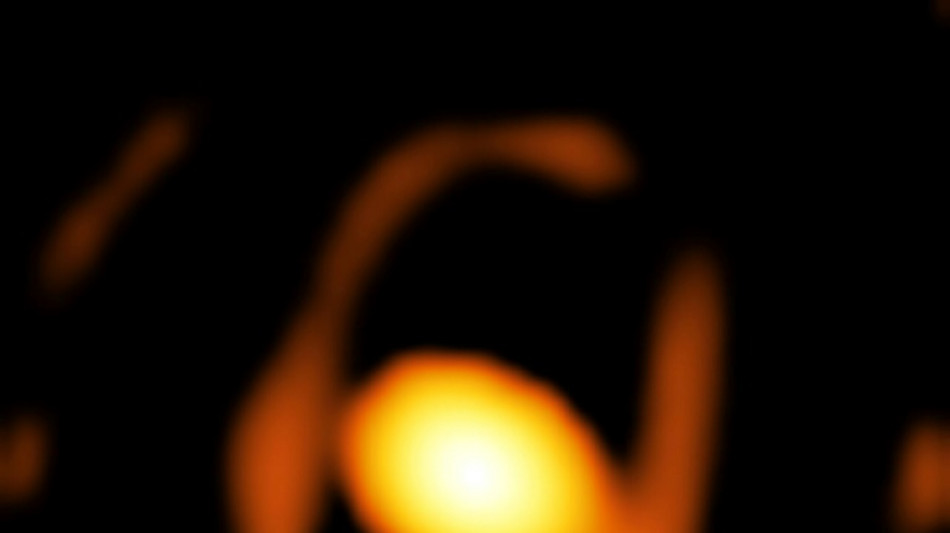
The first 'zoomed-in' image of a star outside our galaxy
The first 'zoomed-in' image of a star outside our galaxy / Photo: - - European Southern Observatory/AFP

The first 'zoomed-in' image of a star outside our galaxy

Scientists said Thursday they have taken the first ever close-up image of a star outside of the Milky Way, capturing a blurry shot of a dying behemoth 2,000 times bigger than the Sun.

Text size:

Roughly 160,000 light years from Earth, the star WOH G64 sits in the Large Magellanic Cloud, a satellite galaxy of our home Milky Way.

It is a red supergiant, which is the largest type of star in the universe because they expand into space as they near their explosive deaths.

The image was captured by a team of researchers using a new instrument of the European Southern Observatory's Very Large Telescope in Chile.

Keiichi Ohnaka, an astrophysicist at Chile's Andres Bello National University, said that "for the first time, we have succeeded in taking a zoomed-in image of a dying star".

The image shows the bright if blurry yellow star enclosed inside an oval outline.

"We discovered an egg-shaped cocoon closely surrounding the star," Ohnaka said in a statement.

"We are excited because this may be related to the drastic ejection of material from the dying star before a supernova explosion," added the lead author of a study published in the journal Astronomy & Astrophysics.

- 'Witness a star's life in real time' -

Ohnaka's team has been watching the star for some time.

In 2005 and 2007 they used the Very Large Telescope's interferometer, which combined the light from two telescopes, to learn more about the star.

But capturing an image remained out of reach until a new instrument called GRAVITY -- which combines the light of four telescopes -- recently came online.

When they compared all their observations, the astronomers were surprised to find that the star had dimmed over the last decade.

"The star has been experiencing a significant change in the last 10 years, providing us with a rare opportunity to witness a star's life in real time," said study co-author Gerd Weigelt of Germany's Max Planck Institute for Radio Astronomy.

Red supergiants -- such as Betelgeuse in the Orion constellation -- are "one of the most extreme of its kind, and any drastic change may bring it closer to an explosive end," added study co-author Jacco van Loon of Keele University in the UK.

In their final stages of life, before they go supernova, red supergiants shed their outer layers of gas and dust in a process that can last thousands of years.

It could be this expelled material that is making the star appear dimmer, the scientists said.

This could also explain the strange shape of the dust cocoon that surrounds the star.

Another explanation for the egg-shaped cocoon could be that there is another star hidden somewhere inside that has not yet been discovered.

M.Sugiyama--JT