The Japan Times - Third launch attempt for Boeing's beleaguered Starliner spacecraft

EUR -
AED 4.224876
AFN 72.462986
ALL 96.160604
AMD 434.099231
ANG 2.058963
AOA 1054.738043
ARS 1606.038123
AUD 1.628909
AWG 2.073245
AZN 1.957787
BAM 1.959215
BBD 2.316138
BDT 141.107219
BGN 1.966056
BHD 0.434221
BIF 3416.109293
BMD 1.150205
BND 1.471035
BOB 7.974972
BRL 6.040894
BSD 1.150005
BTN 106.071837
BWP 15.680472
BYN 3.425836
BYR 22544.020924
BZD 2.312943
CAD 1.573084
CDF 2605.214492
CHF 0.906057
CLF 0.026511
CLP 1046.813004
CNY 8.001115
CNH 7.92826
COP 4260.842959
CRC 540.146332
CUC 1.150205
CUP 30.480436
CVE 111.13859
CZK 24.454509
DJF 204.414853
DKK 7.471767
DOP 70.564391
DZD 152.131445
EGP 60.230841
ERN 17.253077
ETB 181.013531
FJD 2.547595
FKP 0.868334
GBP 0.863925
GEL 3.128823
GGP 0.868334
GHS 12.519984
GIP 0.868334
GMD 84.515954
GNF 10093.05076
GTQ 8.814443
GYD 240.721742
HKD 9.006578
HNL 30.561304
HRK 7.539937
HTG 150.724067
HUF 391.404502
IDR 19517.831177
ILS 3.591441
IMP 0.868334
INR 106.132132
IQD 1506.768745
IRR 1519478.512409
ISK 143.211796
JEP 0.868334
JMD 180.895354
JOD 0.815474
JPY 183.113233
KES 148.840282
KGS 100.58578
KHR 4622.10278
KMF 493.437605
KPW 1035.184626
KRW 1714.570528
KWD 0.353216
KYD 0.958279
KZT 555.322921
LAK 24700.655091
LBP 103000.87101
LKR 358.097383
LRD 210.775166
LSL 19.277199
LTL 3.396257
LVL 0.695748
LYD 7.3728
MAD 10.806191
MDL 20.009056
MGA 4779.102216
MKD 61.709926
MMK 2415.019418
MNT 4107.710362
MOP 9.274449
MRU 46.140499
MUR 53.806333
MVR 17.782217
MWK 1997.906655
MXN 20.371795
MYR 4.520887
MZN 73.509782
NAD 19.277204
NGN 1571.67499
NIO 42.235365
NOK 11.132226
NPR 169.721992
NZD 1.964872
OMR 0.442264
PAB 1.150015
PEN 3.943482
PGK 4.948754
PHP 68.636185
PKR 321.223553
PLN 4.272265
PYG 7464.01199
QAR 4.190485
RON 5.09484
RSD 117.426723
RUB 93.449256
RWF 1678.149313
SAR 4.316316
SBD 9.261061
SCR 16.378688
SDG 691.272965
SEK 10.749024
SGD 1.470163
SHP 0.862952
SLE 28.293004
SLL 24119.239327
SOS 657.347107
SRD 43.214935
STD 23806.924333
STN 24.844431
SVC 10.06263
SYP 127.126407
SZL 19.277227
THB 37.243559
TJS 11.039641
TMT 4.031469
TND 3.35973
TOP 2.769417
TRY 50.804333
TTD 7.798663
TWD 36.812088
TZS 2996.284814
UAH 50.697321
UGX 4341.606456
USD 1.150205
UYU 46.751909
UZS 13923.233407
VES 513.274734
VND 30238.893372
VUV 137.524572
WST 3.146058
XAF 657.108248
XAG 0.014306
XAU 0.00023
XCD 3.108487
XCG 2.072531
XDR 0.819555
XOF 661.945035
XPF 119.331742
YER 274.323586
ZAR 19.240229
ZMK 10353.228016
ZMW 22.395236
ZWL 370.365589
  • CMSD

    -0.0900

    22.9

    -0.39%

  • RBGPF

    0.1000

    82.5

    +0.12%

  • CMSC

    -0.0150

    22.975

    -0.07%

  • GSK

    0.3900

    53.78

    +0.73%

  • BP

    0.2400

    42.91

    +0.56%

  • RIO

    2.0400

    89.87

    +2.27%

  • BCC

    1.6900

    71.69

    +2.36%

  • BCE

    0.6421

    25.89

    +2.48%

  • BTI

    1.0150

    60.945

    +1.67%

  • RELX

    0.3500

    34.49

    +1.01%

  • RYCEF

    -0.1500

    16.4

    -0.91%

  • VOD

    0.1900

    14.6

    +1.3%

  • JRI

    -0.0450

    12.545

    -0.36%

  • NGG

    -0.0100

    90.89

    -0.01%

  • AZN

    2.1500

    192.05

    +1.12%

Third launch attempt for Boeing's beleaguered Starliner spacecraft
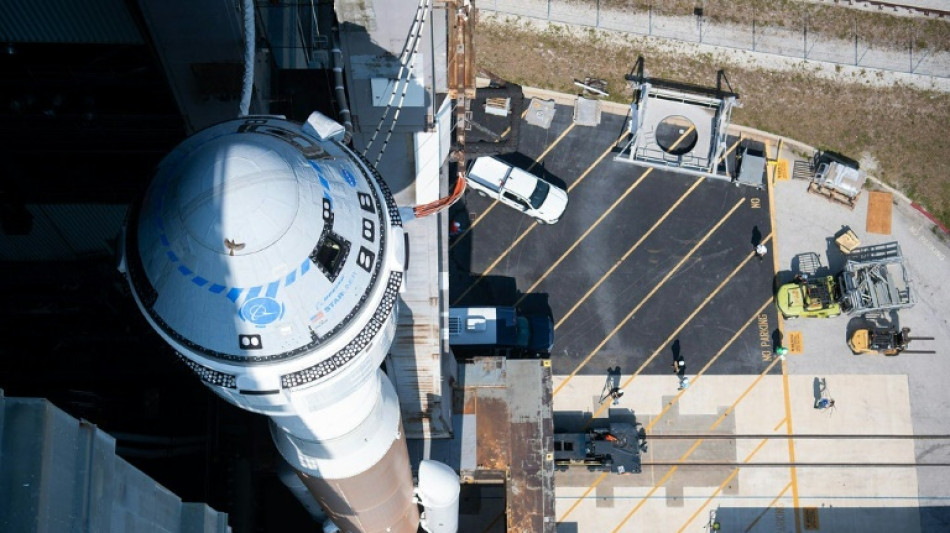
Third launch attempt for Boeing's beleaguered Starliner spacecraft / Photo: Joel KOWSKY - NASA/AFP

Third launch attempt for Boeing's beleaguered Starliner spacecraft

American aerospace giant Boeing is making a third attempt to reach the International Space Station Thursday in a critical uncrewed test flight for its Starliner capsule, which has been beset by numerous failures and false starts.

Text size:

Lift-off for Orbital Test Flight 2 (OFT-2) is scheduled for 6:54 pm Eastern Time (2254 GMT) from the Kennedy Space Center in Florida, with the spaceship fixed atop a United Launch Alliance Atlas V rocket.

The mission's success is key to repairing Boeing's frayed reputation after the first bid, back in 2019, failed to dock with the ISS due to software bugs -- one that led to it burning too much fuel to reach its destination, and another that could have destroyed the vehicle during re-entry.

A second try was scheduled in August of last year, but was rolled back from the launchpad to address sticky valves that weren't opening as they should, and the capsule was eventually sent back to the factory for fixes.

Boeing and NASA say the drama is now behind them.

"There's really no outstanding issues and we're ready," Mark Nappi, vice president and program manager of the Boeing Commercial Crew Program, said at a press conference this week.

NASA is looking to certify Starliner as a second "taxi" service for its astronauts to the space station -- a role that Elon Musk's SpaceX has provided since succeeding in a test mission for its Dragon capsule in 2020.

- Redemption day -

Both companies were awarded fixed-price contracts -- $4.2 billion to Boeing, and $2.6 billion to SpaceX -- in 2014, shortly after the end of the Space Shuttle program, during a time when the United States was left reliant on Russian Soyuz rockets for rides to the orbital outpost.

Boeing, with its hundred-year history, was considered by many as the sure shot, while then-upstart SpaceX was less proven.

In reality, it was SpaceX that rocketed ahead, and recently sent its fourth routine crew to the research platform -- while Boeing's development delays have cost the company hundreds of millions of dollars.

Starliner should dock with the ISS about 24 hours after launch, and deliver more than 500 pounds (226 kilograms) of cargo -- including food and provisions like clothes and sleeping bags for the current crew on the station.

Its sole passenger is a mannequin named Rosie the Rocketeer -- a play on the World War II campaign icon Rosie the Riveter -- whose job is to collect flight data with her sensors in order to learn what human astronauts would experience.

"We are a little jealous of Rosie," said NASA astronaut Mike Fincke, who is expected to be among the first crew selected for a manned demonstration mission should OFT-2 succeed.

The gumdrop-shaped capsule will spend about five to ten days in space, then undock and return to Earth, using giant parachutes to land in the desert of the western United States.

NASA sees a second provider to low Earth orbit as a vital backup, should SpaceX encounter problems.

"It's a really critical step for us and moving towards having two routinely flying crewed vehicles who can bring our crew to and from ISS," Dana Weigel, deputy program manager for the ISS, told reporters.

S.Suzuki--JT