RBGPF
-1.2500

Three Chinese astronauts including the country's only woman spaceflight engineer entered the Tiangong space station on Wednesday following an early morning launch into orbit.
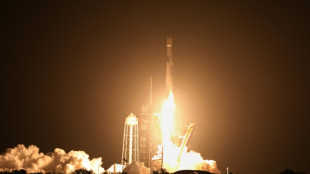
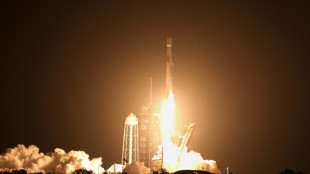
The Shenzhou-19 mission took off with its trio of space explorers at 4:27 am (2027 GMT Tuesday) from the Jiuquan Satellite Launch Center in northwest China, Xinhua and state broadcaster CCTV reported.
Among the crew is Wang Haoze, 34, China's only woman spaceflight engineer, according to the China Manned Space Agency (CMSA). She is the third Chinese woman to take part in a crewed mission.
The crew arrived around 12:51 pm and met with the astronauts from the previous Shenzhou-18 mission, "starting a new round of in-orbit crew handover", state news agency Xinhua said.
The new Tiangong team will carry out experiments with an eye to the space programme's goal of placing astronauts on the Moon by 2030 and eventually constructing a lunar base.
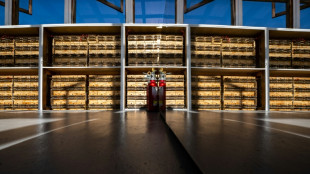
"Like everyone else, I dream of going to the space station to have a look," Wang told a media gathering Tuesday alongside her fellow crew members, lined up behind podiums and tall panes of glass to seal them off from the public.
"I want to meticulously complete each task and protect our home in space," she said.
"I also want to travel in deep space and wave at the stars."
The space agency deemed the launch a "complete success", Xinhua said, adding that about 10 minutes after taking off, the spaceship separated from the rocket and entered its designated orbit.
Xinhua later said the spaceship had "made a fast, automated rendezvous and docking with the front port of the space station's core module Tianhe at 11:00 am", and that the trio would then enter the module.
- 'Honour of my mission' -
Headed by Cai Xuzhe, the team will return to Earth in late April or early May next year, CMSA Deputy Director Lin Xiqiang said at a separate press event ahead of the launch.
Cai, a 48-year-old former air force pilot, brings experience from a previous stint aboard Tiangong as part of the Shenzhou-14 mission in 2022.
"Having been selected for the new crew, taking on a new role, facing new tasks and new challenges, I feel the honour of my mission with a great responsibility," said Cai.
The aerospace veteran added that the crew was now "fully prepared mentally, technically, physically and psychologically" for the mission ahead.
Completing the astronaut lineup is 34-year-old Song Lingdong.
The new and old crew will live and work together for about five days to complete planned tasks and handover work, the CMSA said, according to Xinhua.
The Shenzhou-18 crew is scheduled to return to Earth on November 4, it added.
- 'Space dream' -
China has ramped up plans to achieve its "space dream" under President Xi Jinping.
Its space programme was the third to put humans in orbit and has also landed robotic rovers on Mars and the Moon.
Crewed by teams of three astronauts that are rotated every six months, the Tiangong space station is the programme's crown jewel.
Beijing says it is on track to send a crewed mission to the Moon by 2030, where it intends to construct a base on the lunar surface.
The Shenzhou-19 crew's time aboard Tiangong will see them carry out various experiments, including some involving "bricks" made from components imitating lunar soil, CCTV reported.
These items -- to be delivered to Tiangong by the Tianzhou-8 cargo ship in November -- will be tested to see how they fare in extreme radiation, gravity, temperature and other conditions.
Due to the high cost of transporting materials into space, Chinese scientists hope to be able to use lunar soil for the construction of the future base, CCTV reported.
The Shenzhou-19 mission is primarily about "accumulating additional experience", Jonathan McDowell, an astronomer at the Harvard-Smithsonian Center for Astrophysics in the United States, told AFP.
China has in recent decades injected billions of dollars into developing an advanced space programme on par with the United States and Europe.
In 2019, China successfully landed its Chang'e-4 probe on the far side of the moon, the first spacecraft ever to do so. In 2021, it landed a small robot on Mars.
Tiangong, whose core module launched in 2021, is planned to be used for about 10 years.
Y.Ishikawa--JT