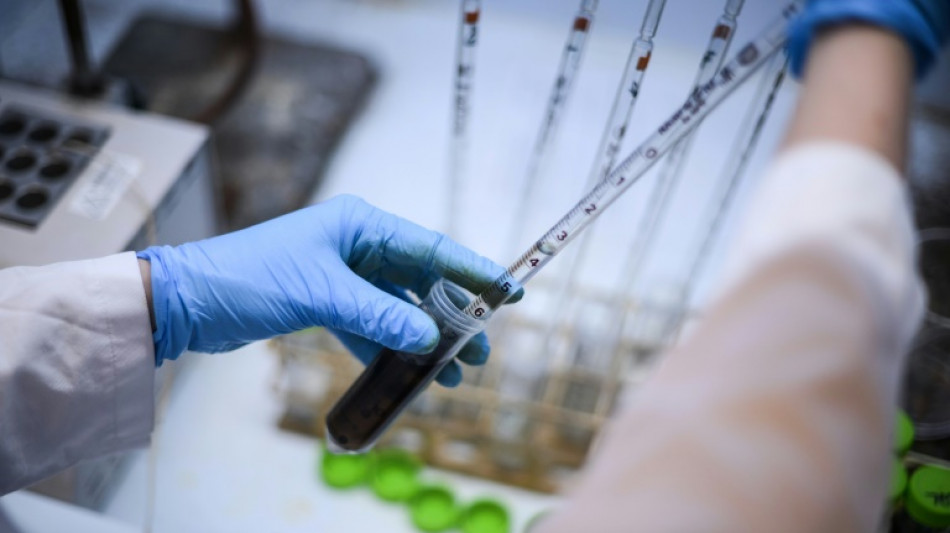
AI-aided research, new materials eyed for Nobel Chemistry Prize / Photo: Daniel LEAL - POOL/AFP

The development of new compounds and science aided by artificial intelligence are some of the research fields commentators say could be contenders for the Nobel Chemistry Prize announced Wednesday.
The winner or winners of the prestigious award will be unveiled by the Royal Swedish Academy of Sciences in Stockholm from 11:45 am (0945 GMT).
The chemistry prize follows the physics prize, which on Tuesday honoured American John Hopfield and Canadian-Brit Geoffrey Hinton for key breakthroughs in artificial intelligence (AI).
While the AI duo was not among the top names mentioned ahead of the physics prize, some pundits have speculated the technology may also feature in the chemistry prize.
Google DeepMind's director John Jumper and CEO and co-founder Demis Hassabis -- who were honoured with the prestigious Lasker Award in 2023 -- could win for their work on the AI-model Alphafold.
The AI tool is used to predict the three-dimensional structure of proteins based on their amino acid sequence.
Analytics group Clarivate, which keeps an eye on potential Nobel science laureates, placed the pair among the top picks for the 2024 candidates.
- 'A kind of revolution' -
David Pendlebury, head of the research group, admits that while a 2021 paper by Jumper and Hassabis has been cited thousands of times, it would be unusual for the Nobel jury to reward work so quickly after publication -- as most discoveries that are honoured date back decades.
But "a paper so recently published and so highly cited is such a clear signal of a kind of revolution", Pendlebury said.
Another name often cited for the chemistry nod is American-Jordanian Omar Yaghi.
Yaghi developed a type of customised porous material known as MOF (metal-organic framework), now used in commercial products that can, among other things, absorb and decontaminate toxins, act as a catalyst or even absorb water from desert air.
Lars Brostrom, science editor at Swedish Radio, told AFP that such materials "are already in practical use and it is time for a Nobel Prize".
Yaghi's name has previously been floated alongside Japan's Susumu Kitagawa and Makoto Fujita -- also considered pioneers of the technology.
If Yaghi is passed over again, Brostrom speculated that Taiwanese-American biochemist Chi-Huey Wong could be awarded for coming up with "biochemical methods used in the pharmaceutical industry".
In the area of pharmaceutics, US chemical engineer Robert Langer has been mentioned. Brostrom called him "one of the most cited scientists in the world".
Karl Deisseroth, a US psychiatrist and neurologist, has also been mentioned for the past decade as a possible laureate for developing the field of optogenetics, using light to control cells.
- Molecular dynamics -
The names of Princeton University's Roberto Car and Italian physicist Michele Parrinello at the Italian Institute of Technology have also been floated this year.
The duo, despite being physicists, have been talked about for the chemistry prize for the "Car-Parrinello method" -- used for calculating molecular dynamics.
In the past, top names believed to be in the running were US-based James J. Collins, Michael Elowitz and Stanislas Leibler, whose work on "synthetic gene circuits" launched the field of "synthetic biology."
Stanford University chemical engineering professor Zhenan Bao has also been tipped for the prize in the past.
The Chinese-American and her team have invented an "artificial electronic skin" by developing materials for stretchable circuits and flexible batteries.
Last year, the chemistry prize went to French-born Moungi Bawendi, Louis Brus of the United States and Russian-born Alexei Ekimov for developing tiny "quantum dots" used to illuminate TVs and lamps.
Awarded since 1901, the Nobel Prizes honour those who have, in the words of prize creator and scientist Alfred Nobel, "conferred the greatest benefit on humankind".
On Monday, the Medicine Prize was awarded to American scientists Victor Ambros and Gary Ruvkun for their discovery of microRNA and its role in how genes are regulated.
Wednesday's chemistry prize will be followed by the highly watched literature and peace prizes to be announced on Thursday and Friday respectively.
The economics prize wraps up the 2024 Nobel season on October 14.
The winners will receive their prize, consisting of a diploma, a gold medal and a $1 million cheque, from King Carl XVI Gustaf at a formal ceremony in Stockholm on December 10, the anniversary of the 1896 death of scientist Alfred Nobel who created the prizes in his will.
K.Yoshida--JT