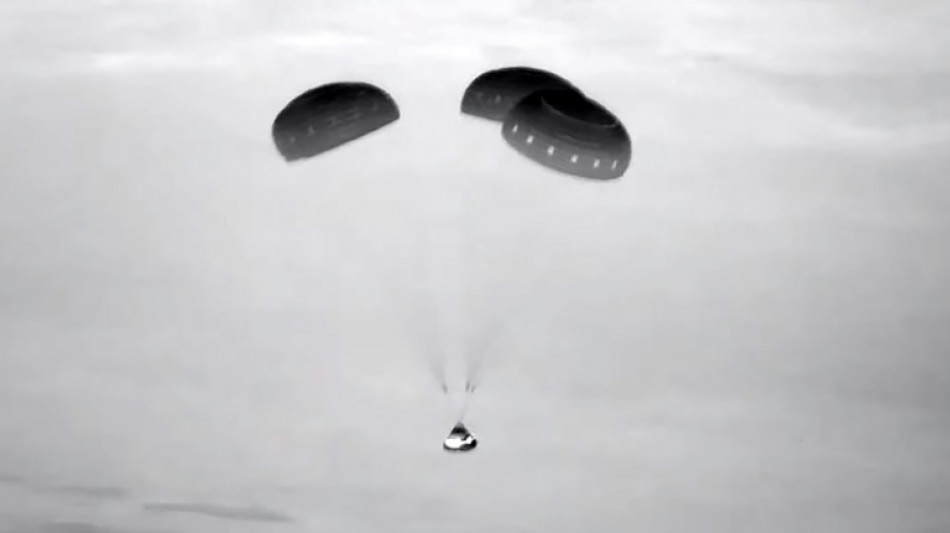
Boeing's beleaguered Starliner back home empty / Photo: Agustin PAULLIER - NASA/AFP

Boeing's beleaguered Starliner returned to Earth empty Saturday after NASA deemed it too risky to bring home the astronauts who rode the spaceship up to the International Space Station.
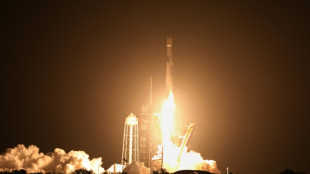
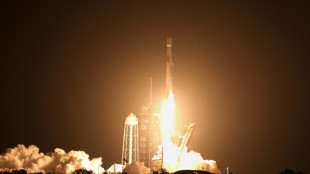
After years of delays, Starliner launched in June for what was meant to be a roughly weeklong test mission -- a final shakedown before it could be certified to ferry crew to and from the orbital laboratory.
But unexpected thruster malfunctions and helium leaks on its way up derailed those plans, and NASA ultimately decided it was safer to bring Butch Wilmore and Suni Williams back on a rival SpaceX Crew Dragon -- though they'll have to wait until February 2025.
The gumdrop-shaped capsule touched down softly at the White Sands Space Harbor in New Mexico at approximately 0401 GMT, its descent slowed by parachutes and cushioned by airbags, having departed the ISS around six hours earlier.
Ground teams reported hearing sonic booms as it streaked red hot across the night sky, having endured temperatures of 3,000 degrees Fahrenheit (1,650 degrees Celsius) during atmospheric reentry.
A smooth, uneventful ride was seen as critical not only for salvaging some pride but also for Boeing's prospects of achieving certification in the future.
The century-old aerospace giant had carried out extensive ground testing aimed at replicating the technical issues the spaceship had experienced on its ascent and devised plans to prevent more problems.
With its reputation already battered by safety concerns affecting its passenger jets, Boeing made assurances in public and in private that it could be trusted to bring the astronauts home -- an assessment not shared by NASA.
"Boeing believed in the model that they had created that tried to predict the thruster degradation for the rest of the flight," Steve Stich, program manager for NASA's Commercial Crew Program, told reporters this week.
But "the NASA team, due to the uncertainty in the modeling, could not get comfortable with that," he added, characterizing the mood during meetings as "tense."
- Certification decisions to come -
Shortly after undocking, Starliner executed a powerful "breakout burn" to swiftly clear it from the station and prevent any risk of collision -- a maneuver that would have been unnecessary if crew were aboard to take manual control if needed.
Following that, mission teams conducted thorough checks of its thrusters in preparation for the critical "deorbit burn," required to guide the capsule onto its reentry path around 40 minutes before landing.
While expectations were high that Starliner would stick the landing, as it had in two previous uncrewed tests, NASA will now carefully review all aspects of the mission's performance before deciding on the next steps.
NASA awarded Boeing and SpaceX multibillion-dollar contracts over a decade ago to develop spacecraft to taxi astronauts to and from the ISS, after the end of the Space Shuttle program left the US space agency reliant on Russian rockets.
Although initially considered the underdog, Elon Musk's SpaceX surged ahead of mighty Boeing, successfully flying dozens of astronauts since 2020.
The Starliner program, meanwhile, has faced numerous setbacks.
In 2019, during its first uncrewed test flight, a software glitch prevented the capsule from rendezvousing with the ISS. A second software issue, which could have caused a catastrophic collision between its modules, was caught and fixed just in time.
In 2021, with the rocket poised on the launchpad for another attempt, blocked valves forced yet another postponement.
The capsule finally reached the ISS in May 2022 on a non-crewed flight, but further issues, including weak parachutes and flammable tape in the cabin that needed removal, delayed the crewed test.
For the current mission, astronauts Wilmore and Williams had been strapped into their seats and ready to fly twice before last-minute "scrubs" due to technical glitches sent them back to their quarters.
K.Tanaka--JT