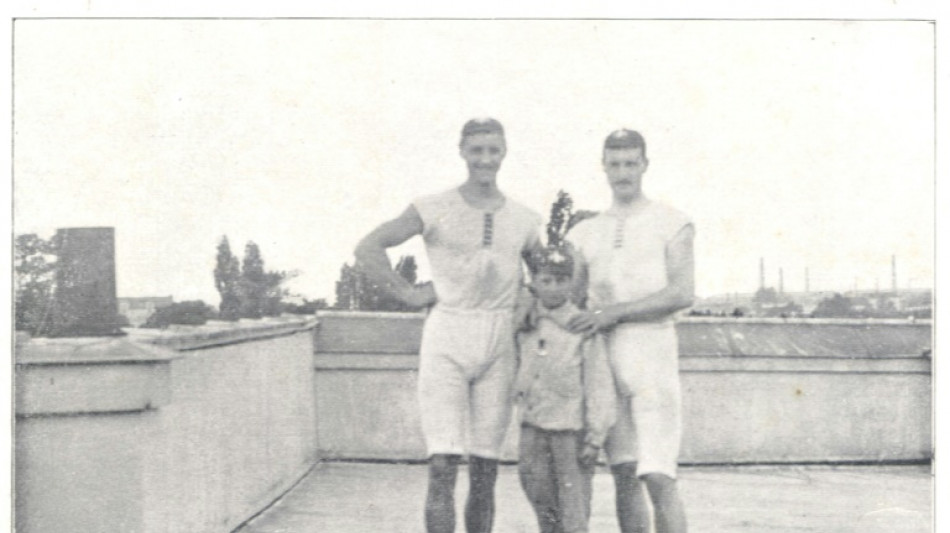
'Unknown Boy' may be the youngest ever Olympic champion / Photo: HANDOUT - International Society of Olympic Historians/AFP

"It's probably the biggest Olympics mystery of all," says historian Hilary Evans of the chaotic 1900 rowing race in Paris that may have produced the youngest-ever champion.
As the third Olympics hosted in Paris draw to a close, the identity of a child coxswain who steered two Dutch rowers, Francois Antoine Brandt and Roelof Klein, across the finish line first in Paris more than a century ago remains unknown.
In the constantly updated Olympic archives in Lausanne, he is recorded simply as "Unknown French Boy", infuriating researchers like Evans who at various times have come tantalisingly close to uncovering his name.
"People think they've made a breakthrough every decade or so and it feels like it's within reach, but we've never managed to solve it," Evans explained by phone from his home in Wales.
The story shines a light not only on the amateurish beginnings of the modern Olympics, which have since become a multi-billion-dollar industry, but also the work of a passionate group of researchers for whom no trivia question is too small.
Evans, who spends his days as a sheep farmer and his evenings poring over microfilm and old sports magazines, developed a theory earlier this year about the Unknown Boy and says "we actually thought we'd solved it conclusively".
Alas, it was another false dawn -- and a bitter disappointment for the 54-year-old who describes his biggest achievement as discovering the names of the 1900 gymnastics finalists.
"The ages didn't match up so we had to put the theory to bed," he added.
Evans was hoping that the latest Paris Olympics must prompt someone, somewhere to delve into some dusty Parisian rowing club archives, or find a yellowing photograph that cracks the riddle?
"If it doesn't happen this year, with all the publicity, it's going to be really hard, to be honest," Evans says.
- 'Obsessive' -
Only one photo exists of the Unknown Boy, unearthed by the late Dutch researcher Tony Bijkerk who spent nearly half a century on the conundrum.
In it, the boy is dark haired and small-framed, smartly dressed in long trousers and a shirt. He stands between the two victorious Dutch rowers and the top of his head comings up to their chests.
According to an account given by Brandt, he was picked out of the crowd shortly before the final of the two-man coxed pairs race to give a weight advantage to the Dutch rowers, who ended up winning by less than a metre.
"The young French cox stayed around long enough to be photographed with his new Dutch friends but then he vanished into the city," says "The Complete Book of the Olympics", a compendium of records and information about the Games.
Author David Wallechinsky, who co-founded the International Society of Olympic Historians, says "there just aren't that many large mysteries any more" in Olympic history and the Unknown Boy continues to fascinate "obsessive researchers" like him.
"The first reason this stands out is the photograph. Who is this guy?" Wallechinsky told AFP. "And secondly, was he the youngest person to win an Olympic event?"
If he was around eight years' old at the time, as some historians believe, it would make him the youngest champion of all time.
But others, including Bijkerk, believed he might have been 12 or 13.
The youngest recorded medal winner is Dimitrious Loundras, a 10-year-old Greek gymnast who took bronze in the first modern games in Athens in 1896.
- Chaotic -
The rowing race of 1900 took place on a stretch of the river Seine in northern Paris between the Pont de Courbevoie and Pont d'Asnieres, four kilometres (three miles) from the athletes' village for the July 26-August 11 Games this year.
The 1900 Olympiad was the second edition of the modern Olympics and was held on the sidelines of the World Fair which took place in Paris at the same time.
Scheduled over five months on a tiny budget, the Games were poorly organised, often improvised, and drew small crowds.
They had none of the pomp and pageantry that has been invented since, and winners did not even receive medals.
"There were some people who didn't realise they had competed in the Olympics," Wallechinsky explained.
The coxed four-man rowing was overshadowed by an argument about the qualification process for the final, while the athletics was held on an uneven, boggy field.
It was in this context that the Dutch rowers were able to swap their cox mid-competition and his name was never recorded.
"You would never have that happen now," Wallechinsky laughs. "Every athletes's got a profile."
- Theories -
Several names have been put forward for the Unknown Boy over the years, none conclusively.
Based on Bijkerk's research, he was assumed to be French and to have had a connection with a local rowing club, the Societe de la Basse-Seine.
But in 2016, the small world of Olympic historians was set aflutter by a new theory: the Unknown French Boy wasn't French at all. He was Georgian, and aged 12.
Tbilisi-based historian and Georgian National Olympic Committee member Paata Natsvlishvili claimed the cox was Giorgi Nikoladze, the son of a diplomat and journalist.
He based his claim, written up in the Journal of Olympic History, on a physical resemblance between Nikoladze and the Unknown Boy; that Nikoladze was in Paris at the time with his family; and that Nikoladze had told his sister he had won a rowing race in Paris.
"I am convinced that Giorgi Nikoladze was in that boat," Natsvlishvili told AFP by email. "Until there are convincing counter-arguments or if another more convincing version appears, for me, it will be Giorgi Nikoladze."
Others are unconvinced -- with the editor of the "Journal of Olympic History" saying at the time that "definitive proof is still lacking" to support the theory.
The official IOC records remain unchanged -- despite Natsvlishvili's best efforts.
In the meantime, the search goes on to resolve perhaps the most perplexing footnote in Olympics history.
"I won't give up hope," said Wallechinsky. "I feel that some day something's going to happen."
S.Fujimoto--JT