The Japan Times - 'Well-preserved' dinosaur fossil revealed by Brazilian flood

EUR -
AED 4.295165
AFN 74.252998
ALL 95.669362
AMD 433.177117
ANG 2.093015
AOA 1073.470824
ARS 1628.616302
AUD 1.628333
AWG 2.104844
AZN 1.983656
BAM 1.957227
BBD 2.356078
BDT 143.532222
BGN 1.950608
BHD 0.441896
BIF 3479.424146
BMD 1.169358
BND 1.493783
BOB 8.08286
BRL 5.762481
BSD 1.169833
BTN 111.402769
BWP 15.897526
BYN 3.311659
BYR 22919.412959
BZD 2.352676
CAD 1.592607
CDF 2707.063667
CHF 0.915286
CLF 0.026898
CLP 1058.61512
CNY 7.987123
CNH 7.983738
COP 4343.696499
CRC 532.179012
CUC 1.169358
CUP 30.987982
CVE 110.650435
CZK 24.380289
DJF 207.817935
DKK 7.472549
DOP 69.682762
DZD 154.857156
EGP 62.6975
ERN 17.540367
ETB 183.939159
FJD 2.567851
FKP 0.86399
GBP 0.863512
GEL 3.139759
GGP 0.86399
GHS 13.109123
GIP 0.86399
GMD 85.362938
GNF 10261.114696
GTQ 8.929359
GYD 244.737439
HKD 9.163146
HNL 31.095678
HRK 7.533358
HTG 153.099035
HUF 361.775864
IDR 20346.299579
ILS 3.43744
IMP 0.86399
INR 111.217329
IQD 1532.391353
IRR 1538874.869857
ISK 143.210976
JEP 0.86399
JMD 184.082676
JOD 0.829036
JPY 184.598916
KES 151.022297
KGS 102.225843
KHR 4692.083792
KMF 491.719704
KPW 1052.425758
KRW 1718.025101
KWD 0.360244
KYD 0.974807
KZT 543.5741
LAK 25696.637284
LBP 104715.991157
LKR 374.336598
LRD 214.635059
LSL 19.492736
LTL 3.452809
LVL 0.707333
LYD 7.407912
MAD 10.800481
MDL 20.190639
MGA 4872.532668
MKD 61.633552
MMK 2455.308347
MNT 4184.672079
MOP 9.442446
MRU 46.709266
MUR 54.901173
MVR 18.072383
MWK 2037.020948
MXN 20.320401
MYR 4.633575
MZN 74.707248
NAD 19.493699
NGN 1600.546616
NIO 43.05066
NOK 10.831644
NPR 178.244993
NZD 1.985809
OMR 0.449611
PAB 1.169848
PEN 4.101121
PGK 5.08671
PHP 71.845175
PKR 325.989266
PLN 4.247353
PYG 7088.13902
QAR 4.2757
RON 5.239073
RSD 117.385968
RUB 88.27924
RWF 1710.440098
SAR 4.387925
SBD 9.385112
SCR 16.08425
SDG 702.193463
SEK 10.848146
SGD 1.49151
SHP 0.873044
SLE 28.825025
SLL 24520.843989
SOS 668.584735
SRD 43.823999
STD 24203.34562
STN 24.517461
SVC 10.235289
SYP 129.249966
SZL 19.493069
THB 38.061897
TJS 10.93763
TMT 4.098599
TND 3.410487
TOP 2.815533
TRY 52.903382
TTD 7.929647
TWD 36.914321
TZS 3043.235488
UAH 51.408772
UGX 4416.145131
USD 1.169358
UYU 47.104353
UZS 14078.026219
VES 571.74902
VND 30781.005476
VUV 138.597583
WST 3.175895
XAF 656.432925
XAG 0.016057
XAU 0.000257
XCD 3.160248
XCG 2.108229
XDR 0.815785
XOF 656.432925
XPF 119.331742
YER 279.038007
ZAR 19.481571
ZMK 10525.62207
ZMW 22.080008
ZWL 376.532736
  • RYCEF

    -0.0200

    16.33

    -0.12%

  • RBGPF

    1.6000

    64.7

    +2.47%

  • NGG

    0.1400

    87.64

    +0.16%

  • RELX

    -0.2000

    36.16

    -0.55%

  • RIO

    1.8700

    100.5

    +1.86%

  • GSK

    -0.5200

    50.38

    -1.03%

  • BCC

    -2.2000

    72.13

    -3.05%

  • CMSC

    0.0099

    22.88

    +0.04%

  • AZN

    -2.2200

    181.24

    -1.22%

  • BCE

    0.1700

    24.1

    +0.71%

  • JRI

    0.1100

    13.04

    +0.84%

  • CMSD

    0.0400

    23.29

    +0.17%

  • VOD

    -0.3100

    15.74

    -1.97%

  • BTI

    1.0500

    59.4

    +1.77%

  • BP

    -0.4400

    46.5

    -0.95%

'Well-preserved' dinosaur fossil revealed by Brazilian flood
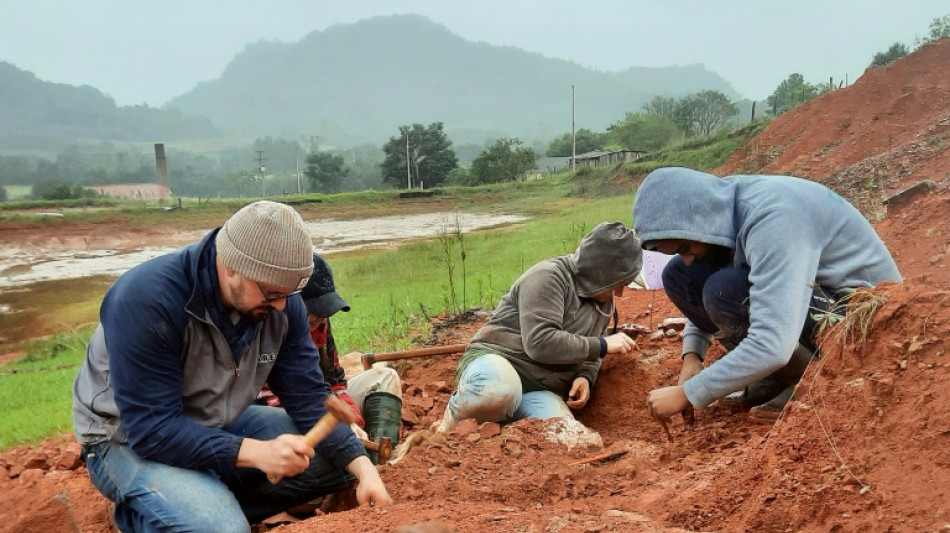
'Well-preserved' dinosaur fossil revealed by Brazilian flood / Photo: Handout - Federal University of Santa Maria/AFP

'Well-preserved' dinosaur fossil revealed by Brazilian flood

Torrential rains causing historic flooding in southern Brazil have revealed a "very well-preserved" dinosaur fossil dating back some 200 million years, according to the research team who discovered it.

Text size:

The fossil was first identified in May near the city of Sao Joao do Polesine, some 280 kilometres (170 miles) west of Porto Alegre, in a part of the Brazilian pampas dubbed the country's 'El Dorado' of palaeontology.

A team of palaeontologists from the Federal University of Santa Maria spent four days excavating the fossil to remove the block of rock containing a "near complete" dinosaur fossil to take back to their research centre for study.

Initial findings have determined the fossil was a specimen of the Herrerasauridae family, which were bipedal carnivores with long tails found in the area of modern-day Brazil and Argentina.

The fossil dates to the Triassic period, between 250 to 200 million years ago.

Rodrigo Temp Muller, who's leading the research effort, told AFP that the fossil is possibly the second most complete fossil of a Herrerasauridae specimen to date.

The most complete was found in the same part of Brazil in 2014, leading to the identification of a new species with hooked claws, dubbed gnathovorax cabreirai.

The fossil will undergo several rounds of analysis before researchers can determine whether the specimen is a member of the same species.

"We have to be very careful with this work, it's very meticulous, almost surgical," Muller said, adding the process could take "several months."

"Every little part that we might damage will be a bit of information that we might not be able to recover."

Once the analysis is done, Muller's team will publish the results in a scientific journal.

- Erosion acceleration -

The heavy rains that affected the pampas in May killed more than 180 people in Brazil and caused major damage to infrastructure.

The floods revealed the fossil much earlier by "accelerating erosion," a silver lining to researchers, who would not have discovered it until much later, according to Muller.

The downpour is not without its drawbacks, however, as heavy rainfall "also destroys a lot of the material" from the fossils, especially small fragments.

Palaeontologists maintain a close watch on the fossil deposits as a result, especially any fragments that may be exposed, and focus their efforts during excavations to recover these fossils in the best possible condition.

M.Saito--JT