The Japan Times - Webb telescope finds most distant galaxy ever observed, again

EUR -
AED 4.304535
AFN 74.415645
ALL 95.657107
AMD 433.266248
ANG 2.097923
AOA 1075.987332
ARS 1632.462783
AUD 1.618609
AWG 2.10978
AZN 1.995685
BAM 1.95696
BBD 2.355816
BDT 143.515066
BGN 1.955182
BHD 0.442264
BIF 3480.663113
BMD 1.1721
BND 1.493585
BOB 8.08179
BRL 5.777048
BSD 1.169703
BTN 111.388975
BWP 15.895422
BYN 3.311291
BYR 22973.155008
BZD 2.352414
CAD 1.593832
CDF 2713.410971
CHF 0.915931
CLF 0.026961
CLP 1061.125158
CNY 8.005851
CNH 7.994049
COP 4354.596695
CRC 532.117675
CUC 1.1721
CUP 31.060643
CVE 110.330397
CZK 24.387118
DJF 208.285235
DKK 7.472581
DOP 69.691606
DZD 155.219479
EGP 62.848343
ERN 17.581496
ETB 184.078001
FJD 2.563206
FKP 0.866016
GBP 0.863679
GEL 3.153155
GGP 0.866016
GHS 13.111772
GIP 0.866016
GMD 85.5636
GNF 10265.084482
GTQ 8.926425
GYD 244.705045
HKD 9.184562
HNL 31.091562
HRK 7.536132
HTG 153.080736
HUF 361.208245
IDR 20385.100166
ILS 3.445502
IMP 0.866016
INR 111.392962
IQD 1535.450666
IRR 1542483.264488
ISK 143.183982
JEP 0.866016
JMD 184.059098
JOD 0.831057
JPY 185.02061
KES 151.059928
KGS 102.465547
KHR 4691.780986
KMF 492.899268
KPW 1054.893514
KRW 1708.523207
KWD 0.360983
KYD 0.974686
KZT 543.506793
LAK 25685.443819
LBP 104960.575553
LKR 374.295051
LRD 214.629049
LSL 19.57457
LTL 3.460905
LVL 0.708991
LYD 7.420462
MAD 10.810308
MDL 20.188138
MGA 4875.934547
MKD 61.666821
MMK 2461.06562
MNT 4194.484409
MOP 9.441277
MRU 46.704082
MUR 55.029953
MVR 18.11485
MWK 2028.202188
MXN 20.298431
MYR 4.633318
MZN 74.895135
NAD 19.57457
NGN 1600.967936
NIO 43.028082
NOK 10.812432
NPR 178.221398
NZD 1.974344
OMR 0.450665
PAB 1.169693
PEN 4.100631
PGK 5.086015
PHP 71.917685
PKR 325.951694
PLN 4.24541
PYG 7087.261339
QAR 4.27424
RON 5.239167
RSD 117.373693
RUB 88.494306
RWF 1710.213705
SAR 4.397511
SBD 9.414608
SCR 16.200818
SDG 703.844816
SEK 10.812479
SGD 1.492646
SHP 0.875091
SLE 28.862896
SLL 24578.341116
SOS 668.496242
SRD 43.92678
STD 24260.098268
STN 24.514531
SVC 10.234153
SYP 129.553035
SZL 19.570266
THB 38.077418
TJS 10.936276
TMT 4.10821
TND 3.386779
TOP 2.822135
TRY 53.020046
TTD 7.928767
TWD 36.943993
TZS 3044.157544
UAH 51.401968
UGX 4415.617294
USD 1.1721
UYU 47.088068
UZS 14094.499388
VES 578.424145
VND 30857.869995
VUV 138.92257
WST 3.183342
XAF 656.34604
XAG 0.015522
XAU 0.000252
XCD 3.167658
XCG 2.107967
XDR 0.816284
XOF 655.789907
XPF 119.331742
YER 279.674102
ZAR 19.389753
ZMK 10550.300729
ZMW 22.077274
ZWL 377.41564
  • NGG

    0.1400

    87.64

    +0.16%

  • CMSC

    0.0099

    22.88

    +0.04%

  • RELX

    -0.2000

    36.16

    -0.55%

  • GSK

    -0.5200

    50.38

    -1.03%

  • RBGPF

    0.0800

    63.18

    +0.13%

  • BTI

    1.0500

    59.4

    +1.77%

  • BP

    -0.4400

    46.5

    -0.95%

  • BCE

    0.1700

    24.1

    +0.71%

  • AZN

    -2.2200

    181.24

    -1.22%

  • RIO

    1.8700

    100.5

    +1.86%

  • CMSD

    0.0400

    23.29

    +0.17%

  • JRI

    0.1100

    13.04

    +0.84%

  • BCC

    -2.2000

    72.13

    -3.05%

  • RYCEF

    0.1500

    16.5

    +0.91%

  • VOD

    -0.3100

    15.74

    -1.97%

Webb telescope finds most distant galaxy ever observed, again
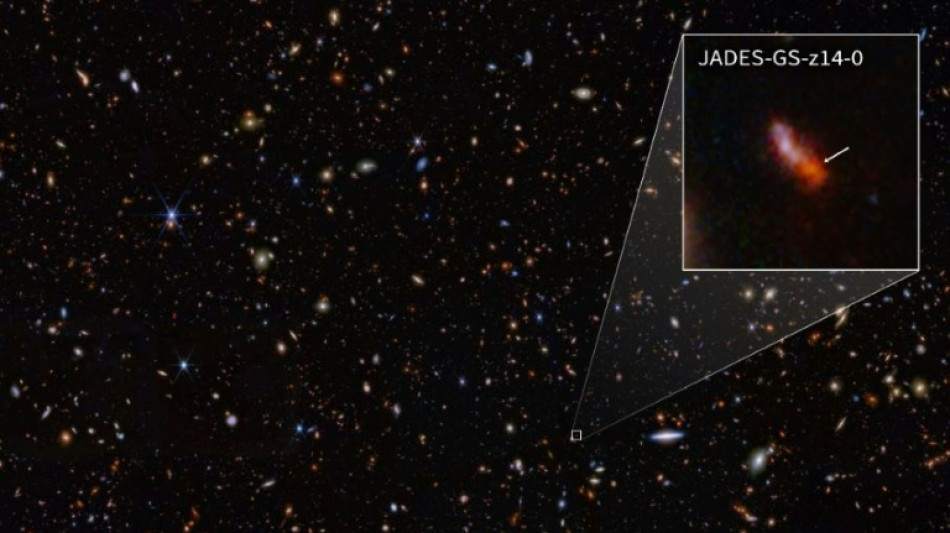
Webb telescope finds most distant galaxy ever observed, again / Photo: HANDOUT - ESA, NASA, CSA, STScI/AFP

Webb telescope finds most distant galaxy ever observed, again

The James Webb Space Telescope has discovered what appears to be a new record-holder for the most distant known galaxy, a remarkably bright star system that existed just 290 million years after the Big Bang, NASA said Thursday.

Text size:

Since coming online in 2022, the Webb telescope has ushered in a new era of scientific breakthroughs, peering farther than ever before into the universe's distant reaches -- which also means it is looking back in time.

And the latest finding has "profound implications" for our understanding of the so-called Cosmic Dawn, researchers said.

An international team of astronomers first spotted the galaxy called JADES-GS-z14-0 in early 2023, but they needed further observations to be sure it really was a record-breaker rather than a "confounding oddball," they said in a joint statement.

"The source was surprisingly bright, which we wouldn't expect for such a distant galaxy, and it was very close to another galaxy such that the two appeared to be part of one larger object," said Stefano Carniani from Scuola Normale Superiore in Italy and Kevin Hainline from the University of Arizona.

By the time light from the most distant galaxies reaches Earth, it has been stretched by the expansion of the universe and shifted to the infrared region of the light spectrum, which Webb is equipped to detect with unprecedented clarity.

The team carried out two confirmatory observations in October and then January -- first with Webb's primary imager called NIRCam, and second with its NIRSpec that analyzes the light from an object to determine its physical properties -- to be more certain of their hypothesis.

Not only does the new finding comfortably beat the previous record for oldest known galaxy -- which was held by JADES-GS-z13-0 that was present 320 million years after the Big Bang -- it also raises intriguing new questions for astronomy.

- Upends predictions -

"The most important aspect of JADES-GS-z14-0 was that at this distance, we know that this galaxy must be intrinsically very luminous," said Carniani and Hainline.

From the images, the galaxy was determined to be 1,600 light years across, suggesting that the light is coming from mostly young stars and not from emission near a growing supermassive black hole.

"This starlight implies that the galaxy is several hundreds of millions of times the mass of the Sun!" said the researchers. "This raises the question: How can nature make such a bright, massive, and large galaxy in less than 300 million years?"

Further analysis of the light emissions indicates the presence of oxygen, another surprising finding that points to "multiple generations of very massive stars had already lived their lives before we observed the galaxy."

Taken together, the observations of JADES-GS-z14-0 upend astronomical predictions of what the earliest galaxies may have looked like following the Big Bang 13.8 billion years ago.

Given the relatively small portion of the night sky they looked at, it's highly likely more luminous galaxies at possibly even earlier times will be found in the coming years, said the researchers, who will now look to publish their findings in a peer-reviewed journal.

S.Ogawa--JT