The Japan Times - Boeing won't fix leaky Starliner before flying first crew to ISS

EUR -
AED 4.244615
AFN 76.271918
ALL 93.366197
AMD 423.127183
AOA 1059.724062
ARS 1729.175777
AUD 1.636562
AWG 2.083045
AZN 1.957641
BAM 1.957599
BBD 2.326338
BDT 142.971375
BHD 0.43579
BIF 3458.258419
BMD 1.155642
BND 1.481061
BOB 14.027586
BRL 5.93827
BSD 1.155061
BTN 109.807426
BWP 15.663325
BYN 3.416139
BYR 22650.58146
BZD 2.322984
CAD 1.618806
CDF 2612.906548
CHF 0.932447
CLF 0.026736
CLP 1055.7021
CNY 7.800486
CNH 7.79785
COP 3677.241005
CRC 523.781299
CUC 1.155642
CUP 30.624511
CVE 110.59024
CZK 24.186025
DJF 205.38031
DKK 7.475767
DOP 67.315816
DZD 153.48698
EGP 57.552815
ERN 17.334629
ETB 186.42297
FJD 2.553387
FKP 0.8589
GBP 0.857966
GEL 3.016319
GGP 0.8589
GHS 13.549949
GIP 0.8589
GMD 84.931373
GNF 10149.421488
GTQ 8.810096
GYD 241.612608
HKD 9.064618
HNL 30.958447
HRK 7.535247
HTG 151.01877
HUF 361.674896
IDR 20654.036712
ILS 3.47126
IMP 0.8589
INR 109.880802
IQD 1513.090368
IRR 1588776.499747
ISK 141.785837
JEP 0.8589
JMD 183.548662
JOD 0.819314
JPY 182.194461
KES 149.505174
KGS 101.061253
KHR 4681.281342
KMF 494.614915
KRW 1642.617952
KWD 0.357348
KYD 0.96258
KZT 542.015709
LAK 26109.426943
LBP 103430.10369
LKR 387.596159
LRD 208.480669
LSL 18.948812
LTL 3.412309
LVL 0.699036
LYD 7.351755
MAD 10.765192
MDL 20.068354
MGA 4916.411299
MKD 61.586591
MMK 2426.04177
MNT 4158.228086
MOP 9.331434
MRU 46.31656
MUR 54.303823
MVR 17.866105
MWK 2002.762338
MXN 19.920816
MYR 4.731317
MZN 73.845071
NAD 18.948812
NGN 1573.810703
NIO 42.509061
NOK 10.997146
NPR 175.693203
NZD 1.961696
OMR 0.444347
PAB 1.155036
PEN 3.909993
PGK 5.178759
PHP 70.091418
PKR 320.721208
PLN 4.300372
PYG 6888.329638
QAR 4.22278
RON 5.246149
RSD 117.338123
RUB 93.584616
RWF 1696.751792
SAR 4.33658
SBD 9.327822
SCR 15.500574
SDG 693.961358
SEK 10.955543
SGD 1.480296
SLE 27.6199
SOS 660.109426
SRD 43.530693
STD 23919.45433
STN 24.522534
SVC 10.106287
SZL 18.93348
THB 38.24539
TJS 10.660665
TMT 4.056303
TND 3.389114
TRY 54.972156
TTD 7.8352
TWD 37.31753
TZS 3062.448769
UAH 51.687796
UGX 4307.958553
USD 1.155642
UYU 46.442676
UZS 13730.616967
VES 871.59813
VND 30336.755811
VUV 138.173179
WST 3.162706
XAF 656.557465
XAG 0.018588
XAU 0.000272
XCD 3.12318
XCG 2.081622
XDR 0.817563
XOF 655.82124
XPF 119.331742
YER 275.44734
ZAR 18.845636
ZMK 10402.165875
ZMW 22.048783
ZWL 372.116224
  • CMSC

    -0.0100

    21.78

    -0.05%

  • BCC

    -1.8500

    84.64

    -2.19%

  • GSK

    -0.0800

    51.45

    -0.16%

  • NGG

    -0.2800

    80.14

    -0.35%

  • RELX

    -0.2400

    36.56

    -0.66%

  • RBGPF

    -1.2500

    69.74

    -1.79%

  • BTI

    0.2920

    59.412

    +0.49%

  • RIO

    2.4000

    101.41

    +2.37%

  • RYCEF

    0.6500

    21

    +3.1%

  • AZN

    5.6900

    161.31

    +3.53%

  • JRI

    -0.0360

    12.684

    -0.28%

  • CMSD

    -0.0690

    21.951

    -0.31%

  • VOD

    -0.3650

    15.325

    -2.38%

  • BP

    -0.7350

    41.705

    -1.76%

  • BCE

    -0.1200

    21.88

    -0.55%

Boeing won't fix leaky Starliner before flying first crew to ISS
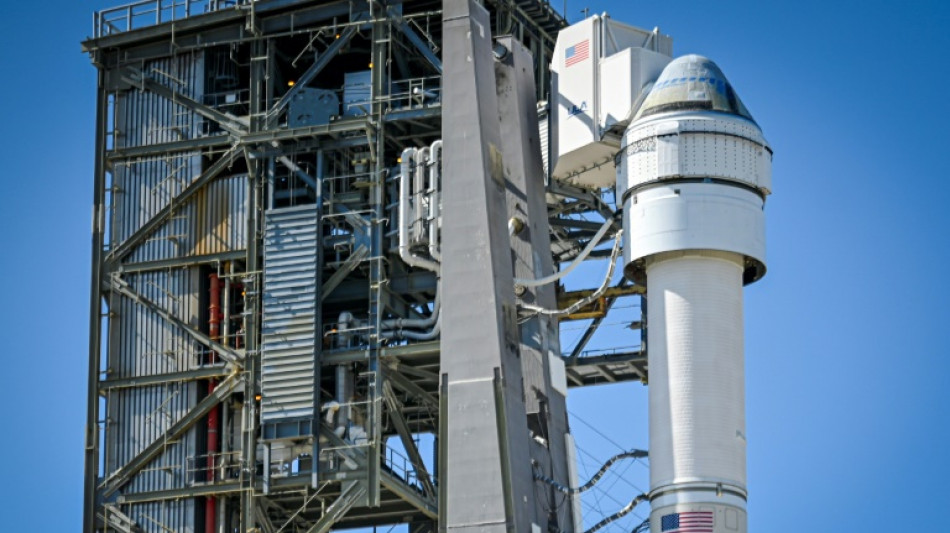
Boeing won't fix leaky Starliner before flying first crew to ISS / Photo: Miguel J. Rodriguez Carrillo - AFP/File

Boeing won't fix leaky Starliner before flying first crew to ISS

Boeing is set to launch its first crewed space mission in June without fixing a small helium gas leak on its troubled Starliner spaceship, officials said Friday.

Text size:

The vessel, under development since 2010, has been plagued by technical problems and has yet to fulfill its purpose of ferrying astronauts to the International Space Station, allowing Boeing's rival SpaceX to zoom ahead with its Crew Dragon capsule.

Starliner was supposed to finally fly astronauts Butch Wilmore and Suni Williams to the orbital outpost on May 6, but the mission was scrubbed hours before lift-off after a faulty valve was discovered on the United Launch Alliance rocket carrying it.

Since then, additional issues came to light, including a helium leak in the spacecraft's service module, which houses the propulsion system.

But while the rocket valve has been replaced, Boeing and NASA have made the decision to fly to the ISS without replacing a shirt button-sized seal on a leaking joint, officials told reporters.

"We can handle this particular leak if that leak rate were to grow even up to 100 times," said Steve Stich, manager of NASA's Commercial Crew Program. Moreover, it impacts just one of a set of 28 thrusters used to control the spaceship's attitude, he added.

Instead, teams will monitor the leak during the hours before launch, scheduled for June 1 at 12:25 pm (1625 GMT) from Cape Canaveral Space Force Station in Florida.

Asked why Boeing wouldn't just replace the seal, Mark Nappi, the company's vice president for the commercial crew program, said the process would be "quite involved" and require taking apart Starliner at its factory.

Stich added that it wasn't unheard of to fly with leaks -- space shuttles encountered similar problems at times, "and we've had a couple of cases with Dragon where we've had a few small leaks as well," he added.

The much-delayed mission comes at a challenging time for Boeing, as a safety crisis engulfs the century-old aerospace titan's commercial aviation arm.

NASA is banking on Starliner's success in order to achieve its goal of certifying a second commercial vehicle to carry crews to the ISS, which it has sought since the last space shuttle flew in 2011.

A successful mission would help dispel the bitter taste left by numerous setbacks in the Starliner program.

In 2019, during a first uncrewed test flight, a software defect meant the capsule failed to rendezvous with the ISS. A second software bug could have caused a catastrophic collision between its modules, but was caught and fixed just in time.

Then in 2021, with the rocket on the launchpad for a new flight, blocked valves forced another postponement.

The vessel finally reached the ISS in May 2022 in a non-crewed launch. But other problems including weak parachutes and flammable tape in the cabin that needed to be removed caused further delays to the crewed test.

T.Ikeda--JT