CMSC
-0.0200

Auroras lit up skies across swaths of the planet for the second night in a row on Saturday, after already dazzling Earthlings from the United States to Tasmania to the Bahamas the day before.
A powerful solar storm -- which could continue into Sunday -- has triggered spectacular celestial shows usually confined to the far northern reaches of the planet, hence their nickname of the "northern lights."
"I have the sensation of living through a historic night in France... It was really charged, with solar particles and emotions," Eric Lagadec, an astrophysicist at the Observatoire de Cote d'Azur, wrote on social media after the first night.
"Find good spots, away from the lights, with a clear view to the north!"
Late Saturday evening, pictures again started trickling onto social media as people in the United States reported sightings, though not as strong as Friday night's.
The first of several coronal mass ejections (CMEs) -- expulsions of plasma and magnetic fields from the Sun -- came just after 1600 GMT Friday, according to the US-based National Oceanic and Atmospheric Administration (NOAA)'s Space Weather Prediction Center (SWPC).
It was later upgraded to an "extreme" geomagnetic storm -- the first since the "Halloween Storms" of October 2003 that caused blackouts in Sweden and damaged power infrastructure in South Africa.
Friday's storm was listed as hitting level five geomagnetic conditions -- the highest on the scale. Saturday saw G3 to G5 conditions, with G4 or higher conditions predicted Sunday and G3 conditions possible into Monday.
But no major disruptions to power or communications networks appear to have been reported this time around, despite initial worries from authorities.
There have only been "preliminary reports of power grid irregularities, degradation to high-frequency communications, GPS and possibly satellite navigation," the SWPC said.
Elon Musk, whose Starlink satellite internet operator has some 5,000 satellites in low Earth orbit, said his satellites were "under a lot of pressure, but holding up so far."
However China's National Center for Space Weather issued a "red alert" Saturday morning, warning the storm will impact communications and navigation in most areas of the country, state news agency Xinhua reported.
Auroras were visible in the northern half of the country, according to media reports.
- Worldwide excitement -
Excitement over the phenomenon -- and otherworldly photos pink, green and purple night skies -- popped up across the world, from Mont Saint-Michel on the French coast to Payette, Idaho -- in the western United States -- to Australia's island state of Tasmania.
Unlike solar flares, which travel at the speed of light and reach Earth in around eight minutes, CMEs travel at a more sedate pace, with officials putting the current average at 800 kilometers (500 miles) per second.
The CMEs emanated from a massive sunspot cluster that is 17 times wider than our planet.
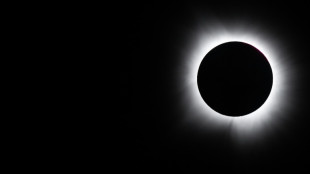
People with eclipse glasses can also look for the sunspot cluster during the day.
The Sun is approaching the peak of an 11-year cycle that brings heightened activity.
NOAA's Brent Gordon encouraged the public to try to capture the night sky with phone cameras even if they couldn't see auroras with their naked eyes.
"You'd be amazed at what you see in that picture versus what you see with your eyes."
- Spacecraft and pigeons -
Fluctuating magnetic fields associated with geomagnetic storms induce currents in long wires, including power lines, which can potentially lead to blackouts. Long pipelines can also become electrified, leading to engineering problems.
Spacecraft are also at risk from high doses of radiation, although the atmosphere prevents this from reaching Earth.
NASA has a dedicated team looking into astronaut safety and can ask astronauts on the International Space Station to move to places within the outpost that are better shielded.
The most powerful geomagnetic storm in recorded history, known as the Carrington Event after British astronomer Richard Carrington, occurred in September 1859.
H.Nakamura--JT