The Japan Times - Object found in the Milky Way 'unlike anything astronomers have seen'

EUR -
AED 4.392152
AFN 77.725587
ALL 96.672854
AMD 453.321241
ANG 2.140553
AOA 1096.536528
ARS 1726.354217
AUD 1.702659
AWG 2.15391
AZN 2.033848
BAM 1.957275
BBD 2.408115
BDT 146.100104
BGN 2.008168
BHD 0.450751
BIF 3541.969294
BMD 1.195786
BND 1.51254
BOB 8.261226
BRL 6.227054
BSD 1.195601
BTN 110.003901
BWP 15.59175
BYN 3.377445
BYR 23437.408869
BZD 2.404612
CAD 1.615896
CDF 2678.561483
CHF 0.916074
CLF 0.026
CLP 1026.642284
CNY 8.316274
CNH 8.309949
COP 4352.661647
CRC 591.5458
CUC 1.195786
CUP 31.688333
CVE 110.34816
CZK 24.311169
DJF 212.515477
DKK 7.466943
DOP 75.116609
DZD 154.547848
EGP 55.98635
ERN 17.936793
ETB 185.990966
FJD 2.624154
FKP 0.867664
GBP 0.866562
GEL 3.222681
GGP 0.867664
GHS 13.061844
GIP 0.867664
GMD 87.292383
GNF 10491.906897
GTQ 9.173914
GYD 250.138509
HKD 9.333768
HNL 31.552779
HRK 7.535726
HTG 156.718106
HUF 380.793919
IDR 20077.249741
ILS 3.699996
IMP 0.867664
INR 109.878519
IQD 1566.280378
IRR 50372.492465
ISK 145.00113
JEP 0.867664
JMD 187.60138
JOD 0.847828
JPY 182.882941
KES 154.2563
KGS 104.572042
KHR 4808.623869
KMF 492.664252
KPW 1076.287842
KRW 1714.135323
KWD 0.366425
KYD 0.996351
KZT 600.612633
LAK 25718.381853
LBP 107067.187834
LKR 369.918778
LRD 221.18669
LSL 18.864417
LTL 3.530846
LVL 0.723319
LYD 7.51066
MAD 10.82726
MDL 20.110155
MGA 5344.027359
MKD 61.830948
MMK 2511.644633
MNT 4265.240494
MOP 9.612344
MRU 47.692942
MUR 53.990114
MVR 18.486994
MWK 2073.162374
MXN 20.62846
MYR 4.696452
MZN 76.243574
NAD 18.864417
NGN 1660.038615
NIO 44.003162
NOK 11.427375
NPR 176.006642
NZD 1.971959
OMR 0.45974
PAB 1.195601
PEN 3.998413
PGK 5.195916
PHP 70.549589
PKR 334.443043
PLN 4.207314
PYG 8023.046318
QAR 4.358485
RON 5.098113
RSD 117.393954
RUB 89.984025
RWF 1744.414623
SAR 4.485017
SBD 9.659173
SCR 16.575561
SDG 719.266256
SEK 10.540765
SGD 1.512418
SHP 0.897149
SLE 29.055949
SLL 25075.037148
SOS 682.114054
SRD 45.444057
STD 24750.35937
STN 24.518478
SVC 10.461884
SYP 13224.88667
SZL 18.858212
THB 37.434099
TJS 11.167016
TMT 4.185252
TND 3.42398
TOP 2.879166
TRY 51.908359
TTD 8.115116
TWD 37.536328
TZS 3067.191445
UAH 51.169262
UGX 4253.205295
USD 1.195786
UYU 45.244097
UZS 14548.964371
VES 428.660821
VND 31090.440337
VUV 142.978985
WST 3.248725
XAF 656.451714
XAG 0.010348
XAU 0.000223
XCD 3.231672
XCG 2.154824
XDR 0.815555
XOF 656.451714
XPF 119.331742
YER 285.072955
ZAR 18.876633
ZMK 10763.513161
ZMW 23.642818
ZWL 385.042658
  • SCS

    0.0200

    16.14

    +0.12%

  • RBGPF

    0.0000

    82.4

    0%

  • CMSC

    -0.0300

    23.67

    -0.13%

  • RYCEF

    -0.1700

    16.43

    -1.03%

  • BCC

    -1.3700

    79.48

    -1.72%

  • NGG

    -0.1300

    84.55

    -0.15%

  • AZN

    -0.2300

    92.99

    -0.25%

  • BTI

    0.0200

    60.18

    +0.03%

  • GSK

    0.7750

    50.875

    +1.52%

  • RIO

    1.4900

    94.86

    +1.57%

  • VOD

    0.0600

    14.63

    +0.41%

  • RELX

    -1.4650

    35.915

    -4.08%

  • BCE

    0.3050

    25.575

    +1.19%

  • JRI

    0.0150

    13.005

    +0.12%

  • CMSD

    0.0692

    24.12

    +0.29%

  • BP

    0.4050

    38.105

    +1.06%

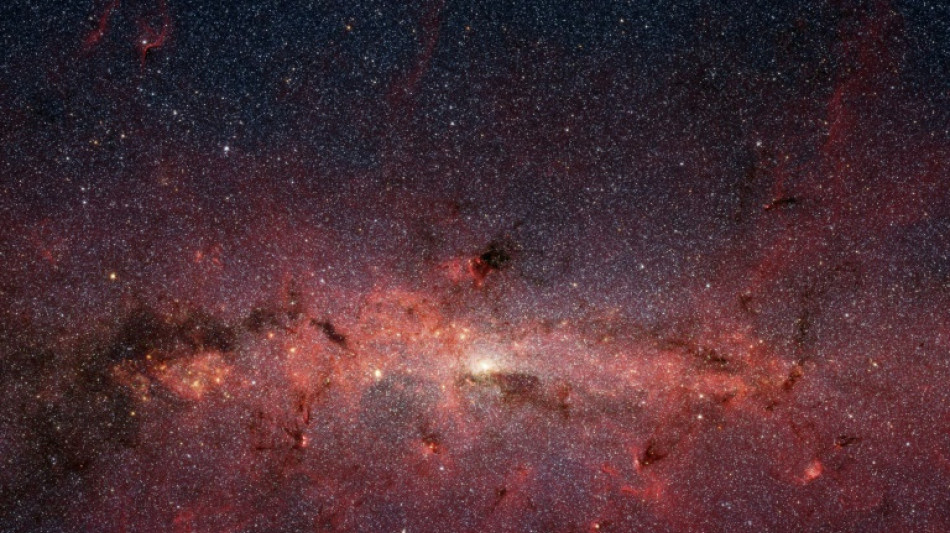
Object found in the Milky Way 'unlike anything astronomers have seen'


Object found in the Milky Way 'unlike anything astronomers have seen'

Australian researchers have discovered a strange spinning object in the Milky Way they say is unlike anything astronomers have ever seen.

Text size:

The object, first spotted by a university student working on his undergraduate thesis, releases a huge burst of radio energy three times every hour.

The pulse comes "every 18.18 minutes, like clockwork," said astrophysicist Natasha Hurley-Walker, who led the investigation after the student's discovery, using a telescope in the Western Australian outback known as the Murchison Widefield Array.

While there are other objects in the universe that switch on and off -- such as pulsars -- Hurley-Walker said 18.18 minutes is a frequency that has never been observed before.

Finding this object was "kind of spooky for an astronomer," she said, "because there's nothing known in the sky that does that."

The research team is now working to understand what they have found.

Trawling back through years of data, they have been able to establish a few facts: the object is about 4,000 light-years from Earth, is incredibly bright and has an extremely strong magnetic field.

But there are still many mysteries to untangle.

"If you do all of the mathematics, you find that they shouldn't have enough power to produce these kind of radio waves every 20 minutes," Hurley-Walker said.

"It just shouldn't be possible."

The object may be something researchers have theorised could exist but have never seen called an "ultra-long period magnetar".

It could also be a white dwarf, a remnant of a collapsed star.

"But that's quite unusual as well. We only know of one white dwarf pulsar, and nothing as great as this," Hurley-Walker said.

"Of course, it could be something that we've never even thought of -- it could be some entirely new type of object."

On the question of whether the powerful, consistent radio signal from space could have been sent by some other life form, Hurley-Walker conceded: "I was concerned that it was aliens."

But the research team was able to observe the signal across a wide range of frequencies.

"That means it must be a natural process, this is not an artificial signal," Hurley-Walker said.

The next step for the researchers is to look for more of these strange objects across the universe.

"More detections will tell astronomers whether this was a rare one-off event or a vast new population we'd never noticed before," Hurley-Walker said.

The team's paper on the object has been published in the latest edition of the journal Nature.

K.Tanaka--JT