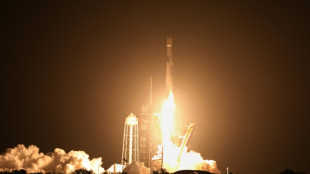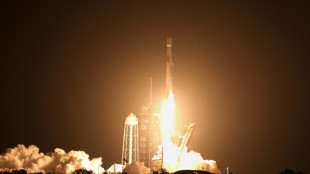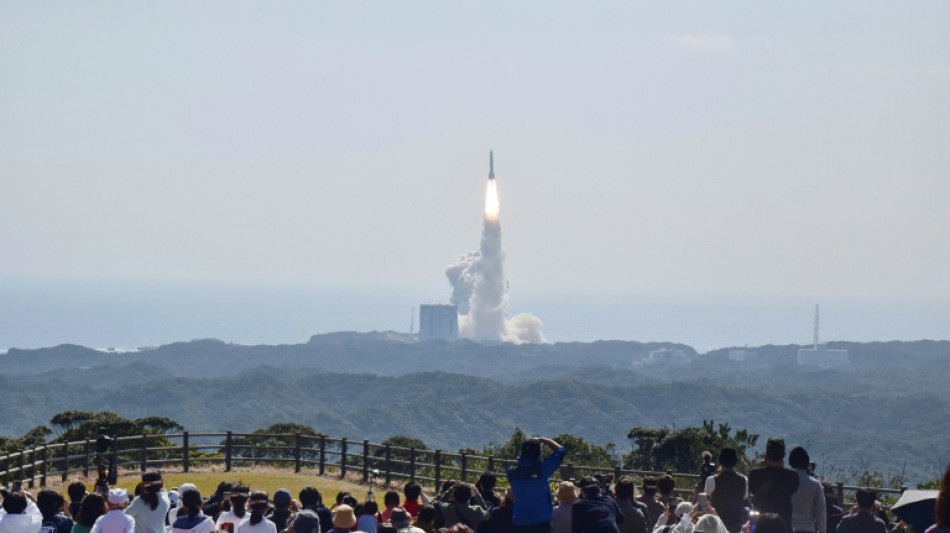
Japan makes third attempt to launch next-gen rocket / Photo: STR - JIJI PRESS/AFP/File

Japan's space agency will try to launch its new flagship rocket on Saturday, hoping for third time lucky following years of delays and two aborted attempts.
The next-generation H3 rocket has been mooted as a possible competitor to Space X's Falcon 9, and could one day be used to deliver cargo to bases on the Moon.
But that's only if Japan -- which last month landed an unmanned probe on the Moon at a wonky angle -- can get it into orbit.
The first H3 launch a year ago was abandoned after ignition issues left the rocket standing motionless on the ground.
And on the second try in March, technical problems meant a destruct command was issued shortly after blast-off.
Designed for "high flexibility, high reliability, and high cost performance", the H3 will "maintain Japan's autonomous access to space", space agency JAXA says.
The rocket, billed as a flexible and cost-effective new flagship, is scheduled to lift off between 9:22 am and 1:06 pm (0022 and 0406 GMT) from the Tanegashima Space Center in southwestern Japan.
Co-developed with Mitsubishi Heavy Industries and intended for more frequent commercial launches, it is the successor to the country's H-IIA model, which debuted in 2001.
H3 will be "an all-rounder -- able to launch satellites into Earth orbit, serve as a supply vehicle for space stations, and go to the Moon," said associate professor Alice Gorman, a space exploration expert at Flinders University.
But "there's a common saying that 'space is hard', to explain why launch failures are a fact of life," she told AFP, comparing the attempts to "training for a marathon".
A successful launch on Saturday would bolster JAXA's reputation after a string of failures, including of a different rocket, a solid-fuel model called the Epsilon-6.
- 'Greater thrust' -
Last month the country made a historic soft lunar touchdown with its SLIM spacecraft, dubbed the "Moon Sniper" for its precision technology.
But the SLIM landed with its solar panels facing the wrong way, meaning it could only be used when the sun's angle changed direction.
Overall, Japan's space programme punches above its weight, said Adrian Michael Cruise, an honorary professor of astrophysics at the University of Birmingham.
The country "has future ambitions for space exploration challenging some of the major players," he said.
"However, space payloads are getting heavier and heavier, and to remain competitive in the missions it can mount, Japan needs access to more powerful launch vehicles, like H3."
The rocket's development could potentially also have "military-related uses", Cruise added.
While the main goal of Saturday's mission is to prove the rocket can get into orbit, it will also carry two small observation satellites.
One is expected to contribute to disaster prevention by taking pictures and video footage. The other, equipped with a sensor to detect infrared rays, is aimed at detecting the operation conditions of factories on the ground.
Unlike the reusable Falcon 9, the H3 is expendable, but scientists say the trial of its world-first technology is significant.
"The H3 rocket has a unique and novel first stage engine that delivers greater thrust compared to state-of-the-art rockets," said Michele Trenti, director of the Melbourne Space Laboratory at the University of Melbourne.
And the H3 "has the potential to be the most cost-effective rocket", making the exploration of the solar system more affordable.
T.Sasaki--JT