The Japan Times - The feline frontier: NASA sends cat video from deep space

EUR -
AED 4.301382
AFN 77.612591
ALL 96.515658
AMD 446.872497
ANG 2.096992
AOA 1074.026857
ARS 1697.419947
AUD 1.770923
AWG 2.11116
AZN 1.990506
BAM 1.956117
BBD 2.359183
BDT 143.25324
BGN 1.956117
BHD 0.441572
BIF 3463.361867
BMD 1.17124
BND 1.514246
BOB 8.094313
BRL 6.490187
BSD 1.17129
BTN 104.952027
BWP 16.475673
BYN 3.442558
BYR 22956.304237
BZD 2.355782
CAD 1.615574
CDF 2996.619849
CHF 0.937644
CLF 0.027188
CLP 1066.578527
CNY 8.246642
CNH 8.24023
COP 4521.233487
CRC 584.994905
CUC 1.17124
CUP 31.03786
CVE 110.282891
CZK 24.323841
DJF 208.583839
DKK 7.472623
DOP 73.371903
DZD 152.342715
EGP 55.873064
ERN 17.5686
ETB 181.967121
FJD 2.674758
FKP 0.875394
GBP 0.880996
GEL 3.144811
GGP 0.875394
GHS 13.453183
GIP 0.875394
GMD 85.500068
GNF 10238.661034
GTQ 8.975456
GYD 245.059756
HKD 9.144454
HNL 30.858006
HRK 7.536231
HTG 153.574915
HUF 386.433658
IDR 19556.194482
ILS 3.756225
IMP 0.875394
INR 104.916756
IQD 1534.448936
IRR 49309.203978
ISK 147.143143
JEP 0.875394
JMD 187.420406
JOD 0.83038
JPY 184.4527
KES 150.984494
KGS 102.424761
KHR 4700.762612
KMF 491.921044
KPW 1054.115738
KRW 1728.422228
KWD 0.359839
KYD 0.976158
KZT 606.158338
LAK 25369.115672
LBP 104892.416862
LKR 362.658835
LRD 207.323634
LSL 19.649688
LTL 3.458367
LVL 0.708471
LYD 6.34903
MAD 10.736642
MDL 19.830217
MGA 5326.864186
MKD 61.559987
MMK 2459.939985
MNT 4159.208977
MOP 9.388123
MRU 46.876605
MUR 54.053231
MVR 18.095992
MWK 2031.129513
MXN 21.126819
MYR 4.775164
MZN 74.835105
NAD 19.649688
NGN 1710.19733
NIO 43.106993
NOK 11.868808
NPR 167.923242
NZD 2.036614
OMR 0.451423
PAB 1.17129
PEN 3.94454
PGK 4.982808
PHP 68.60069
PKR 328.176741
PLN 4.204629
PYG 7858.27486
QAR 4.270293
RON 5.077795
RSD 117.399046
RUB 94.265293
RWF 1705.476682
SAR 4.393298
SBD 9.541798
SCR 17.757881
SDG 704.57615
SEK 10.840933
SGD 1.514529
SHP 0.878733
SLE 28.16805
SLL 24560.321726
SOS 668.208405
SRD 45.024225
STD 24242.303527
STN 24.503975
SVC 10.248663
SYP 12952.112504
SZL 19.647187
THB 36.806238
TJS 10.793751
TMT 4.09934
TND 3.428556
TOP 2.820065
TRY 50.066418
TTD 7.95029
TWD 36.916193
TZS 2922.474118
UAH 49.526335
UGX 4189.679698
USD 1.17124
UYU 45.987461
UZS 14081.284429
VES 330.476672
VND 30818.252819
VUV 141.754875
WST 3.265216
XAF 656.063434
XAG 0.017438
XAU 0.00027
XCD 3.165334
XCG 2.111042
XDR 0.815932
XOF 656.063434
XPF 119.331742
YER 279.230391
ZAR 19.635845
ZMK 10542.568415
ZMW 26.501299
ZWL 377.138806
  • SCS

    0.0200

    16.14

    +0.12%

  • CMSC

    -0.1200

    23.17

    -0.52%

  • JRI

    -0.0500

    13.38

    -0.37%

  • NGG

    -0.2800

    76.11

    -0.37%

  • BCC

    -2.9300

    74.77

    -3.92%

  • RBGPF

    0.0000

    80.22

    0%

  • GSK

    0.3200

    48.61

    +0.66%

  • RIO

    0.6900

    78.32

    +0.88%

  • RYCEF

    0.2800

    15.68

    +1.79%

  • BCE

    -0.0100

    22.84

    -0.04%

  • BTI

    -0.5900

    56.45

    -1.05%

  • CMSD

    -0.0300

    23.25

    -0.13%

  • VOD

    0.0400

    12.84

    +0.31%

  • RELX

    0.0800

    40.73

    +0.2%

  • BP

    0.6300

    33.94

    +1.86%

  • AZN

    0.7500

    91.36

    +0.82%

The feline frontier: NASA sends cat video from deep space
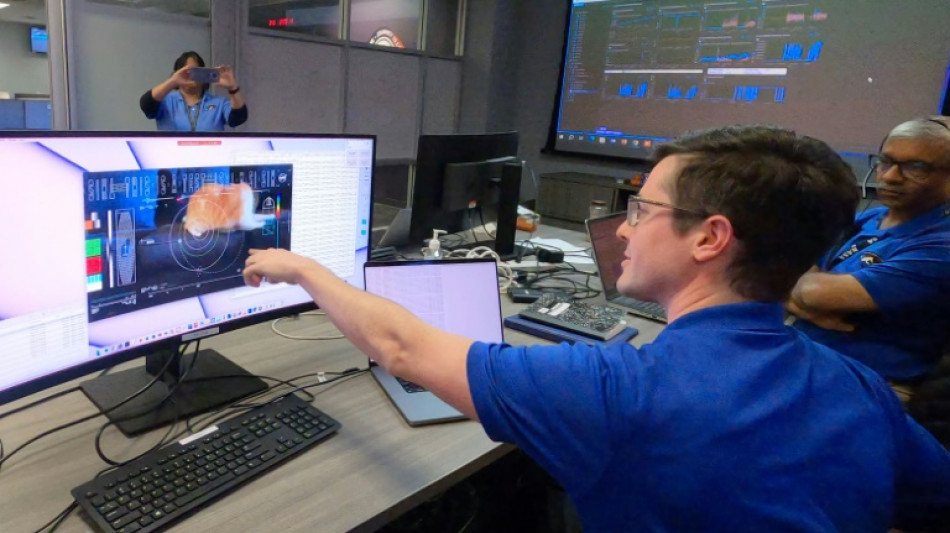
The feline frontier: NASA sends cat video from deep space / Photo: Handout - NASA/JPL-Caltech/AFP

The feline frontier: NASA sends cat video from deep space

NASA on Monday announced it had used a state-of-the-art laser communication system on a spaceship 19 million miles (31 million kilometers) away from Earth -- to send a high-definition cat video.

Text size:

The 15-second meow-vie featuring an orange tabby named Taters is the first to be streamed from deep space, and demonstrates it's possible to transmit the higher-data-rate communications needed to support complex missions such as sending humans to Mars.

The video was beamed to Earth using a laser transceiver on the Psyche probe, which is journeying to the main asteroid belt between Mars and Jupiter to explore a mysterious metal-rich object. When it sent the video, the spaceship was 80 times the distance between the Earth and Moon.

The encoded near-infrared signal was received by the Hale Telescope at Caltech's Palomar Observatory in San Diego County, and from there sent to NASA's Jet Propulsion Laboratory (JPL) in Southern California.

"One of the goals is to demonstrate the ability to transmit broadband video across millions of miles. Nothing on Psyche generates video data, so we usually send packets of randomly generated test data," said Bill Klipstein, the tech demo's project manager at JPL.

"But to make this significant event more memorable, we decided to work with designers at JPL to create a fun video, which captures the essence of the demo as part of the Psyche mission."

Space missions have traditionally relied on radio waves to send and receive data, but working with lasers can increase the data rate by 10 to 100 times.

- Giant pounce for catkind -

The ultra-HD video took 101 seconds to send to Earth at the system's maximum bit rate of 267 megabits per second -- faster than most home broadband connections.

"In fact, after receiving the video at Palomar, it was sent to JPL over the internet, and that connection was slower than the signal coming from deep space," said Ryan Rogalin, the project's receiver electronics lead at JPL.

So why a cat video? First, there's the historic connection, said JPL. When American interest in television began growing in the 1920s, a statue of Felix the Cat was broadcast to serve as a test image.

And while cats may claim the title as man's best friend, few can dispute their number-one position when it comes to internet videos and meme culture.

Uploaded before launch, the clip shows Tabby, the pet of a JPL employee, chasing a laser light on a couch, with test graphics overlayed. These include Psyche's orbital path and technical information about the laser and its data bit rate.

While laser transmission has been demonstrated in low Earth orbit and as far away as the Moon, the Psyche mission is the first time it's been deployed in deep space. Aiming a laser beam from millions of miles away requires extremely precise "pointing," a major technical hurdle engineering teams had to solve.

The technology demonstration even needs to compensate for the fact that in the time it takes for light to travel from the spacecraft to Earth, both the probe and the planet will have moved -- so the uplink and downlink lasers need to adjust for the change accordingly.

K.Okada--JT