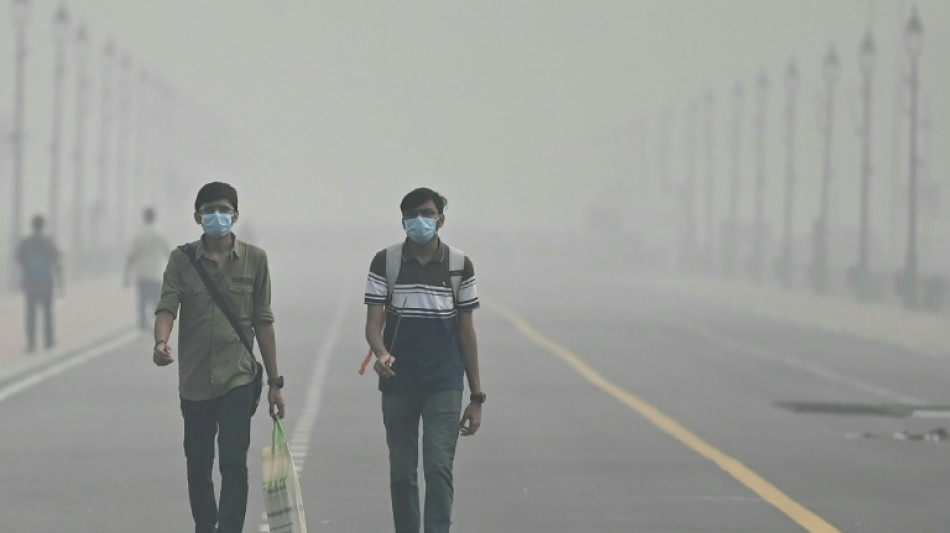
Heat, disease, air pollution: How climate change impacts health / Photo: Arun SANKAR - AFP/File

Growing calls for the world to come to grips with the many ways that global warming affects human health have prompted the first day dedicated to the issue at crunch UN climate talks starting next week.
Extreme heat, air pollution and the increasing spread of deadly infectious diseases are just some of the reasons why the World Health Organization has called climate change the single biggest health threat facing humanity.
Global warming must be limited to the Paris Agreement target of 1.5 degrees Celsius "to avert catastrophic health impacts and prevent millions of climate change-related deaths", according to the WHO.
However, under current national carbon-cutting plans, the world is on track to warm up to 2.9C this century, the UN said this week.
While no one will be completely safe from the effects of climate change, experts expect that most at risk will be children, women, the elderly, migrants and people in less developed countries which have emitted the least planet-warming greenhouse gases.
On December 3, the COP28 negotiations in Dubai will host the first "health day" ever held at the climate negotiations.
- Extreme heat -
This year is widely expected to be the hottest on record. And as the world continues to warm, even more frequent and intense heatwaves are expected to follow.
Heat is believed to have caused more than 70,000 deaths in Europe during summer last year, researchers said this week, revising the previous number up from 62,000.
Worldwide, people were exposed to an average of 86 days of life-threatening temperatures last year, according to the Lancet Countdown report earlier this week.
The number of people over 65 who died from heat rose by 85 percent from 1991-2000 to 2013-2022, it added.
And by 2050, more than five times more people will die from the heat each year under a 2C warming scenario, the Lancet Countdown projected.
More droughts will also drive rising hunger. Under the scenario of 2C warming by the end of the century, 520 million more people will experience moderate or severe food insecurity by 2050.
Meanwhile, other extreme weather events such as storms, floods and fires will continue to threaten the health of people across the world.
- Air pollution -
Almost 99 percent of the world's population breathes air that exceeds the WHO's guidelines for air pollution.
Outdoor air pollution driven by fossil fuel emissions kills more than four million people every year, according to the WHO.
It increases the risk of respiratory diseases, strokes, heart disease, lung cancer, diabetes and other health problems, posing a threat that has been compared to tobacco.
The damage is caused partly by PM2.5 microparticles, which are mostly from fossil fuels. People breathe these tiny particles into their lungs, where they can then enter the bloodstream.
While spikes in air pollution, such as extremes seen in India's capital New Delhi earlier this month, trigger respiratory problems and allergies, long-term exposure is believed to be even more harmful.
However it is not all bad news.
The Lancet Countdown report found that deaths from air pollution due to fossil fuels have fallen 16 percent since 2005, mostly due to efforts to reduce the impact of coal burning.
- Infectious diseases -
The changing climate means that mosquitoes, birds and mammals will roam beyond their previous habitats, raising the threat that they could spread infectious diseases with them.
Mosquito-borne diseases that pose a greater risk of spreading due to climate change include dengue, chikungunya, Zika, West Nile virus and malaria.
The transmission potential for dengue alone will increase by 36 percent with 2C warming, the Lancet Countdown report warned.
Storms and floods create stagnant water that are breeding grounds for mosquitoes, and also increase the risk of water-borne diseases such as cholera, typhoid and diarrhoea.
Scientists also fear that mammals straying into new areas could share diseases with each other, potentially creating new viruses that could then jump over to humans.
- Mental health -
Worrying about the present and future of our warming planet has also provoked rising anxiety, depression and even post-traumatic stress -- particularly for people already struggling with these disorders, psychologists have warned.
In the first 10 months of the year, people searched online for the term "climate anxiety" 27 times more than during the same period in 2017, according to data from Google Trends cited by the BBC this week.
T.Sasaki--JT