The Japan Times - Water supply fears as Morocco hit by worst drought since 1980s

EUR -
AED 4.224876
AFN 72.462986
ALL 96.160604
AMD 434.099231
ANG 2.058963
AOA 1054.738043
ARS 1606.038123
AUD 1.628909
AWG 2.073245
AZN 1.957787
BAM 1.959215
BBD 2.316138
BDT 141.107219
BGN 1.966056
BHD 0.434221
BIF 3416.109293
BMD 1.150205
BND 1.471035
BOB 7.974972
BRL 6.040894
BSD 1.150005
BTN 106.071837
BWP 15.680472
BYN 3.425836
BYR 22544.020924
BZD 2.312943
CAD 1.573084
CDF 2605.214492
CHF 0.906057
CLF 0.026511
CLP 1046.813004
CNY 8.001115
CNH 7.92826
COP 4260.842959
CRC 540.146332
CUC 1.150205
CUP 30.480436
CVE 111.13859
CZK 24.454509
DJF 204.414853
DKK 7.471767
DOP 70.564391
DZD 152.131445
EGP 60.230841
ERN 17.253077
ETB 181.013531
FJD 2.547595
FKP 0.868334
GBP 0.863925
GEL 3.128823
GGP 0.868334
GHS 12.519984
GIP 0.868334
GMD 84.515954
GNF 10093.05076
GTQ 8.814443
GYD 240.721742
HKD 9.006578
HNL 30.561304
HRK 7.539937
HTG 150.724067
HUF 391.404502
IDR 19517.831177
ILS 3.591441
IMP 0.868334
INR 106.132132
IQD 1506.768745
IRR 1519478.512409
ISK 143.211796
JEP 0.868334
JMD 180.895354
JOD 0.815474
JPY 183.113233
KES 148.840282
KGS 100.58578
KHR 4622.10278
KMF 493.437605
KPW 1035.184626
KRW 1714.570528
KWD 0.353216
KYD 0.958279
KZT 555.322921
LAK 24700.655091
LBP 103000.87101
LKR 358.097383
LRD 210.775166
LSL 19.277199
LTL 3.396257
LVL 0.695748
LYD 7.3728
MAD 10.806191
MDL 20.009056
MGA 4779.102216
MKD 61.709926
MMK 2415.019418
MNT 4107.710362
MOP 9.274449
MRU 46.140499
MUR 53.806333
MVR 17.782217
MWK 1997.906655
MXN 20.371795
MYR 4.520887
MZN 73.509782
NAD 19.277204
NGN 1571.67499
NIO 42.235365
NOK 11.132226
NPR 169.721992
NZD 1.964872
OMR 0.442264
PAB 1.150015
PEN 3.943482
PGK 4.948754
PHP 68.636185
PKR 321.223553
PLN 4.272265
PYG 7464.01199
QAR 4.190485
RON 5.09484
RSD 117.426723
RUB 93.449256
RWF 1678.149313
SAR 4.316316
SBD 9.261061
SCR 16.378688
SDG 691.272965
SEK 10.749024
SGD 1.470163
SHP 0.862952
SLE 28.293004
SLL 24119.239327
SOS 657.347107
SRD 43.214935
STD 23806.924333
STN 24.844431
SVC 10.06263
SYP 127.126407
SZL 19.277227
THB 37.243559
TJS 11.039641
TMT 4.031469
TND 3.35973
TOP 2.769417
TRY 50.804333
TTD 7.798663
TWD 36.812088
TZS 2996.284814
UAH 50.697321
UGX 4341.606456
USD 1.150205
UYU 46.751909
UZS 13923.233407
VES 513.274734
VND 30238.893372
VUV 137.524572
WST 3.146058
XAF 657.108248
XAG 0.014306
XAU 0.00023
XCD 3.108487
XCG 2.072531
XDR 0.819555
XOF 661.945035
XPF 119.331742
YER 274.323586
ZAR 19.240229
ZMK 10353.228016
ZMW 22.395236
ZWL 370.365589
  • RBGPF

    0.1000

    82.5

    +0.12%

  • CMSC

    -0.0600

    22.93

    -0.26%

  • AZN

    1.9670

    191.867

    +1.03%

  • RIO

    2.1000

    89.93

    +2.34%

  • GSK

    0.6900

    54.08

    +1.28%

  • BTI

    1.3050

    61.235

    +2.13%

  • NGG

    -0.1000

    90.8

    -0.11%

  • CMSD

    0.0000

    22.99

    0%

  • RELX

    0.3900

    34.53

    +1.13%

  • BCE

    0.6971

    25.945

    +2.69%

  • BCC

    2.3550

    72.355

    +3.25%

  • JRI

    -0.0200

    12.57

    -0.16%

  • RYCEF

    -0.1500

    16.4

    -0.91%

  • BP

    0.4500

    43.12

    +1.04%

  • VOD

    0.2250

    14.635

    +1.54%

Water supply fears as Morocco hit by worst drought since 1980s


Water supply fears as Morocco hit by worst drought since 1980s

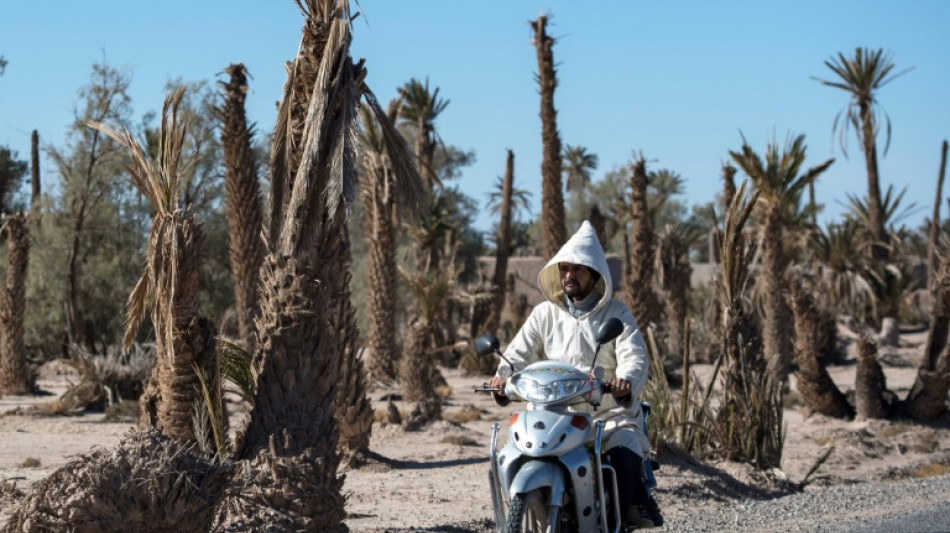
As Morocco withers under its worst drought in 40 years, experts warn that a combination of climate change and bad resource management could trigger severe drinking water shortages.

Text size:

"The country hasn't seen a situation like this since the start of the 1980s," said water policy expert Abderrahim Hendouf.

While it was usually farmers who bore the brunt of repeated droughts in the North African kingdom, today water supplies to cities are under threat, water minister Nizar Baraka told parliament in mid-March.

Morocco has had little rain since September, and authorities say its reservoirs have received just 11 percent of what they would in an average year.

"That's a worrying sign," Abdelaziz Zerouali, the water ministry's head of research and planning, told state television station M2, adding that some preemptive measures had been taken to mitigate the risks.

Two major cities, tourist hub Marrakesh and Oujda in the east, already started tapping into groundwater reserves in December to ensure adequate supplies.

The government in February also released a package of around one billion euros in aid to the beleaguered agricultural sector, which makes up some 14 percent of GDP and is the top employer in the Moroccan countryside.

"We need to change our vision of water," Zerouali told a conference on the right to water in Rabat.

"Climate change is real and we will have to face it."

- 'Absolute scarcity' -

Moroccans have access to just 600 cubic metres of water per person per year, far below the 2,600 cubic metres they enjoyed in the 1960s.

According to the United Nations' definition, water scarcity occurs when supplies drop below 1,000 cubic metres per person annually, while supplies of 500 cubic metres are considered "absolute scarcity".

The decline in supplies in Morocco is a result of a mix of environmental factors, high demand and over-exploitation of groundwater for farming, according to Baraka.

In a recent report for the Moroccan Institute for Policy Analysis, Amal Ennabih wrote that "Morocco's water scarcity is deeply linked to the way water is used in irrigation, consuming around 80 percent of Morocco's water annually".

The kingdom, with its Atlantic and Mediterranean coastlines, hopes desalination plants can help make up the deficit, although they are energy-intensive and pump brine back into the sea which causes its own environmental problems.

Moreover, efforts to build 15 more dams and more desalination facilities have been bogged down by delays.

One such plant has been under construction since 2020 near Casablanca, the country's commercial capital, which could face severe water shortages by 2025.

Baraka notes that a desalination plant meant to serve the northeastern resort town of Saidia has also yet to come online, causing water shortages.

Another desalination plant came online recently, supplying 70 percent of the needs of the Atlantic coastal city of Agadir, a tourist hub and centre of a major farming area.

That should provide some relief to a city that in autumn 2020 was so short of water that at night the taps ran dry.

K.Yamaguchi--JT