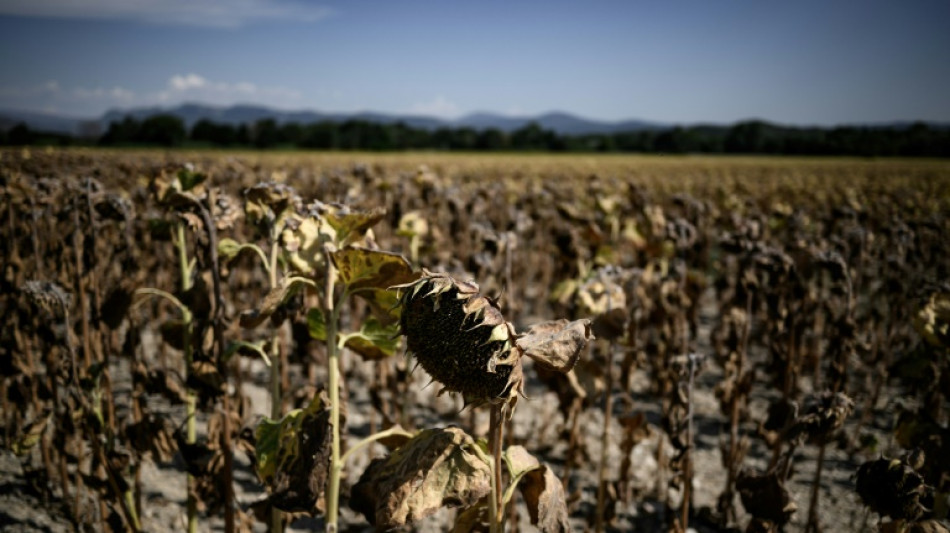
Climate 'countdown clock' report launched ahead of key UN talks / Photo: JEFF PACHOUD - AFP

Top scientists have launched a yearly report series to plug knowledge gaps ahead of crunch climate talks, with their global warming "countdown clock" vying for the attention of world leaders and ordinary citizens alike.
In a year marked by devastating extreme weather events, Dubai will host key UN negotiations starting on November 30 aimed at curbing greenhouse gas emissions and helping the developing world deal with climate impacts.
The UN scientific advisory panel in charge of summarising climate change research has produced comprehensive and authoritative assessment reports in cycles of five to seven years since 1988.
The Intergovernmental Panel on Climate Change (IPCC) has warned the world is on course to cross the key warming threshold of 1.5 degrees Celsius above pre-industrial levels in the early 2030s.
But the lengthy time lag between its gargantuan reports -- drawing from studies that may already have been superseded by new findings -- has sparked concern that backward-looking research is less useful for policymakers responding to a fast-moving climate emergency.
So 50 scientists, many lead IPCC contributors, teamed up to produce a paper on climate change in 2022 to update key metrics from the IPCC report.
"We cannot afford to wait" for the next IPCC assessment report in this "decade of action", said Peter Thorne, a professor of physical geography at Maynooth University in Ireland and co-author of the new report.
"If we are flying blind without information, we're going to make bad choices," he told AFP.
- 'Countdown clock' -
The first peer-reviewed report of the series, published in the journal Earth System Science Data in June, said human-induced warming reached 1.26C in 2022 and increased at an "unprecedented rate" of more than 0.2C per decade in the 2013-2022 period.
These were key updates to the IPCC report published less than a year earlier.
It also said there was evidence that increases in greenhouse gas emissions have slowed, and that a change of direction could be observed in future updates.
"This is an annual timely reminder" of climate change after the initial media frenzy around IPCC findings fades, said co-author Chris Smith, of Britain's University of Leeds.
"We have a much more COP (UN climate talks) and policy focus than the IPCC," which strives for political neutrality and consensus without recommending policies, he told AFP.
Key climate metrics are now being monitored in a more coordinated way thanks to the annual datasets, distinguishing the research from other annual climate reports, Smith added.
The work's strength lies in "the simplicity of updating this handful of key numbers" with "immediate policy relevance" so that negotiations and policy decisions happen with "meaningful and updated information", said Thorne.
"In a rational world, it should be ringing alarm bells."
Smith said the findings were "the closest number we can come up with that tells us where we are in relation to 1.5C... This is like a countdown clock."
The scientists also sought to open the work to a wider public, with web engineers designing an interactive online dashboard to present key results in a user-friendly way.
In contrast, IPCC reports can run to thousands of pages and are "scary to the general public", said Thorne.
- Piece of a 'mosaic' -
The new project is to "complement" rather than replace other yearly studies and the IPCC, which has given "tacit endorsement", said Smith.
The organisation faces a formidable workload, which is where the new initiative can step in to help.
IPCC reports outside the standard cycle of scheduled assessments can galvanise action. A 2018 paper on 1.5C, the aspirational target of the 2015 Paris Agreement, was seen as jolting businesses and countries into more ambitious change.
But IPCC chair Jim Skea has rejected publishing such reports on a more regular basis, saying they dragged on the organisation's core work and resources.
"Over my dead body will we see lots and lots of special reports," he told AFP in a July interview.
Producing the new work in a short space of time makes it less exhaustive, but it is "one piece in a mosaic" with other research by bodies including the UN's World Meteorological Organization, added Thorne.
Criticism about a lack of geographical diversity and wider engagement with the scientific community is "fair" and will be addressed in future reports, said Smith.
K.Tanaka--JT