Five things to know about NASA's mission to a metal world / Photo: Handout - NASA/JPL-Caltech/AFP

For the first time ever, a NASA probe is set to journey to an object composed not of rock, ice, or gas, but metal: the asteroid Psyche.
By studying this space oddity, scientists hope to learn more about the inner cores of rocky planets such as our own -- or, potentially catalog a previously unknown class of cosmic body.
Here are some big numbers and fun facts to dazzle your friends with about the mission.
- $10 quadrillion -
If Psyche were mineable, its iron, nickel and gold deposits could be worth an eye-watering $10,000 quadrillion (that's $10,000,000,000,000,000,000), according to an estimate reported by Forbes magazine.
But Lindy Elkins-Tanton, the mission's principal investigator who was responsible for that calculation, said it's nothing more than a "fun intellectual exercise with no truth to it."
"We have zero technology as a species to bring Psyche back to Earth," she said in a recent briefing. Attempting to do so could backfire by causing an apocalyptic collision -- but even if the endeavor were successful, it would flood the metals market, reducing their value to zero, she said.
- An electric voyage -
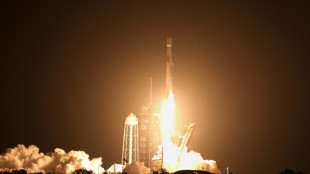
The Psyche probe will blast off on a SpaceX Falcon Heavy rocket, but to complete its 2.2 billion-mile (3.6 billion-kilometer) journey, it will turn to a far more efficient form of propulsion.
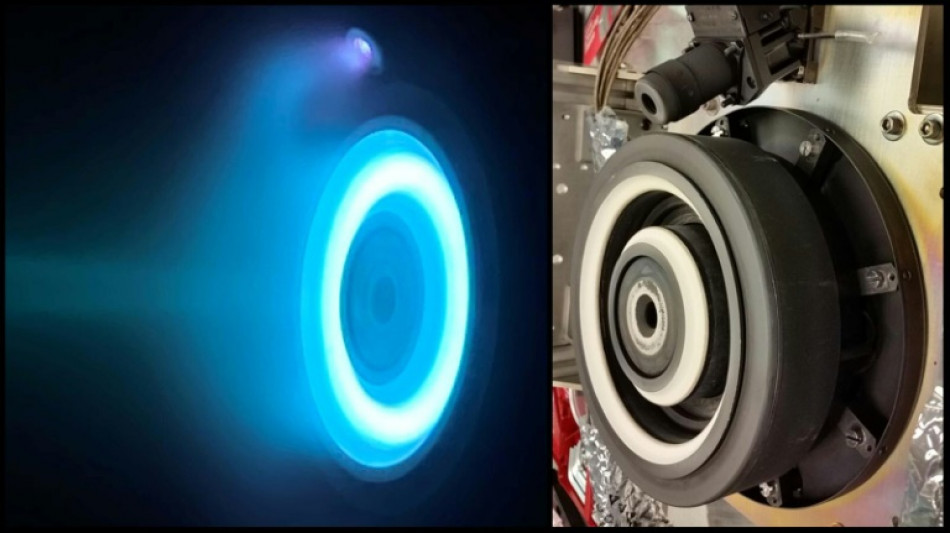
Psyche's solar arrays convert light into electricity, providing the power for its four solar electric or "Hall-effect" thrusters. These use electromagnetic fields to accelerate and expel ions (charged atoms) of xenon, the same inert gas used in car headlights and plasma TVs.
While the resulting blue glow is evocative of Star Trek, it's no warp drive: the actual force it exerts in a given moment is roughly equal to the weight of an AA battery in the palm of your hand.
But in the void of space, the probe will accelerate continuously to tens of thousands of miles an hour.
- Laser communications -
With deep space missions demanding higher and higher data rates, NASA is turning to laser-based systems to complement radio-frequency based communications.
Psyche will carry onboard a technology experiment, to demonstrate a "10 times augmentation of traditional telecom data rates," said Abi Biswas of NASA's Jet Propulsion Laboratory -- enabling the transmission of higher resolution images, more science data, and streaming video.
NASA will shoot its laser beam from a JPL facility on Table Mountain in California, with the spacecraft firing its signal back to Caltech's Palomar Observatory. The hope is eventually to use the technology on human missions to Mars.
- Gravity science -
Psyche has a suite of dedicated scientific instruments to probe the asteroid's chemical and mineral composition and look for signs of an ancient magnetic field.
But the science team will also use Psyche's trusty old radio system to probe the asteroid's gravity field using the Doppler Effect.
"We can look at the pitch or frequency of the radio waves coming from the antenna and figure out how fast the spacecraft is moving" as it orbits its target, said planetary scientist Ben Weiss, just as ambulance sirens have a higher pitch as they come towards you and lower as they move away.
By tracking the spacecraft's speed at different points around the asteroid, they can determine how "lumpy" the gravity field is, which in turn provides clues about the composition and structure of the interior.
- Less metal, more rock? -
Given its brightness, there was until recently broad consensus that Psyche was almost entirely metal -- consistent with the theory it is an exposed planetary core whose rocky crust and mantle were blown off in an ancient collision.
But the way it imposes gravity on neighboring bodies suggests it's less dense than all iron-body should be, according to a 2022 paper by researchers at Brown University.
One possibility they put forward is iron-spewing volcanoes brought metal up from Psyche's core to coat its surface above a rocky mantle -- effectively creating a structure akin to a metal sandwich.
It won't be until 2029, when the Psyche spacecraft reaches its destination, that we'll know for sure.
Y.Kato--JT