The Japan Times - 36-million-year-old whale fossil found in Peruvian desert

EUR -
AED 4.23802
AFN 75.009645
ALL 91.822462
AMD 419.371076
ANG 2.066061
AOA 1059.361499
ARS 1739.938845
AUD 1.617987
AWG 2.078622
AZN 1.96195
BAM 1.956713
BBD 2.324895
BDT 142.125725
BGN 1.942672
BHD 0.43519
BIF 3452.526508
BMD 1.153989
BND 1.46988
BOB 12.691979
BRL 5.942696
BSD 1.154344
BTN 110.764342
BWP 15.65624
BYN 3.505421
BYR 22618.177576
BZD 2.321533
CAD 1.608372
CDF 2668.601419
CHF 0.944638
CLF 0.027877
CLP 1100.731891
CNY 7.744937
CNH 7.738861
COP 3605.787561
CRC 516.338776
CUC 1.153989
CUP 30.580699
CVE 110.316493
CZK 24.317997
DJF 205.556839
DKK 7.475296
DOP 68.141511
DZD 154.49369
EGP 60.241788
ERN 17.30983
ETB 188.544523
FJD 2.553719
FKP 0.856186
GBP 0.857708
GEL 3.000867
GGP 0.856186
GHS 13.257246
GIP 0.856186
GMD 84.837295
GNF 10149.693636
GTQ 8.812151
GYD 241.503774
HKD 9.052683
HNL 30.981327
HRK 7.534742
HTG 150.871076
HUF 364.288252
IDR 20411.751273
ILS 3.493701
IMP 0.856186
INR 110.685058
IQD 1512.199303
IRR 1586272.80065
ISK 139.81731
JEP 0.856186
JMD 182.16503
JOD 0.818235
JPY 178.930566
KES 149.45276
KGS 100.916189
KHR 4674.141263
KMF 492.752932
KPW 1038.590154
KRW 1578.286984
KWD 0.356051
KYD 0.961945
KZT 513.264011
LAK 25840.501864
LBP 103369.297972
LKR 382.598587
LRD 200.272614
LSL 18.793154
LTL 3.407429
LVL 0.698036
LYD 7.331422
MAD 10.885181
MDL 20.125307
MGA 4991.221642
MKD 61.558734
MMK 2422.942927
MNT 4148.675915
MOP 9.327052
MRU 46.218574
MUR 54.549391
MVR 17.763357
MWK 2001.642987
MXN 19.780751
MYR 4.667653
MZN 73.751759
NAD 18.792991
NGN 1531.250478
NIO 42.479644
NOK 10.7937
NPR 177.229494
NZD 2.003018
OMR 0.443708
PAB 1.154314
PEN 3.872691
PGK 5.219436
PHP 72.405291
PKR 319.946943
PLN 4.356918
PYG 6830.188154
QAR 4.196359
RON 5.264035
RSD 117.381466
RUB 97.310084
RWF 1703.187624
SAR 4.331006
SBD 9.273741
SCR 15.783059
SDG 694.122339
SEK 11.277793
SGD 1.469339
SHP 0.856519
SLE 28.434169
SLL 24198.555665
SOS 659.705075
SRD 43.565958
STD 23885.235199
STN 24.511335
SVC 10.100671
SYP 15004.160744
SZL 18.790852
THB 38.34735
TJS 10.646724
TMT 4.0505
TND 3.379477
TOP 2.778528
TRY 56.150837
TTD 7.826416
TWD 36.669375
TZS 3052.303433
UAH 51.478729
UGX 4519.109402
USD 1.153989
UYU 46.441678
UZS 13609.352491
VES 970.716816
VND 30001.973964
VUV 136.35185
WST 3.15816
XAF 655.957
XAG 0.017845
XAU 0.000265
XCD 3.118712
XCG 2.080362
XDR 0.81593
XOF 655.957
XPF 119.331742
YER 272.933541
ZAR 18.761513
ZMK 10387.282953
ZMW 22.653476
ZWL 371.583875
SSP 6526.132978
MXV 2.242868
  • RYCEF

    0.2600

    19.3

    +1.35%

  • CMSC

    0.1500

    20.47

    +0.73%

  • BTI

    -0.1350

    56.385

    -0.24%

  • NGG

    1.5000

    76.43

    +1.96%

  • RBGPF

    0.0000

    69.99

    0%

  • GSK

    0.1950

    50.205

    +0.39%

  • VOD

    -0.1050

    17.575

    -0.6%

  • BP

    -1.1200

    45.84

    -2.44%

  • RIO

    -0.0950

    97.165

    -0.1%

  • BCE

    -0.2950

    22.605

    -1.31%

  • CMSD

    0.1800

    20.25

    +0.89%

  • RELX

    0.1750

    34.395

    +0.51%

  • JRI

    0.0300

    11.65

    +0.26%

  • BCC

    0.1950

    76.125

    +0.26%

  • AZN

    1.5500

    163.4

    +0.95%

36-million-year-old whale fossil found in Peruvian desert


36-million-year-old whale fossil found in Peruvian desert

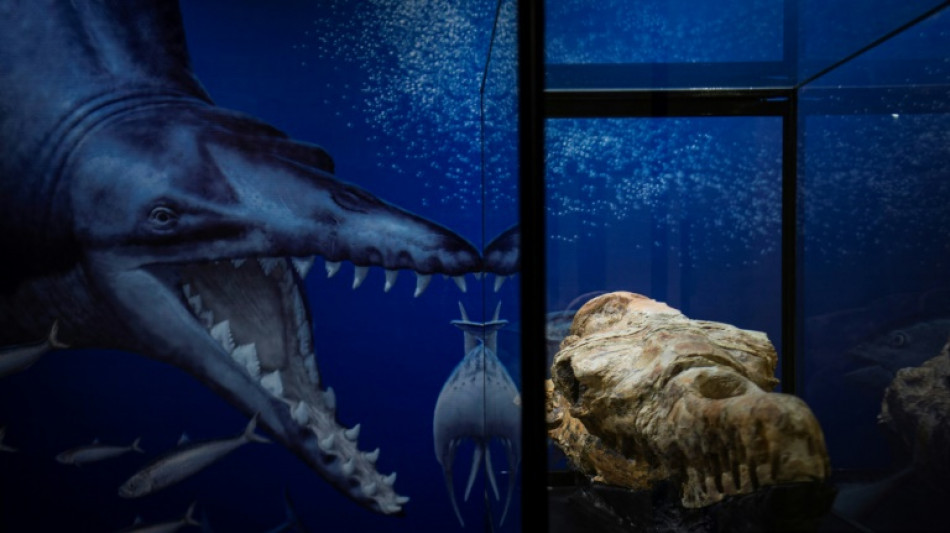
Paleontologists on Thursday unveiled the fossilized remains of an ancient whale that inhabited the seas 36 million years ago, found last year in a Peruvian desert.

Text size:

"We have presented the new Peruvian basilosaurus, it is the complete skull of an archaic whale that lived 36 million years ago," paleontologist Mario Urbina, head of the team that discovered the skeleton, told AFP.

Urbina said the basilosaurus was found at the end of 2021 in the Ocucaje Desert in the Ica department, about 350 kilometers (215 miles) south of Lima. The desolate landscape was a shallow sea millions of years ago, and its dunes have yielded large numbers of striking primitive sea mammal remains.

The "Ocucaje Predator," as the researchers dubbed it, was about 17 meters (55 feet) long and used its massive, powerful teeth to feed on tuna, sharks and schools of sardines.

"This finding is very important because there are no other similar specimens discovered in the world," said Urbina, a researcher at the National University of San Marcos, in Lima.

Team member Rodolfo Salas-Gismondi explained the basilosaurus differs from other known ancient whale species by its size and the development of its teeth, both of which indicate the animal was likely at the top of the food chain.

"This is an extraordinary find because of its great state of preservation," he told AFP. "This animal was one of the largest predators of its time."

"At that time the Peruvian sea was warm," added Salas-Gismondi, who heads the Department of Vertebrate Paleontology at the Natural History Museum in Lima. "Thanks to this type of fossil, we can reconstruct the history of the Peruvian sea."

The first cetaceans, like the basilosaurus, evolved from land animals some 55 million years ago.

By the late Eocene period (between 56 million and 34 million years ago), cetaceans had fully adapted to marine life.

Whales had not yet evolved, and almost all cetaceans were marine macropredators, according to the research team.

The Ocucaje Desert is rich in fossils, the researchers said, providing scientists with 42 million years' worth of evolutionary evidence.

Other fossils found there include four-legged dwarf whales, dolphins, sharks and other species from the Miocene period (between 23 million and five million years ago).

T.Sasaki--JT