'It hurts my heart': Japan's Kanto massacre, 100 years on / Photo: Richard A. Brooks - AFP

This week Japan marks 100 years since the Great Kanto Earthquake that killed 105,000 people. Less well known is the subsequent massacre of thousands of ethnic Koreans that haunts the community to this day.
Over several days of horror after the quake of September 1, 1923, mobs armed with swords, iron bars and bamboo sticks went on a killing spree of Koreans living in the Tokyo region, after malicious rumours spread about the community.
Historians say that soldiers with machine guns from the imperial military actively participated -- something Japan is yet to fully face up to.
Kim Do-im, 86, believes her uncle was among those murdered in the flaming ruins of Tokyo after the quake. His body was never found.
"His tomb is in Korea but it doesn't contain his ashes," Kim, who was born and grew up in Japan, told AFP.
"My uncle was 33 when he died. He had three children," she said. "I first heard the story when I was around five years old... It hurts my heart."
- Deadly inferno -
The death toll from the 7.9-magnitude quake, one of the deadliest of the 20th century, was made much worse by huge blazes that ripped through the mostly wooden houses that made up Tokyo back then.
With a news blackout, rumours then started that Korean students and workers wanted to take advantage of the chaos to loot, kill Japanese citizens, and even stage a coup.
Nobody knows precisely how many Korean, and also Chinese, immigrants the bloodthirsty mobs butchered.
But the consensus among historians is that "several thousand" perished, said Tessa Morris-Suzuki, professor emerita of Japanese history at the Australian National University.
And it wasn't just ordinary people who were the perpetrators.
"There is a considerable amount of testimony collected immediately after the event showing that members of the police and army participated in the killings," she told AFP.
- Rumours -
Historian Kenji Hasegawa from Yokohama National University, who has conducted extensive research into what happened, agrees.
"It was not just vigilantes with their bamboo poles out there. The military used machine guns and that's where the largest massacres took place," Hasegawa told AFP.
Xenophobia towards Korean immigrants was rife in 1920s Japan, which at the time occupied the Korean peninsula and was about to become the military dictatorship that would drag the country into World War II.
The government, under pressure to deal with the aftermath of the quake, used Koreans as a convenient, imagined enemy within to avoid angry Japanese people rioting.
"We don't have enough evidence to pinpoint the blame for the first rumours on the state," Hasegawa said, but since the 1960s there has "pretty much been a consensus" among scholars that it had a "central role" in spreading them.
For the authorities, the Korean massacre "was a means of crowd control, of controlling the Japanese crowd, which was much larger," he suspects.
- 'Killed on the spot' -
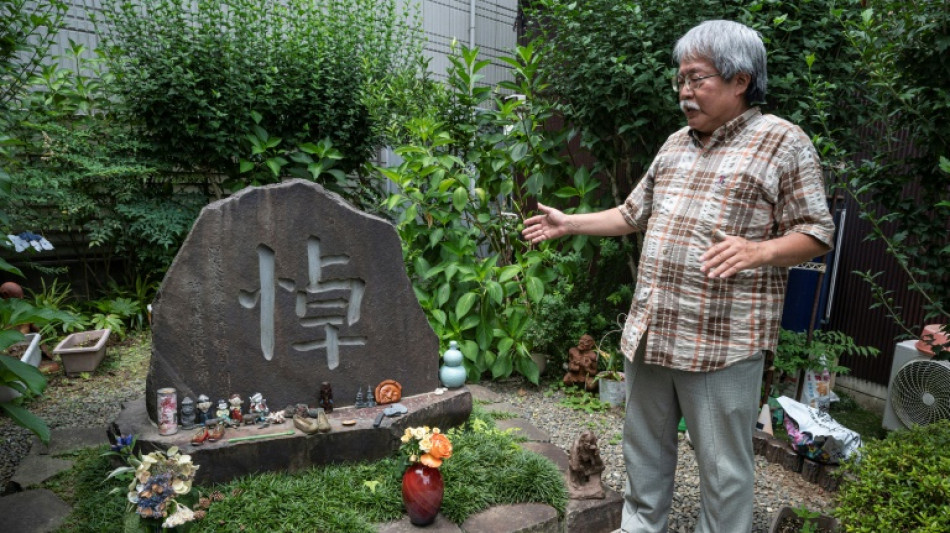
Masao Nishizaki heads Housenka, a small association based in eastern Tokyo devoted to keeping memories of the atrocity alive.
Walking along the grassy banks of the Arakawa River in his working-class neighbourhood, he stopped abruptly to say: "It's here."
Citing eyewitness accounts from the time, he told AFP that armed men stood near a bridge, screening terrified people desperate to escape the fires.
Those identified as Koreans were "killed on the spot" and their bodies "piled up like wood", said Nishizaki.
Later the Japanese army also "lined up Koreans on the river bank and executed them with machine guns," he added.
- Symbolic trials -
Japan has long been accused of trying to erase the memory of its crimes in Asia during its imperialistic period, often poisoning its regional relations.
Historians say that successive governments have failed to investigate the events of 1923 properly or admit to the authorities' active role.
A few months after the massacre, the government conducted an investigation but put the toll in the hundreds.
It also put some vigilante group members on trial but went no further.
More recently, the Japanese government has repeatedly said it has no archives to verify fully the circumstances around the tragedy.
In 2009 a government-organised conference issued a report on the earthquake which touched on the killings but avoided -- except for in one table -- the word "massacre", Morris-Suzuki said.
"This report, of course, is a different matter from an official admission of the massacre by the Japanese prime minister or cabinet, but it does indicate that the Japanese authorities are unable to ignore or deny that these events took place," she said.
- Different opinions -
Since the 1970s citizen groups have held an annual commemoration of the massacre every September 1, and for years the governor of Tokyo sent a message of condolence.
But in 2017, right-wing governor Yuriko Koike -- one of a group of politicians like former premier Shinzo Abe who struck a more nationalistic tone with regard to Japan's past -- stopped sending this message.
Koike argued that there were "different opinions" about what happened and that she had sent a eulogy to a separate earthquake victim memorial service held the same day in the same park.
In doing so, the governor is "erasing" the memory of the massacre and "instilling doubt" about its authenticity, said Hasegawa.
The massacre "should never have happened," said Kim. "I want the government to say sorry to the victims."
T.Shimizu--JT