The Japan Times - NASA and SpaceX re-attempt launch of four crew to ISS

EUR -
AED 4.31516
AFN 75.186175
ALL 95.293746
AMD 434.669939
ANG 2.102729
AOA 1078.452193
ARS 1630.2308
AUD 1.624055
AWG 2.116081
AZN 1.972096
BAM 1.949543
BBD 2.366794
BDT 144.45575
BGN 1.95966
BHD 0.443305
BIF 3494.983871
BMD 1.174784
BND 1.487719
BOB 8.119904
BRL 5.802732
BSD 1.175123
BTN 111.184676
BWP 15.724465
BYN 3.318535
BYR 23025.776091
BZD 2.363405
CAD 1.602048
CDF 2720.800684
CHF 0.915216
CLF 0.026764
CLP 1053.358606
CNY 8.00175
CNH 8.003695
COP 4381.253041
CRC 536.176843
CUC 1.174784
CUP 31.131789
CVE 110.371275
CZK 24.334502
DJF 208.783018
DKK 7.472646
DOP 69.958736
DZD 155.303645
EGP 61.942028
ERN 17.621767
ETB 184.561449
FJD 2.56679
FKP 0.865372
GBP 0.864271
GEL 3.159791
GGP 0.865372
GHS 13.216641
GIP 0.865372
GMD 86.346819
GNF 10314.60781
GTQ 8.970172
GYD 245.810019
HKD 9.204719
HNL 31.240732
HRK 7.535039
HTG 153.770943
HUF 357.845822
IDR 20346.562573
ILS 3.41111
IMP 0.865372
INR 111.018189
IQD 1538.967688
IRR 1542492.041252
ISK 143.805836
JEP 0.865372
JMD 185.157308
JOD 0.83289
JPY 183.801491
KES 151.759011
KGS 102.700249
KHR 4714.997648
KMF 492.234745
KPW 1057.310151
KRW 1699.372266
KWD 0.361786
KYD 0.979253
KZT 544.161183
LAK 25810.015627
LBP 105201.95124
LKR 376.191003
LRD 215.661076
LSL 19.425102
LTL 3.468833
LVL 0.710615
LYD 7.448409
MAD 10.806258
MDL 20.200081
MGA 4896.264456
MKD 61.652583
MMK 2466.517899
MNT 4205.316758
MOP 9.48422
MRU 46.876763
MUR 54.984854
MVR 18.156291
MWK 2046.474994
MXN 20.267324
MYR 4.610988
MZN 75.080436
NAD 19.425034
NGN 1600.056316
NIO 43.241033
NOK 10.928374
NPR 177.895283
NZD 1.972428
OMR 0.451734
PAB 1.175123
PEN 4.067693
PGK 5.109601
PHP 71.29591
PKR 327.500562
PLN 4.231549
PYG 7191.917329
QAR 4.280899
RON 5.267261
RSD 117.367963
RUB 87.820039
RWF 1715.185362
SAR 4.407583
SBD 9.436172
SCR 16.301074
SDG 705.462002
SEK 10.849505
SGD 1.490061
SHP 0.877095
SLE 28.958687
SLL 24634.638952
SOS 671.372647
SRD 43.949817
STD 24315.667154
STN 24.421514
SVC 10.281956
SYP 130.640379
SZL 19.149458
THB 37.85511
TJS 10.981508
TMT 4.11762
TND 3.414342
TOP 2.828599
TRY 53.113764
TTD 7.963407
TWD 36.875262
TZS 3045.25641
UAH 51.522813
UGX 4418.798927
USD 1.174784
UYU 47.218451
UZS 14189.398315
VES 579.75196
VND 30926.201816
VUV 138.918767
WST 3.198451
XAF 653.855648
XAG 0.01523
XAU 0.000251
XCD 3.174915
XCG 2.117894
XDR 0.818154
XOF 653.858422
XPF 119.331742
YER 280.332926
ZAR 19.270342
ZMK 10574.444756
ZMW 22.239527
ZWL 378.280128
  • CMSD

    0.1300

    23.42

    +0.56%

  • CMSC

    0.1300

    23.01

    +0.56%

  • GSK

    0.1500

    50.53

    +0.3%

  • BTI

    0.1600

    59.56

    +0.27%

  • NGG

    0.2100

    87.85

    +0.24%

  • RIO

    5.0100

    105.51

    +4.75%

  • AZN

    3.6800

    184.92

    +1.99%

  • BCE

    0.1300

    24.23

    +0.54%

  • RELX

    -0.4100

    35.75

    -1.15%

  • RYCEF

    1.0500

    17.5

    +6%

  • RBGPF

    0.0800

    63.18

    +0.13%

  • BP

    -1.8700

    44.63

    -4.19%

  • JRI

    0.1300

    13.17

    +0.99%

  • BCC

    2.1100

    74.24

    +2.84%

  • VOD

    0.3900

    16.13

    +2.42%

NASA and SpaceX re-attempt launch of four crew to ISS
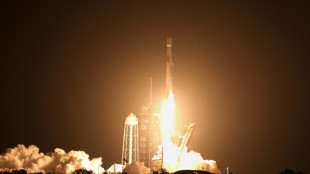
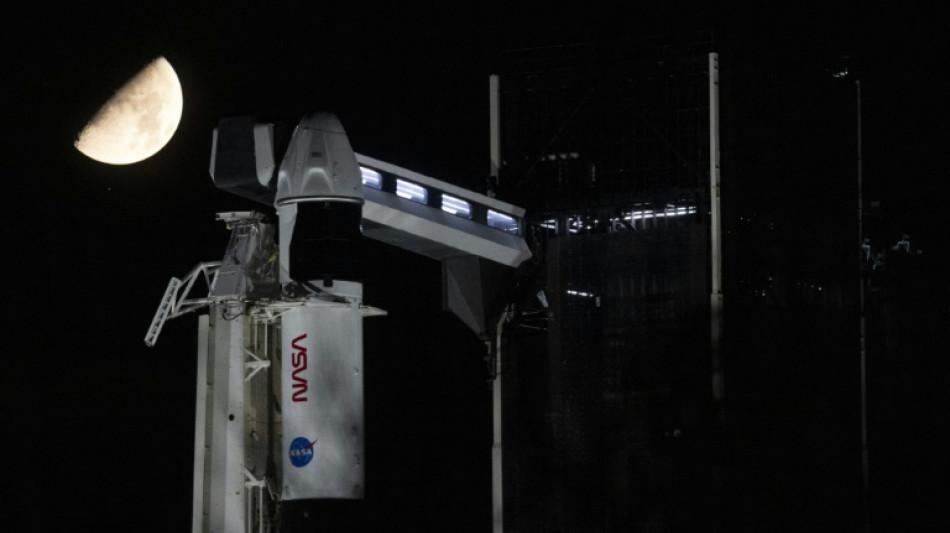
NASA and SpaceX re-attempt launch of four crew to ISS / Photo: Joel KOWSKY - NASA/AFP

NASA and SpaceX re-attempt launch of four crew to ISS

NASA and SpaceX will try again on Saturday to send the next crew of four astronauts to the International Space Station.

Text size:

Dubbed Crew-7, the mission will be commanded by American Jasmin Moghbeli and includes Andreas Mogensen of Denmark, Satoshi Furukawa of Japan and Konstantin Borisov of Russia.

Liftoff is planned for 3:27 am (0727 GMT) from Launch Complex 39A at NASA's Kennedy Space Center in Florida, with a backup opportunity on Sunday.

The launch was pushed back to Saturday to give engineers an extra day to review a component of the Crew Dragon capsule's environmental control and life support system, NASA said in a blog post.

It will be the first space mission for both Moghbeli and Borisov.

"This is something I've wanted to do for as long as I can remember," said Moghbeli, a Naval test pilot, during a media call last month.

"One of the things I'm most excited about is looking back at our beautiful planet," added the 40-year-old of Iranian heritage.

"Everyone who I've talked to who has flown already has said that was a life-changing perspective -- and also floating around in space, it seems really fun."

Crew-7 is set to be the seventh routine mission to the orbital platform for Elon Musk's SpaceX, with the first coming in 2020.

NASA pays SpaceX for the taxi service as part of a commercial crew program that it put in place to reduce dependency on Russian rockets for astronaut transport after the space shuttle program ended in 2011.

Boeing is the other contracted private partner, but its program remains mired in delays and technical difficulties. It has not yet flown any crew.

Borisov will be the third Russian to fly on a SpaceX Crew Dragon capsule, fixed atop a Falcon 9 rocket.

Space remains a rare area of cooperation between the United States and Russia despite Moscow's invasion of Ukraine, with Americans also continuing to fly aboard Russian Soyuz rockets that launch from Kazakhstan.

The crew will spend six months aboard the ISS, where they will carry out science experiments including collecting samples during a spacewalk to determine whether the station releases microorganisms through its life support system vents.

The goal is to understand if microorganisms can survive and reproduce in space.

Another experiment will aim to assess the physiological differences between sleep on Earth and in space.

"I'm looking forward to coping with all the tasks. This is a very interesting profession: you are preparing for something that you haven't tried yet, and you really want to do it well," said Borisov.

Crew-7 will join the seven people already aboard the ISS, before members of Crew-6 leave for Earth a few days later.

The first segment of the ISS was launched in 1998, and it has been continuously inhabited by an international crew since 2001.

Its operations are set to continue until at least 2030, after which it will be decommissioned and crash into the ocean. Several private companies are working on commercial space stations to replace it.

T.Sasaki--JT