The Japan Times - NASA lab hopes to find life's building blocks in asteroid sample

EUR -
AED 4.309185
AFN 77.664833
ALL 96.578153
AMD 447.171387
ANG 2.100795
AOA 1075.974916
ARS 1700.476811
AUD 1.767714
AWG 2.11499
AZN 1.993018
BAM 1.957417
BBD 2.36071
BDT 143.349055
BGN 1.95623
BHD 0.4424
BIF 3465.69311
BMD 1.173365
BND 1.515258
BOB 8.099727
BRL 6.513937
BSD 1.172048
BTN 105.019984
BWP 16.486341
BYN 3.444788
BYR 22997.944348
BZD 2.357308
CAD 1.616486
CDF 3002.053142
CHF 0.931885
CLF 0.027239
CLP 1068.571028
CNY 8.261601
CNH 8.251715
COP 4494.45541
CRC 585.383681
CUC 1.173365
CUP 31.094159
CVE 110.356654
CZK 24.322262
DJF 208.718899
DKK 7.469058
DOP 73.420665
DZD 152.282774
EGP 55.701142
ERN 17.600468
ETB 182.087276
FJD 2.683896
FKP 0.880157
GBP 0.874526
GEL 3.150516
GGP 0.880157
GHS 13.462181
GIP 0.880157
GMD 85.655547
GNF 10245.552838
GTQ 8.981459
GYD 245.223664
HKD 9.127767
HNL 30.878119
HRK 7.532879
HTG 153.677633
HUF 386.567869
IDR 19695.509941
ILS 3.76599
IMP 0.880157
INR 105.136335
IQD 1535.468701
IRR 49398.645621
ISK 147.210343
JEP 0.880157
JMD 187.544961
JOD 0.831933
JPY 184.814279
KES 151.376059
KGS 102.610622
KHR 4703.906708
KMF 492.81343
KPW 1056.02802
KRW 1736.943149
KWD 0.360833
KYD 0.976807
KZT 606.561179
LAK 25385.542435
LBP 104960.335779
LKR 362.89366
LRD 207.457879
LSL 19.662411
LTL 3.464641
LVL 0.709756
LYD 6.353141
MAD 10.743823
MDL 19.843057
MGA 5330.313385
MKD 61.60011
MMK 2464.431858
MNT 4166.879392
MOP 9.394362
MRU 46.907758
MUR 54.17501
MVR 18.128533
MWK 2032.444691
MXN 21.122085
MYR 4.783227
MZN 74.995458
NAD 19.662747
NGN 1711.915715
NIO 43.136009
NOK 11.894511
NPR 168.034124
NZD 2.029398
OMR 0.45116
PAB 1.172073
PEN 3.947178
PGK 4.986162
PHP 68.993251
PKR 328.389238
PLN 4.205643
PYG 7863.363174
QAR 4.273149
RON 5.086416
RSD 117.383056
RUB 93.018839
RWF 1706.580996
SAR 4.401058
SBD 9.559106
SCR 16.336993
SDG 705.789525
SEK 10.866224
SGD 1.514473
SHP 0.880327
SLE 28.219844
SLL 24604.87134
SOS 668.652483
SRD 45.105889
STD 24286.276292
STN 24.520365
SVC 10.255474
SYP 12975.512305
SZL 19.659909
THB 36.586091
TJS 10.800924
TMT 4.106776
TND 3.430849
TOP 2.825181
TRY 50.228508
TTD 7.955573
TWD 36.975015
TZS 2914.028456
UAH 49.558404
UGX 4192.481957
USD 1.173365
UYU 46.018219
UZS 14090.462297
VES 331.076119
VND 30899.967624
VUV 141.511723
WST 3.271124
XAF 656.488242
XAG 0.017038
XAU 0.000266
XCD 3.171076
XCG 2.112445
XDR 0.816461
XOF 656.488242
XPF 119.331742
YER 279.730202
ZAR 19.609678
ZMK 10561.685231
ZMW 26.518459
ZWL 377.822893
  • SCS

    0.0200

    16.14

    +0.12%

  • CMSD

    -0.0300

    23.25

    -0.13%

  • RIO

    0.6900

    78.32

    +0.88%

  • AZN

    0.7500

    91.36

    +0.82%

  • BP

    0.6300

    33.94

    +1.86%

  • RBGPF

    0.0000

    80.22

    0%

  • NGG

    -0.2800

    76.11

    -0.37%

  • CMSC

    -0.1200

    23.17

    -0.52%

  • BCE

    -0.0100

    22.84

    -0.04%

  • GSK

    0.3200

    48.61

    +0.66%

  • BTI

    -0.5900

    56.45

    -1.05%

  • RYCEF

    0.2800

    15.68

    +1.79%

  • JRI

    -0.0500

    13.38

    -0.37%

  • BCC

    -2.9300

    74.77

    -3.92%

  • VOD

    0.0400

    12.84

    +0.31%

  • RELX

    0.0800

    40.73

    +0.2%

NASA lab hopes to find life's building blocks in asteroid sample
NASA lab hopes to find life's building blocks in asteroid sample / Photo: Mark Felix - AFP

NASA lab hopes to find life's building blocks in asteroid sample

Eager scientists and a gleaming lab awaits.

Text size:

A sample from the asteroid Bennu, which could be key to understanding the formation of the solar system and our own planet, is set to be analyzed at NASA's Johnson Space Center in Houston after it reaches Earth in late September.

The precious cargo is currently aboard OSIRIS-REx, a US space probe launched in 2016 to Bennu, which orbits the Sun at an average distance of about 105 million miles (168 million kilometers).

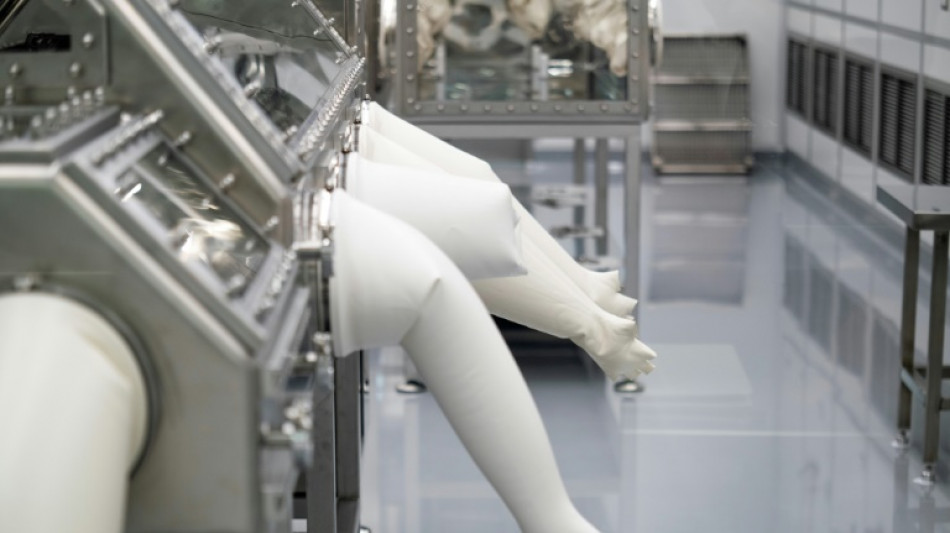
Long white sleeves hang from the huge metal and glass box in which the sample will be handled.

Scientists will separate pieces of the rock and dust for study now, while carefully storing away the rest for future generations equipped with better technology -- a practice first started during the Apollo missions to the Moon.

"We don't expect there to be anything living but (rather) the building blocks of life," Nicole Lunning, lead OSIRIS-Rex sample curator, told AFP.

"That's really what motivated going to this type of asteroid, to understand what the precursors were that may have fostered life in our solar system and on Earth."

Once the return vessel arrives at the Texas "cleanroom," Lunning's job will be to carefully disassemble it and separate the contents, all while keeping the material pure and uncontaminated.

- Origins of life -

The spacecraft is scheduled to land in the Utah desert on September 24, carrying an estimated 8.8 ounces, or 250 grams of material -- just over a cupful.

Obtaining it involved a high-risk operation in October 2020: the probe came into contact with the asteroid for a few seconds, and a blast of compressed nitrogen was emitted to raise the dust sample which was then captured.

The whole mission was imperiled when NASA realized a few days later that the valve of the collection compartment was failing to close, letting fragments escape into space.

But the precious cargo was finally secured after being transferred to a capsule fixed in the spacecraft's center.

The first samples brought to Earth by asteroids were carried out by Japanese probes in 2010 and 2020, with the latter found to contain uracil, one of the building blocks of RNA.

The finding lent weight to a longstanding theory that life on Earth may have been seeded from outer space when asteroids crashed into our planet carrying fundamental elements.

Cosmochemist Eve Berger can't wait to get to work on the Bennu material.

"These samples haven't hit the Earth. They haven't been exposed to our atmosphere. They haven't been exposed to really anything except harsh space for billions of years," she said.

Ultimately they "will help us to determine whether what we really think is true, is true," said Berger.

Not only might the Bennu sample add to our knowledge of the ingredients that brought life to our world, but "if we can figure out what happened here on the Earth, that helps us to extrapolate to other bodies where we might look or how we might interpret what we're seeing," she added.

Could Bennu bring back something that's never been seen before? "You never know," said Berger.

"Bennu is a trickster, so we'll know more in a few months when the sample comes back -- that would be exciting!"

H.Hayashi--JT